


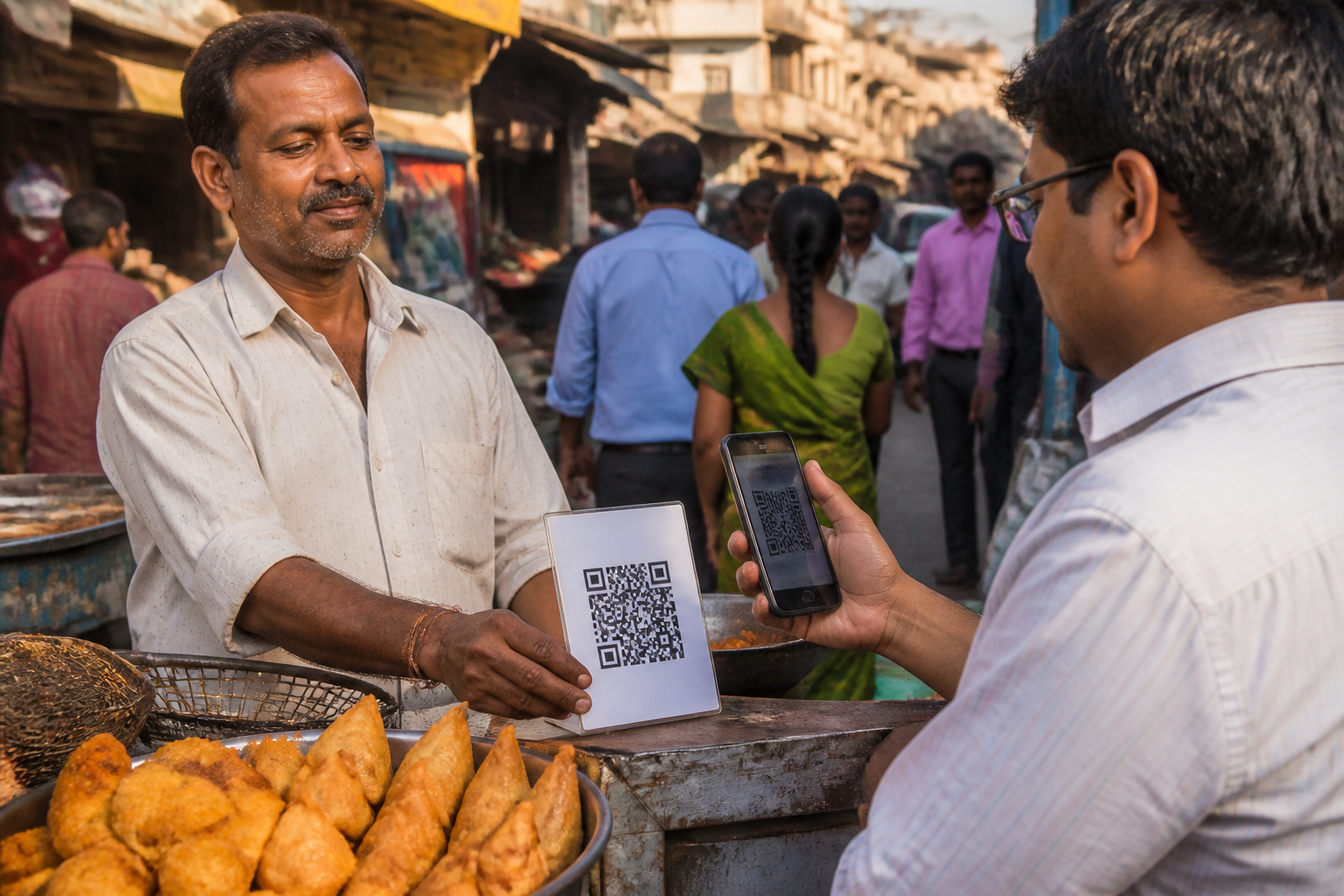
A reported change in UPI merchant charges from 15 October could alter how small shops, street vendors and informal businesses are classified when they receive digital payments, while also bringing more of their trade into formal banking and tax-monitoring systems. Aaj Tak Business says the reported framework would keep most low-value payments free but apply a 0.4% merchant discount rate, or MDR, to certain larger transactions received by businesses crossing a monthly UPI collection threshold of ₹1 lakh.
The report says customers would continue to use UPI without paying a transaction fee. The potential charge would instead affect eligible merchants. Under the account described by Aaj Tak Business, small vendors receiving up to ₹1 lakh a month through a UPI QR code would remain in the P2PM, or Person-to-Person-Merchant, category. MDR would reportedly remain zero for all their transactions, including payments above ₹2,000.
The report also says that payments of ₹2,000 or less would attract zero MDR even when a merchant’s total monthly UPI collection exceeds ₹1 lakh. The reported 0.4% charge would apply only when both conditions are met: the merchant’s monthly UPI collection is above ₹1 lakh and an individual customer payment exceeds ₹2,000. The report gives the example of a ₹3,000 payment, on which a 0.4% charge would amount to ₹12. It says the charge would be capped at ₹300 per transaction.
These provisions, if confirmed in the underlying notification, would make the effect uneven across the informal urban economy. A tea stall, vegetable seller or street-food counter typically handles a large number of small payments. A business selling higher-value goods, accepting catering orders or receiving occasional large digital payments would face a different exposure if its monthly UPI collection moved above the reported threshold.
The distinction is important because UPI has become part of the everyday operating infrastructure of Indian cities. Small retailers and street vendors use QR codes not only to collect payments but also to reduce dependence on cash, record sales and serve customers who do not carry currency. For many informal businesses, the QR code is a low-cost connection to the formal financial system even when the business has no conventional billing software, point-of-sale machine or registered accounting process.
Aaj Tak Business reports that merchants whose monthly UPI collections cross ₹1 lakh could be shifted by banks or UPI applications from the P2PM category to the P2M, or business-merchant, category. The report presents this as an automatic account-level update. It also says the reported system is intended to bring larger informal businesses closer to formal banking, credit and tax networks rather than to stop their operations.
That claim has wider implications for how urban livelihoods are recorded. Cash-based commerce can remain largely invisible to formal data systems. Digital payments create an electronic trail that can help financial institutions assess transaction activity, but the same record can also trigger new scrutiny of businesses that have historically operated outside formal registration, accounting and tax structures. The supplied report says that vendors with annual UPI-linked business above ₹20 lakh or ₹40 lakh could enter financial monitoring databases and that bank data could be available to income-tax systems. It does not identify the statutory basis, applicable turnover definitions or the precise thresholds governing that process.
The difference between UPI collections and business income will be central to how such a system affects vendors. Gross digital receipts do not necessarily represent profit. A small trader may receive money for goods purchased from a wholesaler, collect payments on behalf of a family-run business or record transactions that include operating costs. The supplied report does not explain how the reported ₹1 lakh monthly threshold would be calculated, whether it would apply to one QR code or an account-linked merchant profile, or how refunds, transfers and non-sales receipts would be treated.
The report’s central assurance is that most small merchants would not face a direct financial burden because their individual bills are below ₹2,000. It attributes the view that more than 96% of small merchants’ daily transactions would not be directly affected by the charge. The source material does not provide the methodology, sample, date or issuing authority behind that figure, so the statistic requires confirmation before it can be treated as an established measure of impact.
The reported framework also raises an institutional question about responsibility. Banks and UPI applications would appear to play a role in identifying merchants, monitoring monthly collections and updating account classifications. NPCI or another competent authority would need to define the applicable categories, while tax and financial agencies would determine how digital transaction information could be used. The supplied report does not establish which institution issued the notification, how merchants would be informed, or whether they would have a process to challenge an incorrect classification.
For street vendors, the practical effect would depend on the mix of payments they receive rather than simply on whether they use UPI. A food seller with many ₹50 or ₹100 payments could cross a monthly collection threshold without making large individual sales. A small retailer may receive one large payment but remain below the monthly threshold. Under the rules described by Aaj Tak Business, the reported charge would apply only when both the monthly and individual-transaction conditions are met. Whether that interpretation is correct must be checked against the primary notification.
The timing also needs verification. Aaj Tak Business reports that the changes would apply from 15 October, but the supplied material does not include the notification number, issuing authority, publication date or operational circular. It also does not specify whether the threshold is based on a calendar month, a rolling 30-day period or another accounting cycle.
The confirmed facts therefore remain narrower than the wider debate around digital payments and informal commerce. The supplied report describes a proposed or reported classification and MDR structure, including a ₹1 lakh monthly threshold, a ₹2,000 individual-payment threshold and a 0.4% charge capped at ₹300. It does not provide the primary document needed to establish the rule’s legal status, detailed scope and implementation process. Confirmation of the NPCI or government notification, the effective date, the category definitions and the treatment of merchant data is required before the implications for small urban businesses can be reported conclusively.
