


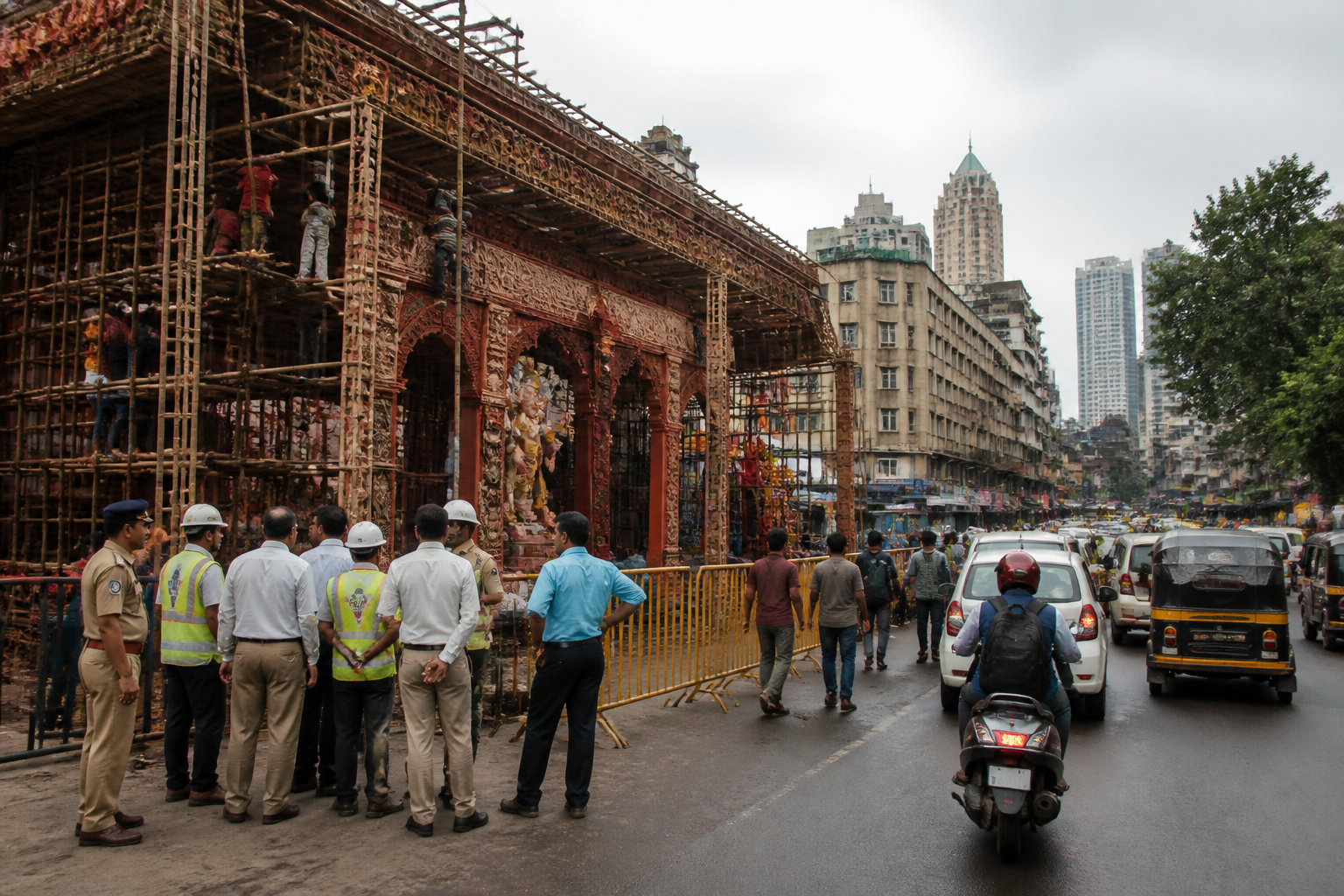
Mumbai’s Ganpati mandal permission process is facing a last-minute rush, with the Brihanmumbai Municipal Corporation clearing 2,702 applications while 17 others remain pending just as idol immersions are due to begin. The permissions allow mandals to erect pandals across the city, many of them on roads, making the process directly relevant to traffic management, public space and festival safety.
According to civic records cited in the report, 4,164 mandals applied for permission this year. The 2,702 approvals issued so far are almost on par with last year’s figure, while the number is expected to rise marginally as more applications are processed. The pending applications are with ward-level municipal commissioners.
The permission process involves more than the municipal approval. Organisers said police no-objection certificates are routed through the BMC, and delays in police verification can hold up final clearances. Nikhil Morye of Bal Mitra Mandal, which hosts the Mithanagar Cha Raja, said the civic body had begun issuing five-year permissions, but mandals still had to apply because changes to an installation, including an increase in its size, could require fresh police clearance.
Morye said the BMC had taken steps to streamline the process but that there was still scope for improvement. He said delays in police verification sometimes left organisers uncertain shortly before the festival. Naresh Dahibhavkar, president of the Brihanmumbai Sarvajanik Ganeshotsav Samanvay Samiti, said police personnel were often stretched by VVIP movements in the run-up to the festival. He called for mandal permissions to be processed well in advance to prevent a last-minute rush.
The approvals are being processed alongside preparations for the immersion period. With immersions scheduled to begin on Tuesday, additional municipal commissioner Avinash Dhakne inspected key sites including Girgaum Chowpatty and Dadar Chowpatty in the island city, Juhu beach in the western suburbs and Powai Lake in the eastern suburbs. He directed officials to inform mandals that the BMC provides cranes free of charge at immersion sites for Ganesh idols.
The civic body has also prepared more than 383 artificial immersion ponds for household idols measuring up to six feet. These facilities are intended to provide alternatives to natural water bodies and manage the large number of household immersions across the city. However, organisers have raised concerns about conditions at some sites. Dahibhavkar said water levels at Shyam Talao in Jogeshwari had fallen, which could make it difficult to immerse taller idols there and force organisers to use other nearby locations.
The combination of pending pandal permissions, police clearances and differing conditions at immersion sites places several agencies in the same operational chain. For organisers, municipal permission does not always conclude the approval process; for the civic administration, the festival requires coordination between ward offices, police authorities, immersion-site teams and traffic-related arrangements. The BMC’s next steps are to process the remaining applications, complete site preparations and manage immersions from Tuesday.
