


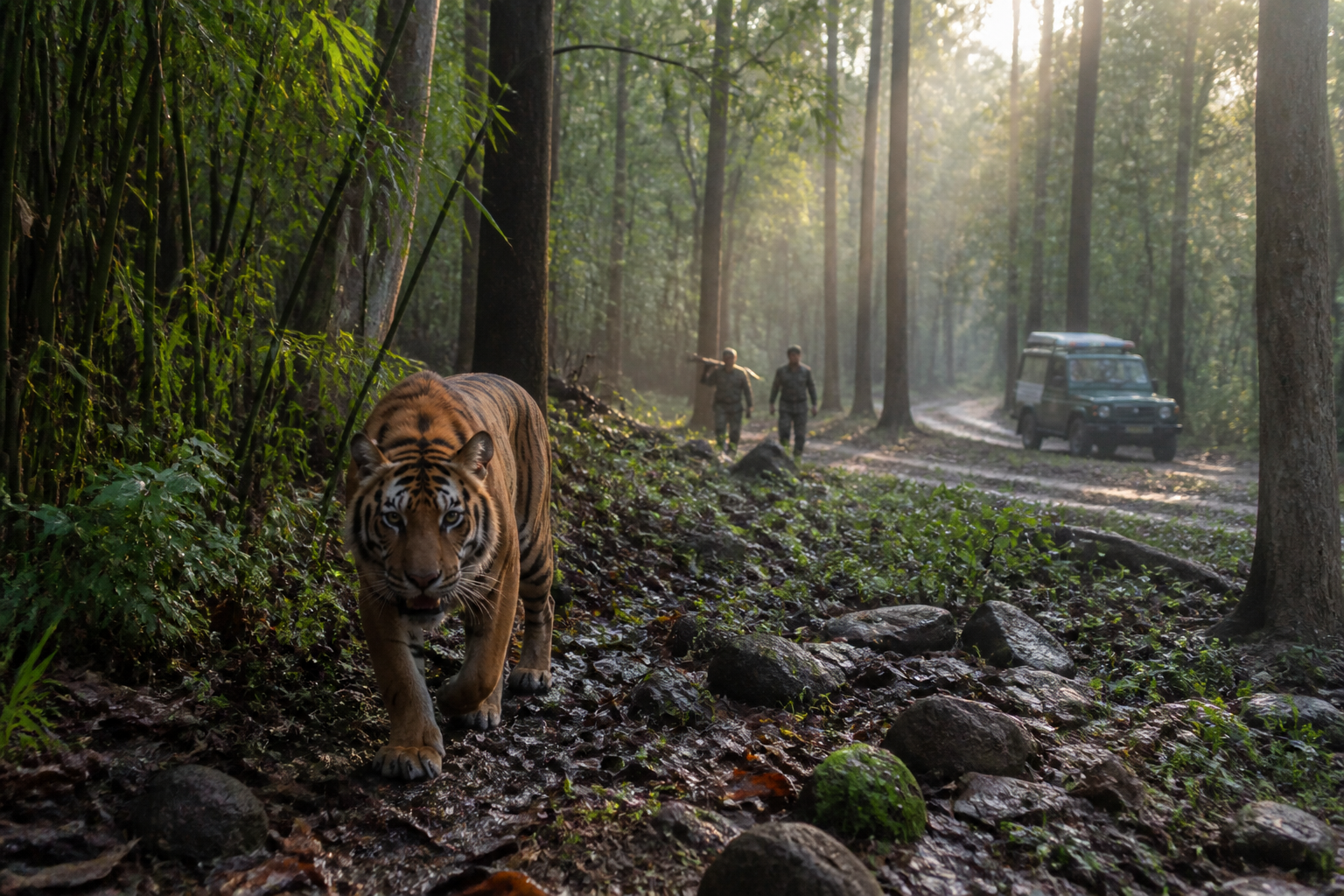
The Bengal government plans to relocate a tigress from Bihar’s Valmiki National Park and Tiger Reserve to Buxa Tiger Reserve in north Bengal, in an effort to revive a tiger population that has declined over several decades.
Three teams have been formed for the operation. Two teams from Bengal are scheduled to leave for Valmiki in West Champaran district on September 14, while a third team from the Wildlife Institute of India will travel from Dehradun to assist with the capture and relocation. The tigress will be selected from three identified animals currently living in the wild.
Forest officials said the animal would be chosen using multiple scientific parameters. Once selected, it will be tranquilised and transported to Buxa in one of two animal ambulances being taken from the reserve to Bihar. The tigress will initially be kept in a 2.2-hectare enclosure before being released into the forest in early October.
Teams from Buxa Tiger Reserve and Sundarbans Tiger Reserve will participate in darting and tranquilising the animal. After its release, the tigress will be fitted with a radio collar and monitored by all three teams. A forest official said the teams would maintain a triangular monitoring arrangement around the animal and prevent it from moving towards the forests of Bhutan.
Officials said a tigress had been preferred over a male tiger because males are more likely to move beyond their territory while searching for a mate. The selected animal will come from Valmiki National Park and Tiger Reserve, which lies along the border with Nepal’s Chitwan National Park.
Buxa once had a resident tiger population of around 25 to 26 animals in the early 1990s, according to forest officials. That population declined by the early 2000s amid high population density in villages inside the forest and the resulting biotic pressure. In recent years, camera traps have recorded male tigers entering Buxa from adjoining forests in Bhutan and Assam while searching for mates.
A male tiger was spotted in Buxa in January. Officials believed it had come from Bhutan, but the animal remained difficult to track and was last recorded moving towards the Bhutan border. The planned relocation is therefore being undertaken alongside efforts to reduce settlement pressure inside the reserve.
The relocation of villagers from Buxa has begun, with nearly 80 per cent of families in Jayanti reported to have signed memoranda of understanding with the forest department to move outside the core area. Residents of Bhutia Basti and Gangutia Basti have already been relocated, according to a senior forest official.
The forest department expects the remaining village relocations to support the planned release. Chief minister Suvendu Adhikari and Union environment, forests and climate change minister Bhupender Yadav are scheduled to attend the release programme. The tigress is expected to be released into the wild in Buxa in early October, subject to the completion of the relocation and monitoring arrangements.
