


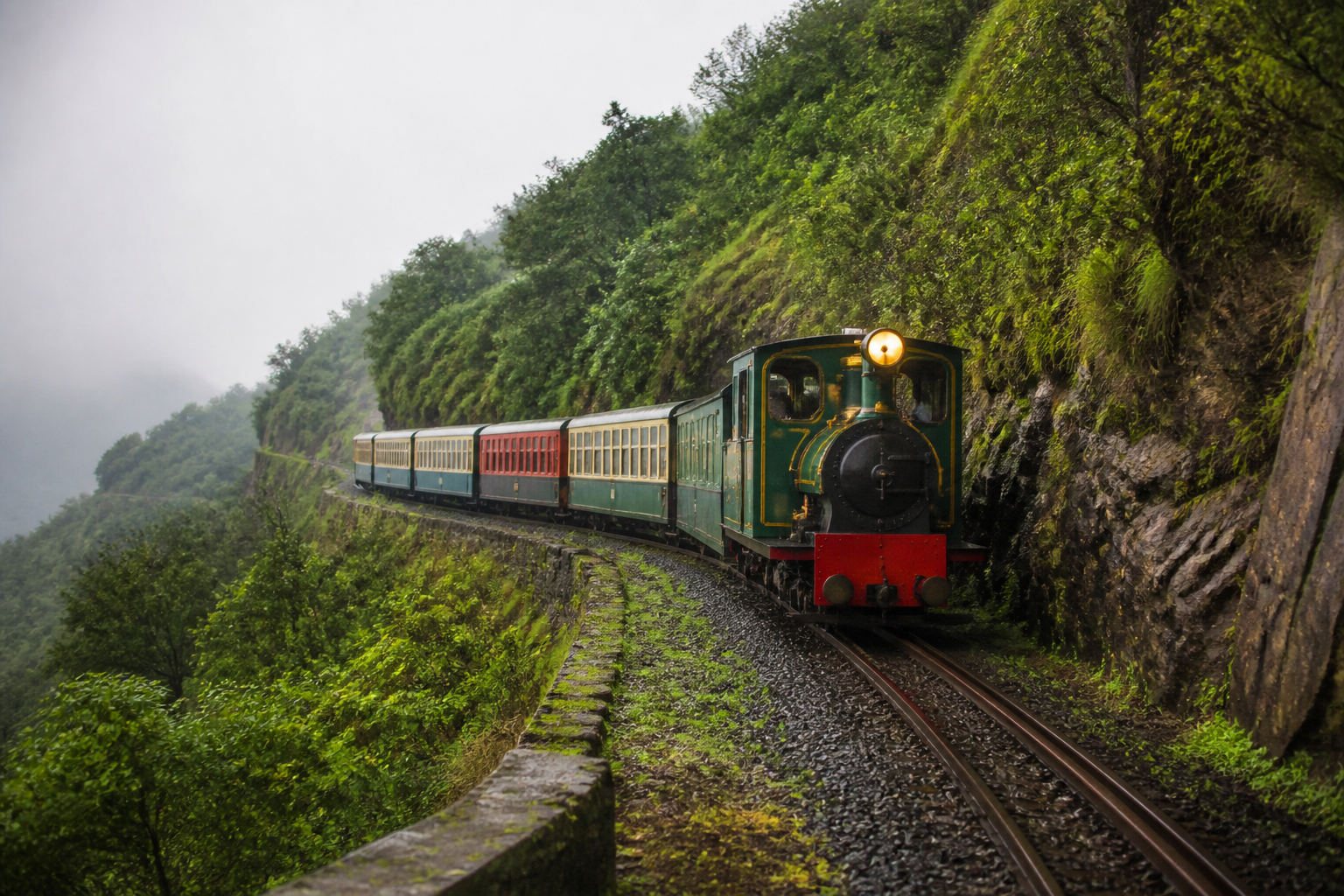
The Neral-Matheran railway, built more than a century ago through the Sahyadri hills, remains both a working transport link and a reminder that access to a hill station has always depended on infrastructure designed around difficult terrain. Its latest operational limitation reflects that continuing tension: regular passenger services between Neral and Aman Lodge are scheduled to remain suspended from June 15 to October 15, 2026, because of monsoon and heavy-rain safety concerns, while trains will continue between Aman Lodge and Matheran.
The railway’s significance lies not only in its age. It was conceived as a way to make Matheran easier to reach for Indian travellers, at a time when reaching the hill station could involve horseback travel or palanquins. The project also shows how transport infrastructure can shape a destination’s social and economic life. Its promoter, Mumbai businessman Sir Adamjee Peerbhoy, did not treat the railway as an isolated engineering work. He later built inns and hotels, established a community cemetery and helped set up the local civic council.
Peerbhoy first visited Matheran on horseback and proposed a railway to the Secretary of State in India in 1901. The British government initially warned that the project might not succeed, but permission was eventually granted for a two-foot narrow-gauge line between Neral, at the foot of the hills, and Matheran. Construction began in 1904 under conditions that would make surveying, excavation and logistics difficult even today.
The route was built without aerial surveys or modern construction machinery. According to the Peerbhoy family, workers cut through the hills by hand to create the gradient required for the railway. Communications and transport facilities in the hilly area were limited, while the line had to negotiate steep sections and numerous curves. Despite those constraints, the approximately 21-kilometre railway was completed in three years and opened for traffic in 1907.
That timeline is central to understanding the line. The project was not simply a short connection between two stations. It was a carefully graded ascent through a landscape where the terrain itself determined the railway’s alignment. The narrow gauge reduced the scale of the infrastructure, but it did not remove the engineering challenge. The route still required workers to shape the hills, maintain a controlled gradient and construct a railway capable of carrying passengers up to Matheran.
Peerbhoy travelled to Germany to acquire locomotives for the line. Four narrow-gauge steam engines were purchased from Orenstein & Koppel and numbered 738, 739, 740 and 741. Engine 738 hauled the first train to Matheran. The four locomotives remained in service from 1907 until 1982. Two are now preserved at Neral and Matheran, one is at the National Railway Museum in Delhi and the fourth is in the United Kingdom.
The railway’s original purpose also complicates the idea that it was built only for tourism. Matheran had limited accommodation when the line first began operating, which restricted tourist traffic. Peerbhoy responded by building 105 inns and hotels in the hill station. In this sense, the railway and the settlement developed together: transport improved access, while accommodation made that access commercially useful.
This relationship between infrastructure and urban or settlement growth remains visible in the line’s role today. Matheran is a hill station where motor vehicles are not permitted beyond a designated entry point. The railway therefore operates within a transport system that is different from that of an ordinary town. It connects the lower settlement of Neral and the upper hill station, while the Aman Lodge-Matheran section continues to serve passengers during the period when the lower section is shut.
The current suspension illustrates how infrastructure in a sensitive hill environment cannot be assessed only through its nominal length or historical value. The Neral-Aman Lodge section is scheduled to remain closed during the monsoon period because of safety concerns linked to heavy rain. The source report does not provide details of specific damage, repair work or a revised engineering plan. What it establishes is a seasonal operating arrangement: trains will continue between Aman Lodge and Matheran according to the prescribed timetable, using a six-coach rake comprising three second-class coaches, one first-class coach and two SLR/LR coaches.
This arrangement divides the railway into two operational realities. The upper section remains active, preserving a rail connection to Matheran, while passengers on the lower section face a longer or altered access journey during the monsoon. The distinction matters because the line’s value is not limited to heritage tourism. Its route connects a hill station with the transport network below, and any interruption changes how visitors, workers and local businesses reach the settlement.
The railway has faced disruptions before, including a major suspension after derailments and damage during heavy rains. Sections have continued to operate as a heritage railway, but the history of interruptions shows that preservation and operation are inseparable. A railway can be an important historic asset and still require routine safety decisions based on weather, terrain and track conditions.
That is the institutional challenge presented by the Neral-Matheran line. Its identity is divided between a historic mountain railway, a passenger service and an access system for a settlement with restrictions on motor vehicles. Each role creates a different expectation. Heritage value encourages continuity and preservation; passenger transport requires safety and reliability; the hill station’s environmental and mobility conditions limit how access can be provided.
The available evidence does not establish the precise condition of the track, the cost of the seasonal suspension or the number of passengers affected. It also does not specify whether the current arrangement will lead to permanent infrastructure upgrades or whether services will resume across the suspended section after October 15, 2026. Those questions require official railway records or statements beyond the supplied report.
What the documented history does establish is that the line was built as an access project with consequences far beyond the railway itself. A Mumbai businessman’s investment of about Rs 16 lakh created a 21-kilometre connection through difficult terrain. The line helped make Matheran more accessible to Indian travellers, supported the growth of accommodation and became part of the hill station’s civic and economic structure.
More than a century later, the same route continues to demonstrate the limits and possibilities of infrastructure in the Sahyadri landscape. The immediate milestone is the planned resumption of regular services on the Neral-Aman Lodge section after October 15, 2026. Until then, the Aman Lodge-Matheran section is scheduled to remain operational under its prescribed timetable, keeping part of the historic rail link active during the monsoon.
