


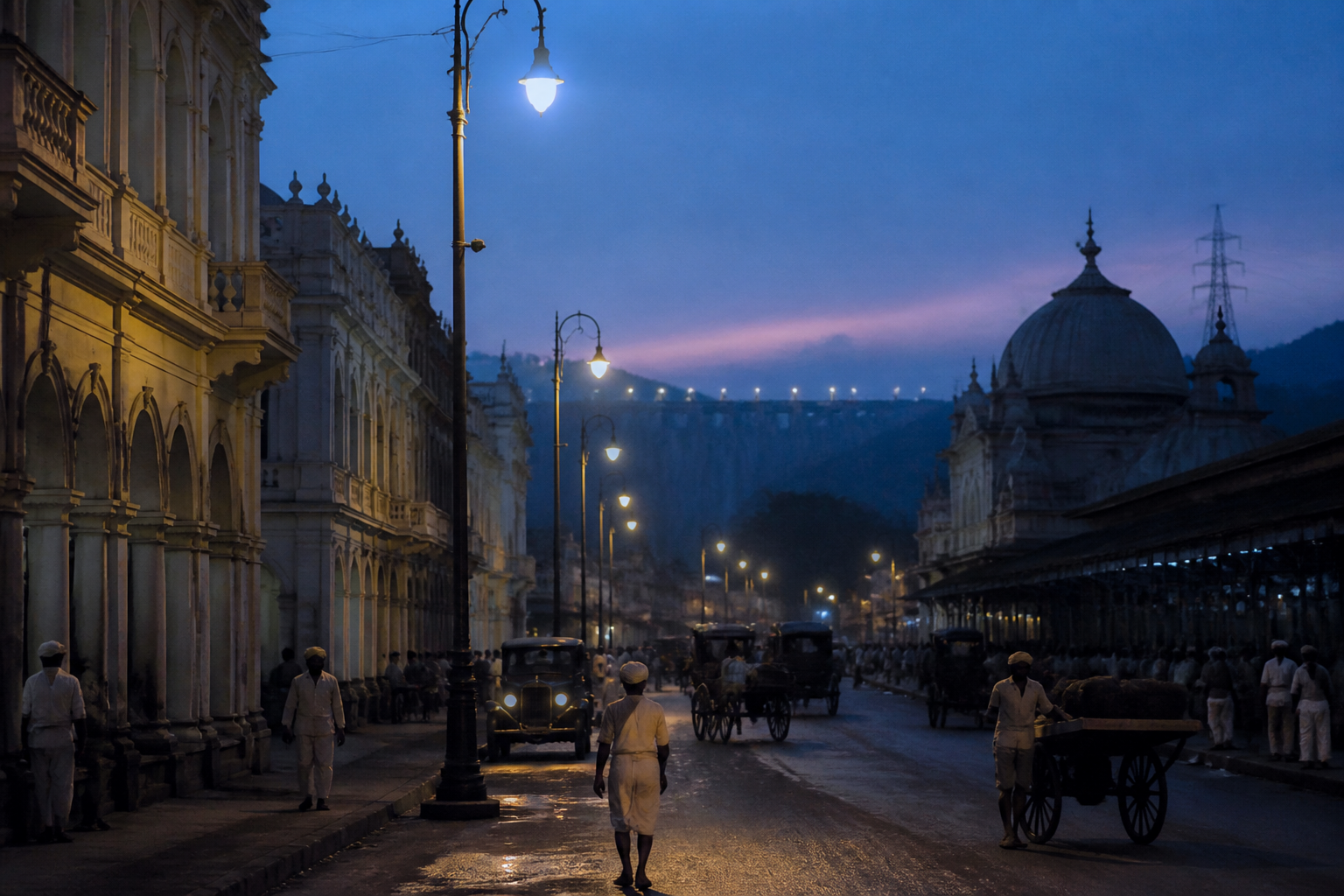
Bengaluru’s first electric streetlights were not the product of a city-first power plan. They became possible because Mysore’s administration had developed a hydroelectric project at Shivanasamudra to serve the machinery and operations of the Kolar Gold Fields. The story of the city’s first electric lights is therefore also a story about how industrial demand can create infrastructure that later transforms public life.
The Shivanasamudra hydroelectric project began supplying electricity to KGF in 1902, according to the supplied account. Three years later, on August 5, 1905, Bengaluru’s streets began receiving electric light. Areas around KR Market were among the first parts of the city to be illuminated, replacing kerosene lamps that had previously been lit and maintained manually. The transition was not simply a change in the type of street lamp. It marked the arrival of a centrally supplied electricity network in the city.
That sequence matters because it places Bengaluru’s electrification within a wider regional system rather than treating it as an isolated municipal improvement. The power was generated at Shivanasamudra from the flow of the Cauvery river. It was then transmitted over a considerable distance to the Kolar Gold Fields, where electricity was required for machinery and other mining equipment. Once that network existed, the same project could support another urban use: public lighting in Bengaluru.
The arrangement connected three different elements of the built environment. There was a generating station located away from the main centres of consumption, an industrial district whose operations required dependable power, and a growing city that could use electricity for streets and eventually homes. The system was therefore organised around more than one demand. Mining provided the original industrial purpose, while Bengaluru became an additional public and domestic consumer.
This was an early example of a basic principle that continues to shape infrastructure: the location of generation does not have to match the location of consumption. Electricity can be produced where the natural resource, technology or land makes generation possible and then moved to the places where it is needed. In the account of Shivanasamudra and KGF, long-distance transmission was not a secondary detail. It was central to making the project useful to an industrial centre located away from the hydroelectric station.
The Kolar Gold Fields provided the initial economic rationale. The mines were among India’s major gold-mining centres at the time, and the increasing use of machinery in extracting and processing gold created a demand for electricity. The hydroelectric project was developed primarily to answer that demand. Its later connection to Bengaluru shows how infrastructure built for a specialised economic activity can acquire a broader civic role.
Bengaluru’s public lighting needs were different from those of KGF. The mines needed electricity to operate equipment. The city needed it first to illuminate streets and subsequently to serve domestic consumers and other users. These uses required the same underlying network but produced different kinds of urban change. At KGF, electricity supported industrial production. In Bengaluru, it altered the nighttime public realm and began the expansion of household access.
Historical accounts cited in the supplied material state that Bengaluru had more than 1,600 domestic electricity connections within a year of the introduction of electric lighting. The figure indicates that electrification moved beyond a symbolic street-level demonstration relatively quickly. It also suggests that the first public installations helped establish a platform on which private and domestic connections could grow.
The distinction between public lighting and household electricity is important. Streetlights are visible evidence of a municipal network, but they do not represent the full reach of electrification. The expansion to homes indicates that the electricity system was becoming part of everyday urban life. It shifted from being an infrastructure associated with a major industrial project to one that could serve households and other city users.
The 1905 switch-on also reveals how urban modernisation often proceeds through inherited systems. Bengaluru did not need to develop an entirely separate electricity project before benefiting from electrification. The city could draw on infrastructure whose primary purpose lay elsewhere. The decision by the Mysore administration to use Shivanasamudra’s electricity for public lighting allowed an existing regional asset to support a civic function.
This pattern is recognisable in infrastructure development more broadly. Large systems are often justified by a dominant use, such as industry, transport or water supply. Their wider urban significance emerges when capacity, connections and administrative decisions allow additional users to join. In this case, mining and city lighting were not competing narratives. They were successive stages in the use of the same power system.
The institutional setting also shaped the outcome. Bengaluru, then known as Bangalore, was administered under the princely state of Mysore. The Mysore administration later decided to direct electricity from Shivanasamudra towards public lighting in the city. That decision connected the technical capacity of the hydroelectric project with a public-service objective. Electrification was therefore not only an engineering achievement; it also depended on an administrative choice about where the available power should be used.
The supplied account does not establish the full institutional structure of the project, the precise transmission route, the cost of the electricity system or the later operating history of the station. It also does not provide a detailed record of how many streets were illuminated on the first day or how the domestic connections were distributed. Those gaps matter because the symbolic date of August 5, 1905 should not be mistaken for a complete account of Bengaluru’s electrification.
What the available evidence does establish is the relationship between the project and the city’s early power supply. Shivanasamudra began serving KGF in 1902. Bengaluru received electric street lighting in 1905. The city’s network then expanded to domestic consumers and other users, with more than 1,600 household connections reported within a year. Together, these details describe a progression from industrial generation to public lighting and then to wider urban access.
The geography of the system is as significant as its chronology. The source of power was the Cauvery river at Shivanasamudra, the principal industrial consumer was KGF, and the emerging civic consumer was Bengaluru. These locations represented different relationships with infrastructure: natural-resource-based generation, industrial production and urban public life. Their connection anticipated the regional networks on which modern cities depend, even though the scale and technology were very different.
The history also complicates the familiar image of Bengaluru as a city whose infrastructure story began with its later technology and startup economy. The city’s modern identity was built on much older systems. Before it became known as a technology hub, Bengaluru was already being integrated into a regional electricity network whose origins lay in the need to power gold mining. Its first electric streetlights were part of that earlier industrial and administrative geography.
That does not mean the 1905 event directly caused Bengaluru’s later economic transformation. The supplied material does not support such a claim. It does show, however, that the city’s urban development included an early encounter with networked infrastructure: electricity generated outside the city, transmitted across distance and adapted for public and domestic use within it.
The larger urban question is how infrastructure built for one purpose becomes foundational to many others. Shivanasamudra’s original role was tied to KGF, but its electricity also enabled Bengaluru to replace kerosene street lamps with a central power network. The shift demonstrates that infrastructure decisions can have effects beyond their initial mandate, particularly when they create connections that later users can access.
The evidence leaves several aspects open for further research, including the technical design of the transmission system, the administration of early electricity distribution and the social geography of the first household connections. What is clear from the supplied account is the sequence: industrial demand at KGF helped drive hydroelectric generation at Shivanasamudra; that power was transmitted over distance; and the resulting network helped Bengaluru begin its transition to electric public lighting on August 5, 1905. The next layer of the history lies in tracing how that early network expanded and who gained access to it.
