


Building Collapse Survivors Need Care Long After Rescue Ends
Subheadline: Physical treatment may end after discharge, but trauma, sleep disruption and fear can continue for months or years, experts say.
Standfirst: A building collapse is usually measured in lives lost, people rescued and structures damaged. For survivors, however, the emergency may continue long after rescue teams leave and hospital treatment ends. The experience of being trapped beneath debris can produce acute stress, anxiety, disturbed sleep, flashbacks and, in some cases, post-traumatic stress disorder. The account of Dr Aastha, who spent nearly five hours under rubble after a collapse in Delhi’s Said-ul-Ajaib area, illustrates the gap between physical rescue and psychological recovery. Her experience also raises a wider urban question: whether disaster response systems treat survivors only as patients to be extracted, or continue supporting them after the immediate danger has passed.
The collapse in Said-ul-Ajaib on May 30 killed six people and left Aastha trapped beneath the debris for nearly five hours. She had been studying at a mess next to the building when she was told to leave. Before she could react, the structure came down. She was eventually rescued and treated at the AIIMS Trauma Centre, where she spent five days, including two in intensive care.
Her injuries were concentrated on the right side of her body, affecting her hand and leg and causing muscle damage. After returning to her hometown of Guna, she remained bedridden for a period and experienced swelling in her legs that worsened while sitting. These were visible consequences of the collapse. The less visible effects continued alongside them.
Aastha told the Times of India that she avoided videos of building collapses when they appeared on social media because they made her feel as if she were still trapped beneath the rubble. She also said she did not receive psychological counselling after the incident. Her account points to a break in the chain of care: rescue, emergency treatment and discharge may be organised, while the mental-health consequences of surviving a disaster remain largely unaddressed.
Dr Rajesh Sagar, a psychiatry professor at AIIMS, describes a building collapse as a form of “life-threatening stress”. His explanation places the survivor’s response within a recognised sequence of disaster-related mental distress rather than treating it as an unexplained change in personality or behaviour.
In the immediate aftermath, some survivors may experience acute stress symptoms. For others, symptoms can persist and develop into post-traumatic stress disorder. Sagar identifies repeated recollection of the event, flashbacks, distressing dreams, depression, emotional numbness and a sense of detachment among the possible consequences. Milder but persistent effects may include irritability, mood swings and anxiety.
Sleep is one of the clearest warning signs. Survivors may struggle to fall asleep, wake repeatedly during the night, rise unusually early or be jolted awake by dreams of the collapse. Disturbed sleep matters because it can keep the event present in daily life, reinforcing the sense that the danger has not ended even after the person has returned home.
The distinction between physical recovery and psychological recovery is important in collapse incidents. A patient may be discharged once immediate injuries are stable, but that does not establish that the person has recovered from the experience. In Aastha’s case, the physical injury, restricted movement and continued fear existed together. The absence of counselling meant that one part of the recovery process was not addressed, according to her account.
Sagar says the first step is recognising that these symptoms can be consequences of what the survivor has experienced. Family and friends can help by maintaining support, reconnecting the person with routines and hobbies, and keeping the survivor engaged in everyday life. Breathing exercises, mindfulness and cognitive behavioural therapy may also be useful. Medication may be considered when clinically necessary.
The need for follow-up extends beyond newly developed trauma symptoms. Disasters can worsen pre-existing mental or physical illnesses, Sagar says. Disruption after a collapse may cause some survivors to stop taking regular medication or abandon ongoing treatment. Screening and follow-up therefore have to account for conditions that existed before the incident as well as those caused by it.
That requirement is particularly relevant in urban disasters, where a collapse can affect several groups at once: people who were inside the structure, residents and workers nearby, first responders, relatives waiting for news and communities that continue to live near damaged or unsafe buildings. The supplied account focuses on survivors, but it shows how the effects of a structural failure can extend beyond the site and beyond the date of rescue.
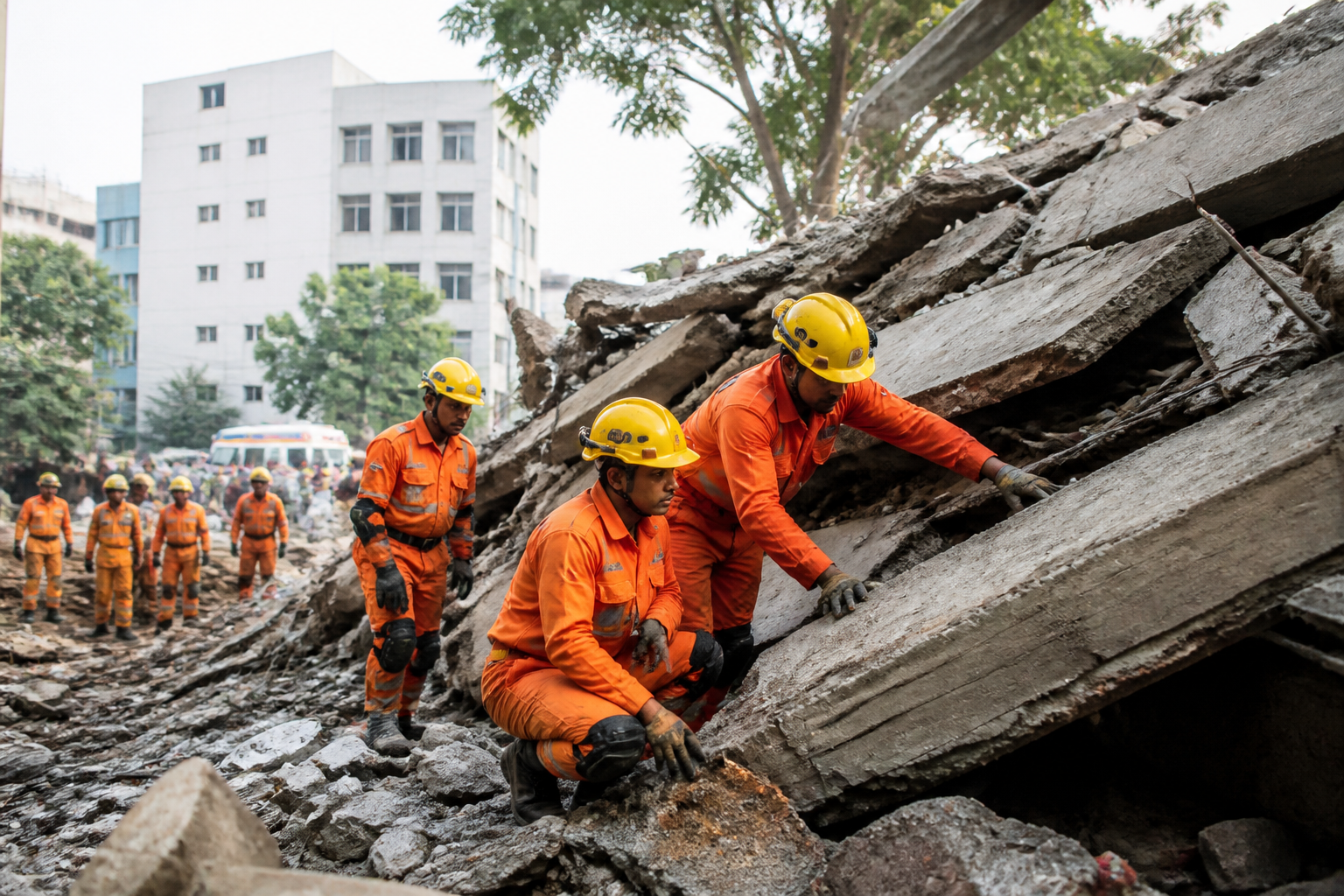
The collapse also exposes a second aspect of survivor care: the methods used during extraction can influence the injuries that follow. Dr (Maj) Rajesh Bhardwaj, who has experience dealing with such incidents, cautions against rushing indiscriminately onto unstable rubble. Adding weight or using heavy machinery too early can destroy air pockets where trapped people may still be breathing, he says.
His account places careful search and extraction at the centre of the rescue operation. Rescuers must identify possible voids, maintain communication where possible, monitor the trapped person and attend to the airway. Victims should not simply be pulled out by their limbs because spinal injuries can convert an otherwise survivable injury into permanent disability, Bhardwaj says.
These instructions reveal why rescue work is not simply a race to remove debris. A collapse creates an unstable environment in which an intervention intended to save time can also add risk. The presence of air pockets, the possibility of spinal injury and the need to keep a trapped person calm all require a controlled response. For the survivor, the rescue itself may become part of the memory that later has to be processed.
The medical and rescue dimensions are therefore connected. Safe extraction reduces the possibility of additional physical harm, while psychological recognition gives survivors a better chance of addressing the effects of what they have endured. Treating the two as separate stages can leave a gap between emergency response and long-term recovery.
The evidence in the report does not establish how frequently collapse survivors in Delhi receive psychological counselling, nor does it quantify the number who develop post-traumatic stress disorder. It does, however, document one survivor who said counselling did not follow hospital treatment, alongside an AIIMS psychiatrist’s description of the symptoms that can emerge after a life-threatening incident. That combination is sufficient to identify a care issue without assuming its scale.
It also shows why the end of rescue operations cannot be treated as the end of the disaster for those who were trapped. The formal emergency may conclude when victims are removed from the rubble and admitted to hospital. For survivors, recovery can involve physical rehabilitation, monitoring of sleep, recognition of recurring memories and support from families and professionals. The timeline is not defined by the moment the debris is cleared.
For cities, the broader question is whether disaster-response planning includes the period after immediate rescue. Building collapses are usually approached through structural safety, emergency access, search operations and trauma medicine. The accounts in this report add psychological support and safe extraction to that chain. They suggest that a complete response must follow the survivor from the collapse site to the hospital and then back into ordinary life.
What the evidence confirms is limited but significant: surviving a building collapse can carry consequences that are not visible after physical injuries heal; sleep disturbance and recurring memories can signal continuing distress; and rescue techniques must account for unstable rubble, air pockets and possible spinal injuries. What remains unclear is how consistently these needs are identified and followed up across collapse incidents. That question deserves attention whenever cities assess not only how people are rescued, but also how they live after rescue ends.
