


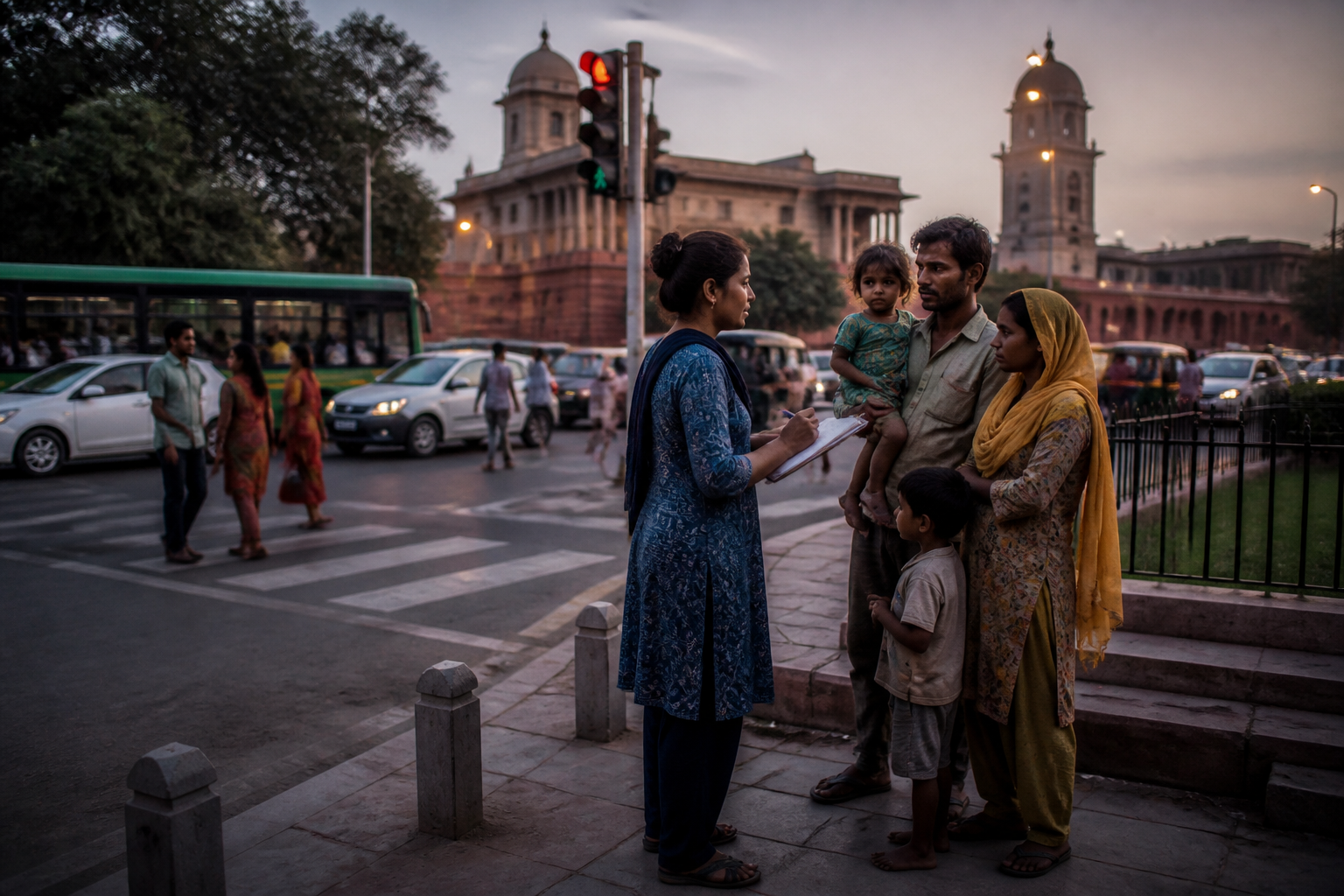
Delhi’s women and child development department has drafted guidelines for Children in Street Situations, or CiSS, seeking to replace fragmented responses to children at traffic signals, on pavements and in other public spaces with a coordinated system of identification, rescue, protection and rehabilitation. The draft is significant not simply because it proposes action against child begging, but because it treats the presence of children on the streets as a problem involving housing insecurity, migration, documentation, schooling, substance use, trafficking and access to public welfare.
The guidelines were prepared after consultations involving more than 150 representatives from government departments, Delhi Police, non-government organisations, academia and civil society. WCD secretary Dr Rashmi Singh said the department was committed to protecting children from begging and exploitation while ensuring their safety, dignity, education and rehabilitation. SM Ali, deputy director of the child protection and development unit, described the proposed framework as a coordinated, child-centric mechanism with clear roles for different stakeholders.
That emphasis on coordination addresses one of the central difficulties in responding to children who live or work on Delhi’s streets. The children visible at traffic signals are not a single, uniform group. Some may live without parental or family support. Others may spend the day begging, rag-picking or selling goods before returning to families at night. A third group may live on the street with their families, including migrant households engaged in construction, casual labour or rag-picking. A single rescue or enforcement response cannot address these different circumstances in the same way.
The draft guidelines divide CiSS into these three broad categories while also covering child labourers, street vendors, abandoned or runaway children, children vulnerable to trafficking or substance abuse, children with disabilities without parental care, children living in sibling-led households and those from highly vulnerable families. This classification is an attempt to move the city away from treating street presence as a visible nuisance and towards assessing the conditions that place each child at risk.
The distinction matters under the Juvenile Justice (Care and Protection of Children) Act, 2015. Children who are found begging, living or working on the streets, abandoned, orphaned, missing, abused, exploited, vulnerable to substance abuse or trafficking, or without proper parental care may fall within the category of Children in Need of Care and Protection. The proposed process therefore combines immediate intervention with child-protection procedures, rather than making removal from a public place the final measure.
The department has identified several overlapping vulnerabilities. Many surveyed children have never attended school, and the situation is reported to have worsened after Covid. Substance use, including inhalants such as correction fluid and adhesives as well as tobacco, is prevalent among some children. Children on the street also face risks of sexual exploitation, trafficking and child labour. These risks are intensified when families lack birth certificates, Aadhaar or ration cards, leaving them outside welfare schemes and making it harder to establish identity, residence, school eligibility or access to food support.
Delhi’s seasonal and permanent migrant population adds another layer of administrative difficulty. Families may move between work sites, informal settlements, shelters and public spaces, making one-time surveys quickly outdated. The guidelines therefore propose district-level mapping of hotspots and continuous, field-based identification. District Child Protection Units would maintain databases recording each child’s location, age, gender, vulnerability, interventions and restoration status. Universities such as the Delhi School of Social Work, Tata Institute of Social Sciences and Jamia Millia Islamia may support surveys and research, subject to ethical approval.
This proposed data system is important because the city’s response depends on knowing whether a child has been identified before, whether a family has been traced, what intervention has already taken place and whether restoration or rehabilitation has been completed. Without such continuity, repeated encounters at the same signal can produce repeated short-term interventions without resolving the conditions that brought the child there. The draft’s focus on intervention and restoration status suggests an effort to create an institutional record rather than relying only on periodic drives.
The proposed outreach structure places a team in each district, led by the district magistrate and facilitated by the District Child Protection Unit. Teams would conduct regular outreach, counselling, rescue and referrals, along with at least one special night drive every month. The timing is relevant because children may be visible in different locations and circumstances after dark, while families working in informal occupations may not be present during daytime outreach.
The rescue protocol combines immediate assistance with a legally defined sequence of follow-up actions. A rescue kit would include food, water, clothing, hygiene items, first aid, information about Child Helpline 1098 and details of nearby shelters. A child would have to be produced before the Child Welfare Committee within 24 hours of rescue. Family tracing and an individual care plan are to be undertaken within seven days, while a social investigation report, school admission, the beginning of skill training or the reintegration process should follow within 15 days.
These timelines create measurable points at which the proposed system can be assessed. They also expose where implementation could fail. Immediate rescue is visible, but family tracing, documentation, school admission and sustained follow-up require coordination among district officials, police, welfare agencies, schools, shelter providers and community organisations. The framework’s success will therefore depend less on the existence of a protocol than on whether institutions can carry a case forward after the initial encounter.
The guidelines also place institutionalisation at the bottom of the response. Families are to be supported first through ration cards, Aadhaar camps, Pradhan Mantri Awas support, Jan Dhan accounts, Mission Vatsalya sponsorship, admissions under the Right to Education framework, Ayushman Bharat and other health schemes, as well as employment assistance. This approach recognises that some children beg because of poverty or family distress. In such cases, removing the child without strengthening the household could leave the underlying problem unchanged.
At the same time, the draft distinguishes poverty from coercion and exploitation. Where parents or guardians are found to have forced a child to beg, or where trafficking or other exploitation is established, legal action would be taken while safeguarding the child’s best interests. That distinction is essential for a child-centred system: family reunification cannot be treated as automatically safe, and rescue cannot be treated as automatically rehabilitative.
The proposed use of sports and physical activities adds a social and developmental component to the framework. The stated objectives include building confidence, discipline, teamwork and social inclusion while reducing exposure to substance abuse, exploitation and violence. These measures do not replace schooling, family support or legal protection, but they indicate that rehabilitation is being framed as more than temporary shelter or removal from a traffic signal.
Shelter access remains a practical concern. The department has noted inconsistent access to permanent and temporary night shelters operated by the Delhi Urban Shelter Improvement Board. For children and families moving through the city, the availability, location and suitability of shelters can determine whether a referral provides genuine protection. A framework that maps children but cannot reliably connect them to safe accommodation, schooling and family services would retain the limitations of the current system.
The larger urban question is whether Delhi can govern street vulnerability through connected institutions rather than isolated campaigns. The draft guidelines bring together child protection, municipal space, policing, education, housing, identity documentation, public health and migrant livelihoods. Each area is administered through different systems, but the child experiences them as one environment. A missing birth certificate can affect school access; insecure housing can lead to street work; irregular employment can push families towards begging; and the absence of safe shelter can increase exposure to exploitation.
The account of the draft also shows why implementation will be more consequential than announcement. Chetna director Sanjay Gupta said his organisation had sought such guidelines for nearly 20 years, welcoming the move and urging NGOs to support implementation. That response points to a long-standing gap between the presence of children in public spaces and the existence of a consistently coordinated citywide mechanism.
The evidence currently establishes that Delhi has drafted a framework, consulted multiple stakeholders and proposed detailed categories, district teams, timelines and welfare linkages. It does not yet establish how many children will be covered, when the guidelines will be formally notified, what budget will support them, how databases will be protected or how district performance will be reviewed. Those are the next facts required to judge whether the plan becomes an operating system for child protection or remains a policy document.
For now, the draft marks a shift in the way Delhi’s street children are officially described: not as a single enforcement problem, but as children facing different combinations of homelessness, poverty, migration, exclusion and exploitation. The next test will be whether the city can translate that recognition into continuous identification, safe referrals, family support, education and accountable follow-up.
