


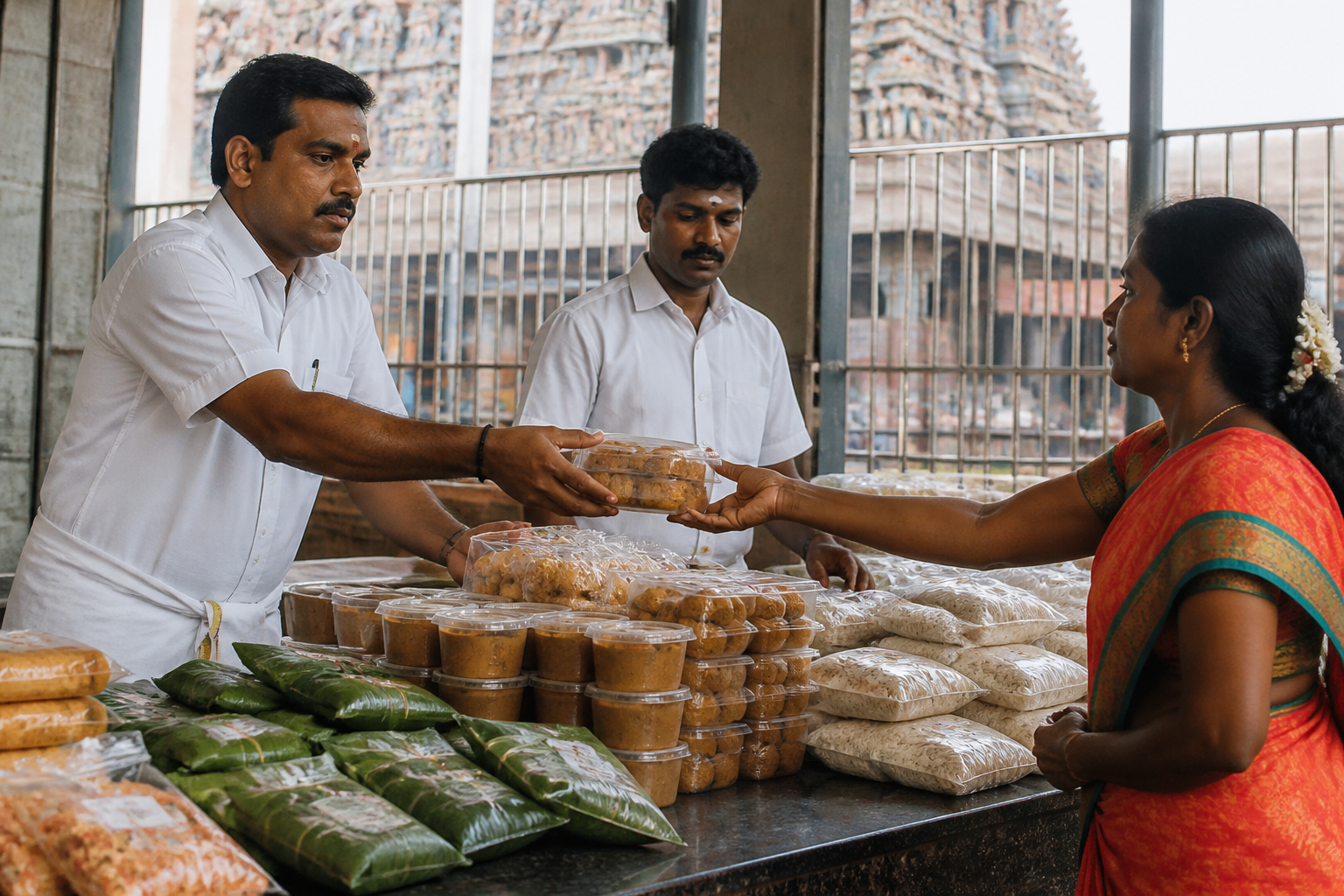
Tamil Nadu’s decision to standardise prasadam sold at temples appears, at first, to be a narrow administrative response to complaints about quality. The Hindu Religious and Charitable Endowments (HR&CE) department has notified a master scheme covering 10 common offerings, specifying recipes, ingredient ratios, portion sizes, batch sizes, prices and packaging. Temples have also been instructed to prepare the offerings on their own premises rather than outsource them.
But the measure is more than a food-service protocol. It creates a formal chain of responsibility around a product that sits at the intersection of religious practice, public consumption and temple administration. Once recipes, quantities, prices and package labels are prescribed, prasadam becomes subject not only to custom and devotional expectation but also to measurable standards of production and sale.
The reported trigger was a set of complaints about the quality of prasadams served at temples. An HR&CE official quoted by The Times of India said many temples outsource the sale of prasadam and that the department does not know how it is prepared. The official said there was a demand for prasadam to be made and sold by temples themselves. That explanation identifies the central administrative problem: the department is attempting to bring a distributed and partly opaque activity back within the institution that is responsible for the shrine.
The scheme therefore addresses two separate questions. The first concerns consistency: whether devotees receive the quantity and quality they are paying for. The second concerns traceability: whether the temple can identify how, where and with which ingredients an offering was prepared. Standardisation may help with the first question, but the second depends on whether temples can implement the production, record-keeping and labelling requirements in practice.
The notified framework covers 10 varieties of prasadam. The reported examples show how the scheme links production cost to the final selling price. A 50-gram laddu will cost ₹13 to produce and will be sold for ₹20. A 250-gram container of panchamirtham will cost ₹26 to make and will be sold for ₹30. The department is expected to calculate prices using the cost of raw materials, LPG, labour and packaging.
These figures suggest that the pricing model is not based on a single uniform markup across all offerings. The difference between production cost and sale price is ₹7 for the laddu and ₹4 for panchamirtham, while the quantities and preparation processes differ. The scheme’s stated approach is to connect prices to the inputs required for each product. That can make the price-setting process more transparent, provided the underlying costs are recorded consistently and reviewed when they change.
The distinction between cost and price is important for temple administration. If prices are fixed without accounting for fuel, labour or packaging, temples may find the scheme financially difficult to operate. If prices are increased without clear cost information, devotees may not understand the basis of the charge. By listing raw materials, LPG, labour and packaging as components, the HR&CE department has indicated the categories it intends to use in its calculations. The supplied report does not establish how often these prices will be revised or how individual temples will report their costs.
The production requirements are equally specific. The reported batch sizes include 1,000 laddus, 2,000 panchamirtham containers and 150 portions each of puliyodharai and sakkarai pongal. These numbers convert a customary offering into a scheduled production operation. A temple will need to estimate demand, procure ingredients, organise labour, allocate preparation space and manage unsold stock within the limits of the prescribed batch.
That creates an operational question that the notification, as described in the report, does not fully answer: how will smaller or less frequently visited temples manage standard batch sizes? A large shrine with steady visitor flows may be able to produce 1,000 laddus or 2,000 panchamirtham containers in a predictable cycle. A smaller temple may face a different demand pattern. The report says temples offering traditional recipes or items outside the 10-product list may submit separate cost proposals to the relevant HR&CE authorities, but it does not state whether variations in demand will receive similar administrative flexibility.
The instruction against outsourcing is the clearest institutional change. Outsourcing can reduce the burden on temple staff, but it also separates the institution selling the prasadam from the place where it is produced. HR&CE’s stated concern is that the department does not know how outsourced prasadam is prepared. Requiring on-site production is intended to close that gap by placing preparation within the temple’s premises and, presumably, under its direct supervision.
On-site preparation, however, is not only a matter of ownership. It requires suitable kitchens, storage, equipment, fuel, workers and procedures. The report does not provide an assessment of the physical capacity of temples to meet those requirements. Nor does it specify how inspections will be conducted, who will certify compliance, or what action will follow if a temple cannot meet the production standards. Those unanswered questions will determine whether the scheme operates as a real accountability system or primarily as a pricing and packaging order.
The packaging provisions extend that accountability to the point of sale. Eco-friendly packages must comply with Rule 27 of the Legal Metrology (Packaged Commodities) Rules, 2011. The packages are to carry the manufacturer or importer’s name and address, the generic name of the commodity, net quantity, date of manufacture or packing, maximum retail price, unit sale price and a consumer contact for complaints.
For temple prasadams, these requirements change the relationship between the buyer and the institution. A devotee receiving an unpackaged offering has limited formal information about quantity, preparation date or the channel for raising a complaint. A labelled package creates a record of what was sold, when it was packed and who can be contacted. It also makes the quantity and price visible before or at the time of purchase.
The requirement for a consumer contact is particularly significant. The scheme does not merely prescribe what the package should contain; it establishes an avenue for response when the product does not meet expectations. The effectiveness of that provision will depend on whether complaints are logged, reviewed and resolved. The supplied material does not indicate whether HR&CE will maintain a central complaints system or whether each temple will handle complaints independently.
The use of Aavin ghee and supplies procured at cooperative store rates adds another layer to the department’s approach. According to the report, HR&CE commissioner T G Vinay said these supplies would be used. The stated objective is to bring greater consistency to ingredients and procurement costs. Central or cooperative-linked sourcing may also make it easier to identify the inputs used across temples, although the report does not establish the procurement volumes, supply arrangements or monitoring process.
The scheme’s design reflects a familiar governance pattern: define a common product, prescribe its production parameters, disclose information to consumers and retain exceptions within an approval process. In this case, the common product is not a manufactured commodity in the ordinary sense. It is an offering whose meaning is tied to a particular temple and tradition. That is why the provision allowing temples with traditional recipes, or those offering items outside the 10 listed varieties, to submit separate cost proposals is important. Standardisation is being applied to common offerings, but the framework leaves a formal route for variation.
This balance between uniformity and tradition will be central to implementation. A fixed recipe can make quality and pricing easier to compare, but temple practices may differ in ingredients, preparation methods and established offerings. The reported scheme does not say that all prasadams must become identical. Instead, it creates a standard category for 10 common offerings and asks temples seeking different treatment to submit cost proposals through the HR&CE hierarchy.
The department’s decision also reveals the limits of standardisation. Recipes and portion sizes can be written down. Prices can be calculated. Labels can be printed. But the quality of an offering depends on daily execution: ingredient handling, cooking conditions, storage and the time between preparation and sale. The supplied report contains no inspection data or evidence yet showing whether complaints have declined under the new system. At this stage, the scheme should therefore be understood as an administrative framework, not proof that quality problems have been solved.
The immediate test will be whether the new requirements produce verifiable information at temple level. That would include records of ingredients and costs, evidence of on-site preparation, compliance with batch sizes, correctly labelled packages and a functioning complaint channel. Without those records, the department may be able to announce uniform prices but not demonstrate uniform practice.
Tamil Nadu’s prasadam policy consequently raises a broader question about how public-facing religious institutions are governed. Temples are sites of worship, but they also manage kitchens, procurement, labour, retail transactions and waste from packaging. When these functions affect large numbers of visitors, administrative clarity becomes part of public accountability. The new scheme places those functions within a more visible framework without resolving every operational issue.
What the decision establishes is clear: HR&CE intends to standardise 10 prasadam varieties, require temple-based preparation, link prices to identified production costs and apply packaged-commodity disclosure requirements. What remains uncertain is how the rules will be monitored across temples with different capacities and demand patterns. The next developments to watch are the department’s implementation instructions, the submission of separate cost proposals for traditional or additional offerings, and evidence of how temples handle production, packaging and consumer complaints.
