


Subheadline: Reservoirs are near capacity, but the BMC is retaining a 10% cut because water security depends on storage buffers, distribution networks and future rainfall—not just today’s lake levels.
Mumbai’s seven reservoirs were holding about 13.95 lakh million litres on September 9, or roughly 96% of their combined capacity. Yet the Brihanmumbai Municipal Corporation has decided to continue the city’s 10% water cut at least until the end of September. The decision captures a recurring weakness in urban water governance: a city can have substantial water stored at its source and still lack certainty about the supply reaching households.
The immediate explanation is cautious reservoir management. Additional municipal commissioner Vipin Sharma said the BMC would continue monitoring lake levels through September before reviewing the situation at the end of the month. Forecasts cited in the report suggested that Mumbai might not receive significant rain during the rest of September, making the final 4% of reservoir capacity uncertain. For the civic administration, the relevant question is therefore not simply whether the lakes are almost full, but whether the city has enough reserve to withstand the next dry period.
That distinction matters because Mumbai’s water restrictions began under very different conditions. On May 15, when the 10% cut was imposed, the seven lakes held only about 23.5% of their combined capacity. Summer demand was still ahead, and the monsoon’s performance could not be assumed. Reducing consumption was intended to extend the available stock until rainfall replenished the reservoirs. Nearly four months later, the lakes have recovered sharply, but the original logic of preserving a buffer remains in place.
The current level is also comfortable without being historically exceptional. On September 8, the lakes were at about 96.41% of capacity. The corresponding levels in 2025 and 2024 were higher, at approximately 97.23% and 97.75%. The difference is small when expressed as a percentage, but it becomes more significant when the civic administration is planning for a city of millions and uncertain rainfall. A reservoir system that is nearly full today does not eliminate the risk of entering a dry period with less protection than in previous years.
Mumbai’s water position is further complicated by the gap between supply and estimated demand. The BMC supplies around 3,850 million litres a day, while the city’s estimated requirement is about 4,300 million litres a day—a shortfall of roughly 450 million litres. The numbers indicate that reservoir storage is only one layer of the system. Even when the source has adequate water, the city must treat, transport and distribute it through a network that can deliver sufficient quantities to different neighbourhoods.
This is why reservoir levels alone cannot provide a complete measure of water security. For residents, the practical test is whether water arrives at the tap, how frequently it arrives, whether pressure is adequate and whether the water is clean. Residents in Malad have reportedly raised concerns about low pressure and dirty water, with the issue reaching a BMC ward committee meeting. Their experience demonstrates the distance between citywide storage figures and neighbourhood-level service delivery.
The BMC’s effort to map Mumbai’s roughly 6,500-kilometre water pipeline network is therefore more than a technical exercise. According to Sharma, the mapping is under way and is intended to identify sections where pipelines require replacement. The project could help the administration understand how an ageing or poorly documented network affects reliability, although the supplied material does not establish its completion timeline or the scale of investment required.
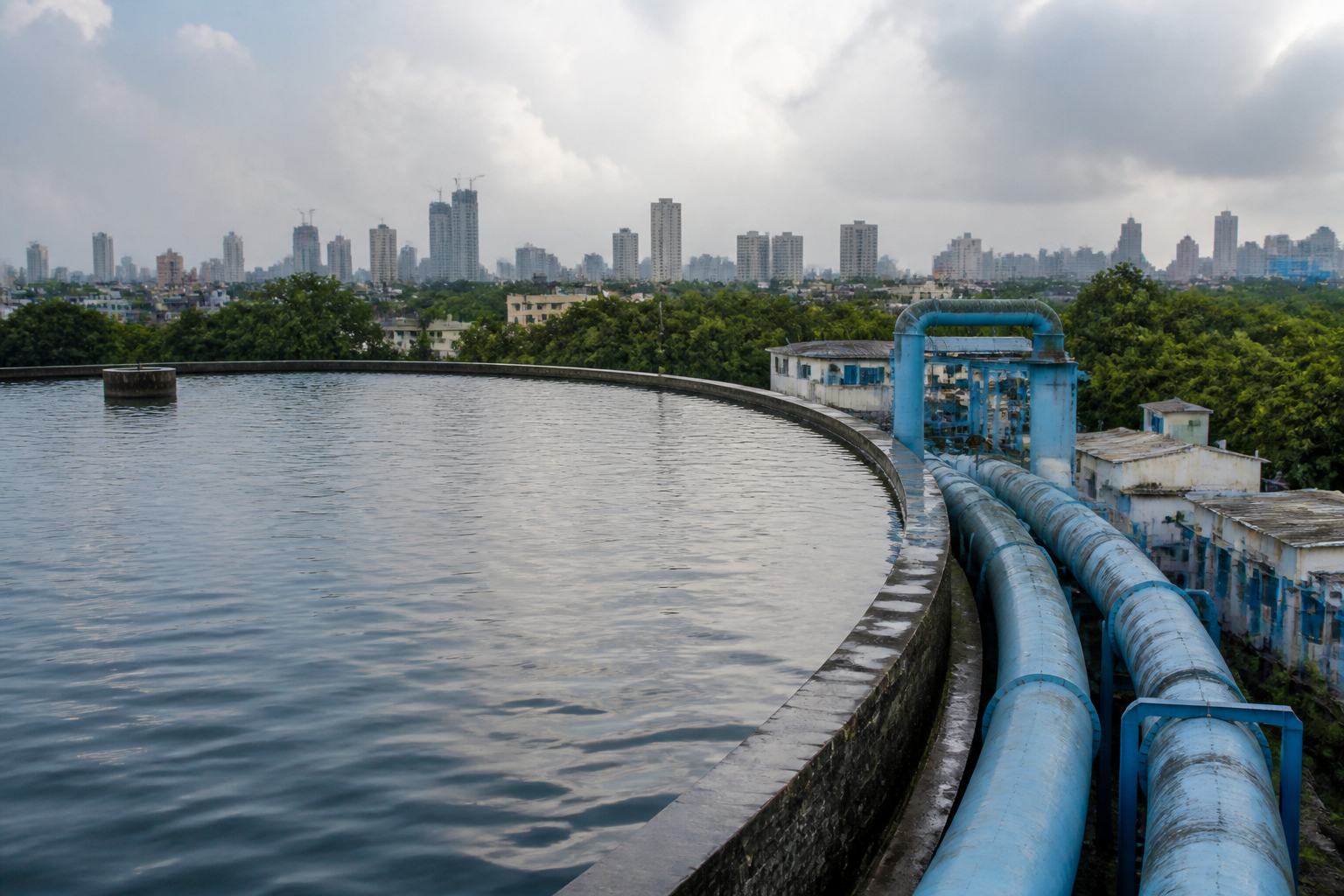
A city’s water system is a chain rather than a single asset. The seven reservoirs—Upper Vaitarna, Modak Sagar, Tansa, Middle Vaitarna, Bhatsa, Vihar and Tulsi—form the supply base. But water must then move through treatment facilities, transmission infrastructure and local distribution pipelines before reaching homes. Leakage, pressure problems, damaged lines, uneven network capacity and contamination at any point can reduce the value of water held at the source.
The reported figures also expose a planning tension. Mumbai supplies less water than its estimated daily requirement, yet the city’s policy response has largely taken the form of a broad consumption restriction. Such a measure can help preserve stocks during a period of uncertainty, but it does not by itself distinguish between avoidable consumption, essential household use, commercial demand or neighbourhoods already experiencing inadequate pressure.
That tension became more visible after the BMC allowed municipal swimming pools to resume water supply from August 16. The decision, announced on August 12, drew criticism from BJP corporator Shivkumar Jha while households remained subject to the 10% reduction. Standing committee chairperson Prabhakar Shinde argued that full supply for households and other essential users should take priority. BJP leader Pravin Darekar suggested withdrawing the residential cut while retaining restrictions on commercial consumption. Congress corporator Ajanta Yadav proposed cleaning and desilting city wells for non-potable uses.
These proposals differ, but the dispute raises a common administrative question: should a citywide cut remain the default response after reservoir levels improve, or should restrictions become more targeted? The supplied material does not establish whether the BMC has adopted a differentiated demand-management framework. It does show that the current policy is being judged not only by storage data but also by how fairly and effectively water is allocated among users.
Mumbai’s dependence on the monsoon makes this question recurring. The city’s annual water cycle typically moves from summer concern over falling stocks to monsoon dependence, rising reservoir levels and debate over when restrictions should end. The cycle becomes difficult to manage when each year’s rainfall is treated as the main determinant of security. Climate variability, as described in the report, makes it harder to assume that future monsoons will replenish the lakes in the same way.
The BMC has been examining longer-term options including the Gargai project, desalination and greater use of treated wastewater. The report does not provide current costs, construction schedules, capacities or approval milestones for these measures, so their eventual contribution cannot be assessed from the available evidence. Their inclusion in the civic discussion does, however, indicate that Mumbai is considering additional sources alongside reservoir management.
Those options address the supply side, but they do not remove the need to strengthen the existing network. Additional water will not automatically resolve low pressure, dirty water or leakage if the distribution system remains weak. Conversely, pipeline replacement and better mapping may improve the value of existing supplies without immediately creating a new source. The city’s water security challenge therefore involves both the quantity of water available and the reliability of the infrastructure that moves it.
The immediate decision to wait until the end of September is presented by the BMC as a precaution, particularly because significant additional rainfall is not assured. The more important institutional test will be the explanation accompanying the next review: what storage level does the administration consider safe, how is the 450 MLD supply-demand gap being managed, and how will network conditions influence the decision to restore normal supply?
Mumbai’s current position confirms that a full reservoir is necessary but not sufficient. The lakes are close to capacity, yet the city remains constrained by uncertainty about rainfall, a reported gap between supply and demand, uneven neighbourhood delivery and the condition of a 6,500-kilometre pipeline network. The next phase of the debate will concern not only whether the water cut is lifted, but whether Mumbai can replace seasonal crisis management with a system that makes supply more predictable between the reservoir and the household tap.
