


Subheadline: UPI’s expansion across 11 countries is changing how Indian travellers pay abroad, but exchange rates, fees and acceptance still determine the final cost.
Standfirst: International UPI is making overseas payments more familiar for Indian travellers. A QR scan can replace cash, a forex card or an international card for some purchases, but the absence of an obvious transaction fee does not necessarily make the payment cheaper. The final cost depends on the exchange rate, conversion markup, bank charges, payment limits and the merchant’s payment infrastructure. This analysis examines what the supplied evidence reveals about UPI’s overseas role, why convenience and affordability are different questions, and how travellers should compare payment options across destinations and transactions.
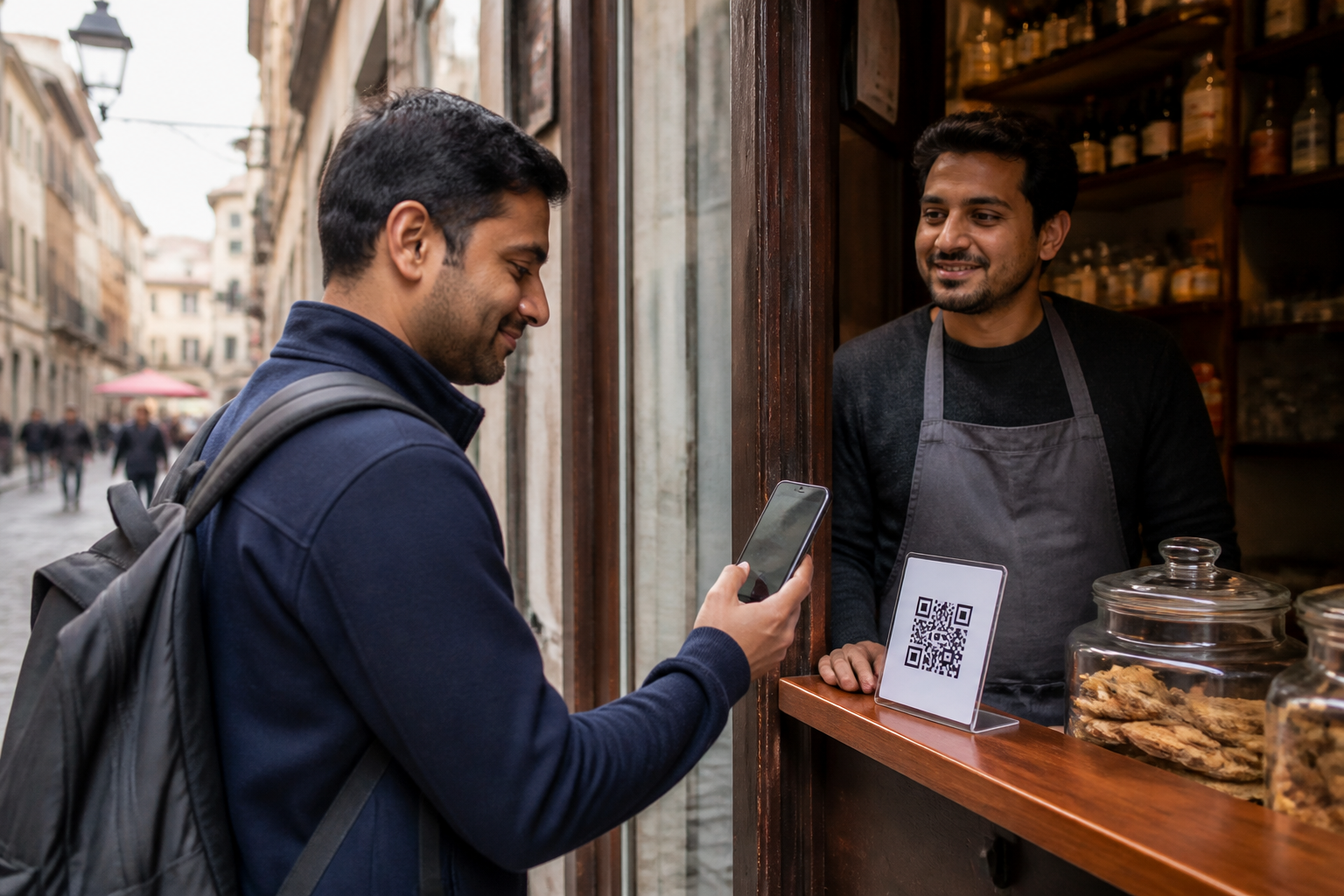
The expansion of international UPI to 11 countries marks a change in the way Indian travellers can make everyday payments abroad. Instead of searching for local currency, loading a forex card before departure or using an international credit or debit card, a traveller may be able to scan a participating merchant’s QR code, enter the amount and approve the transaction through a familiar Indian payment interface.
That change is significant because UPI has become closely associated with routine payments in India. The same behaviour used for groceries, restaurant bills and shared expenses can now be extended to participating merchants in overseas markets. The convenience is immediate. The question of cost, however, is more complicated.
The central finding from the supplied evidence is that international UPI cannot be described as universally cheaper than cash, forex cards or international cards. A payment may show no separate fee while still carrying a cost through the exchange rate or a currency-conversion charge. The amount that matters to a traveller is not simply the foreign-currency price displayed at the merchant. It is the final rupee amount debited from the linked Indian bank account.
Akshay Mehrotra, managing director and group chief executive of Fibe, told NDTV that consumers should compare the complete cost of a transaction rather than assume that one payment method will always be cheaper. That distinction separates payment convenience from payment economics. A familiar interface can make a transaction easier without making its underlying exchange rate more favourable.
The exchange rate is therefore the first major variable. Even a small difference between the prevailing market rate and the rate applied to a transaction can affect the final bill. The effect may be barely noticeable on a low-value purchase, such as a coffee, but can become more material across hotel bills, restaurant payments, shopping and other larger expenses during a longer trip.
This means that travellers need to examine more than whether international UPI displays a transaction fee. They also need to check whether their bank or payment provider applies a forex or currency-conversion markup. A payment that appears free at the point of authorisation may have a less visible cost embedded in the conversion process.
The comparison with forex cards illustrates why there is no single cheapest instrument for every traveller. Forex cards generally offer greater certainty over the exchange rate because the foreign currency is loaded before travel. For someone planning a longer overseas holiday, locking in a rate may be preferable to relying on the rate available at each individual transaction.
That certainty comes with its own cost structure. Travellers need to examine charges for issuing, loading and reloading the card, as well as fees associated with withdrawing cash from an ATM. Destination-specific charges can also affect the final value of the card. A forex card may provide predictability, but predictability is not the same as the lowest total cost.
International credit and debit cards remain competitive in places with strong card acceptance. Their economics vary according to the forex markup applied by the card issuer. The supplied material notes that some cards charge relatively high markups, while others offer lower or zero forex markup. This variation means that a card’s suitability cannot be judged only by its category. The specific terms attached to the instrument matter.
Travellers must also be careful when a merchant offers to convert the transaction into Indian rupees. This practice, known as dynamic currency conversion, can make the price appear easier to understand because the amount is shown in rupees at the point of sale. But the conversion rate may not always be favourable. The supplied evidence indicates that paying in the local currency and allowing the traveller’s bank or card network to handle the conversion may, in some cases, produce a better result.
The comparison is not simply a contest between UPI and cards. It is a transaction-level decision involving the local currency, the exchange rate, the payment provider, the merchant and the size of the purchase. The most useful question is which option delivers the lowest total cost for that particular transaction.
Cash remains part of that system because digital acceptance is not universal. It can be useful for taxis, small shops, local markets and situations in which electronic payments are unavailable. At the same time, travellers who exchange large amounts of money in advance may face a spread or margin in the exchange rate, while carrying substantial cash creates a security concern.
Withdrawing cash abroad can add another layer of charges. The traveller’s bank may impose a withdrawal fee, the ATM operator may charge separately and currency-conversion costs may increase the final amount. Repeatedly withdrawing small amounts can therefore become expensive for some travellers. The evidence supports a mixed approach: carry enough local currency for situations where digital payments are unavailable, while using UPI or cards for other purchases where the total cost is acceptable.
International UPI’s broader importance lies in the choice it adds to this payment system. Its expansion means that an Indian traveller may be able to use a familiar method for some overseas transactions without carrying large amounts of cash or depending exclusively on a card. It also extends an established domestic payment habit into a cross-border setting.
But that expansion does not remove the role of local payment infrastructure. Acceptance can vary by country, city and merchant. A traveller cannot assume that an international UPI-enabled account will work at every business in a destination. The relevant merchant QR code, network partnership and bank or payment-provider arrangements all affect whether a payment can be completed.
The supplied material identifies Uzbekistan as one of the markets involved in the recent expansion, while also stressing that acceptance remains a limitation. The practical implication is that international UPI should be treated as one component of a travel-payment plan rather than a complete replacement for every other instrument.
This distinction also has a governance and infrastructure dimension. A digital payment system’s usefulness abroad depends not only on the application visible to the consumer but on the connections among banks, payment networks, merchants and currency-conversion systems. The traveller experiences a QR scan, but the transaction relies on a wider institutional and technical arrangement. Where that arrangement is incomplete, convenience stops at the merchant interface.
Limits and security checks add another layer. Before departure, travellers should confirm that international UPI is enabled for their bank account and check the applicable transaction limits. They should review the foreign-currency amount, the rupee equivalent, the exchange rate and any applicable fees before authorising a payment.
The security requirements are equally basic and equally important. Travellers should use genuine merchant QR codes, verify the merchant name and transaction amount, and never share a UPI PIN. Unexpected payment requests should not be approved merely because the interface is familiar. International use increases the importance of checking each transaction before authorisation.
The evidence does not establish that UPI will consistently undercut forex cards, cash or international cards. It establishes something more measured: international UPI gives Indian travellers another way to pay, and its value depends on the destination, merchant acceptance, transaction size, exchange rate and charges applied by the relevant financial institutions.
That makes international UPI part of a wider shift towards payment flexibility rather than a universal cost solution. For small purchases at participating merchants, its convenience may be decisive. For planned expenses, a forex card may offer greater rate certainty. Where card acceptance is strong and the forex markup is low, an international card may compete closely. Cash remains necessary when digital payment infrastructure is unavailable.
The larger urban and travel-system question is not whether one instrument will eliminate the others. It is whether consumers can see and compare the full cost of moving money across borders. As international payment networks expand, the most important information remains the same: the final rupee debit, the applied exchange rate, the fees, the transaction limit and the reliability of acceptance at the point of purchase.
