


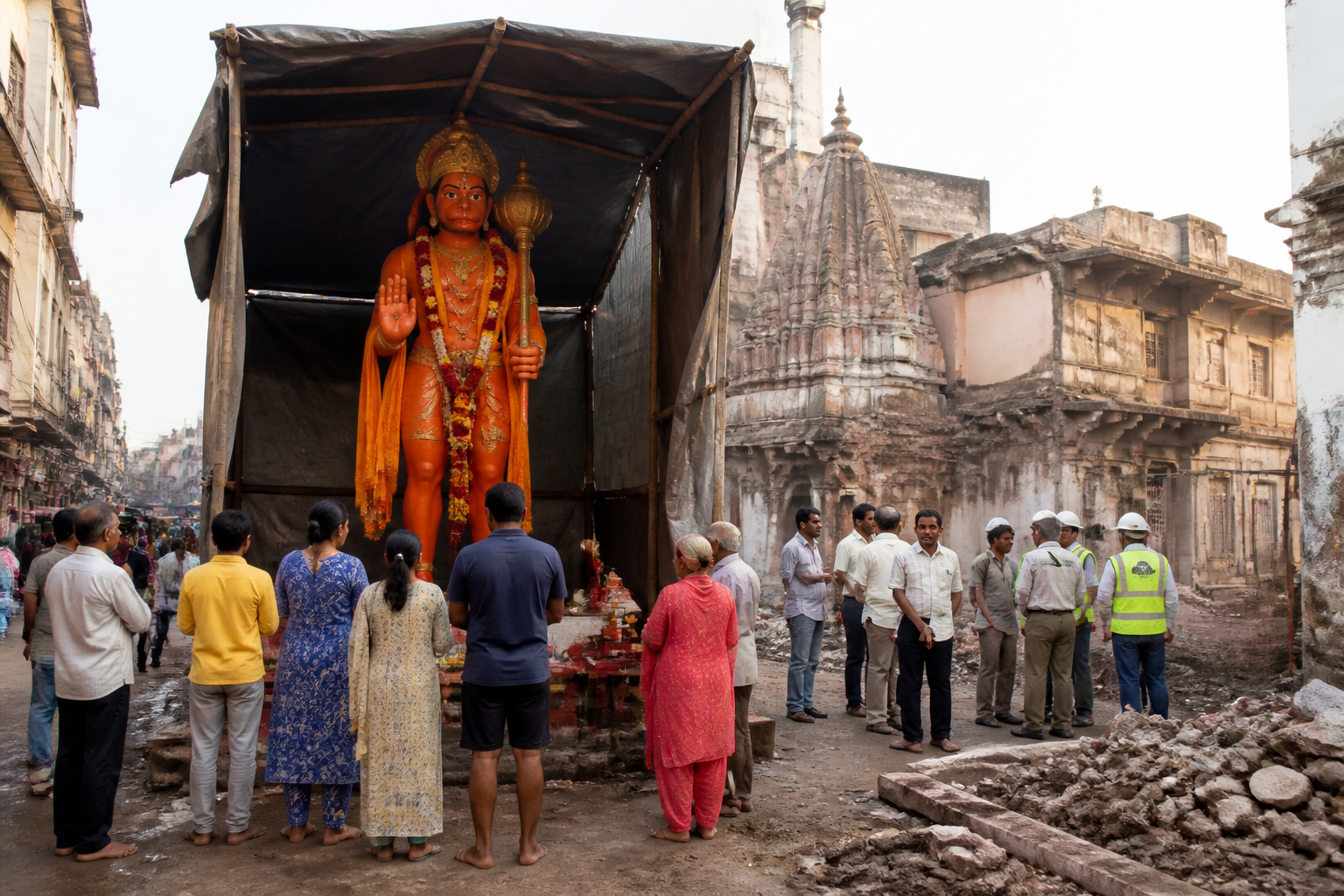
Ujjain’s road-widening project for Simhastha 2028 has encountered an obstacle that cannot be resolved through ordinary municipal demolition or construction work: an eight-foot Khade Hanuman idol that remains standing after the temple around it was dismantled. The administration has paused any attempt to move it and called engineers and technical experts to establish how the idol is connected to the ground beneath it.
Subheadline: A 450-metre road project brings engineering, religious practice and heritage protection into the same municipal decision.
Standfirst: The proposed widening of the road between Kanthal and Gopal Mandir in Ujjain is intended to improve movement ahead of Simhastha 2028. Four religious structures stand along the 450-metre stretch, and officials say arrangements have been made to relocate them. One Ganesha temple has already been shifted. The Khade Hanuman idol, however, has remained in place even after the surrounding temple structure was removed. The administration now plans to seek an assessment from SGSITS Indore and IIT experts before deciding whether and how the idol can be moved. The episode reveals a recurring urban governance problem: infrastructure projects often treat land, structures and access as separable components, while religious sites and older built forms may combine material, cultural and social functions that are not easily captured in a road plan.
The immediate event is not that the idol refused to move, as some social media claims have suggested. Ujjain SDM LN Garg said no attempt had yet been made to remove or relocate it, either manually or with machinery. The administration’s position, according to the report, is that technical experts must first determine what lies beneath the idol and how it is connected to the structure below it.
That clarification matters because the temple building and the idol have followed different trajectories. The temple’s boundary wall and spire were dismantled four days before the report was published, after the priest and members of local Hindu organisations attended a final aarti. A new location near an old water tank at Chhatri Chowk has been identified, and preparations for a new pedestal have begun. The priest is reported to have consented to the relocation. Yet the central object of worship has not been touched.
This separation between a building and the object it houses is one of the key planning questions in the Ujjain case. From a conventional construction perspective, removing a temple structure may appear to clear the way for a road project while leaving the idol as a separate relocation task. But the administration’s decision to stop and investigate suggests that the idol may not be an independent object resting on a simple pedestal.
Additional municipal commissioner Santosh Tagore said a technical team from SGSITS Indore and IIT would be called for a proper analysis. He added that no further attempt would be made until the situation was fully understood. The stated process therefore moves the matter from routine site clearance to technical assessment, with engineering expertise being used before a final administrative decision.
The evidence available in the report does not establish how old the idol is or precisely how deep its supporting structure extends. One possibility being examined by officials is that it was installed using an interlocking technique in which stones beneath it were fitted tightly together. If that is the case, the visible idol could be connected to a larger underground or substructure system. A ground scan may be needed to determine the depth and configuration of that connection.
Archaeologist Raman Solanki, who visited the site as a resident and not in an official capacity, identified the stone at the rear of the idol as Malwa basalt. He suggested that the idol could be as much as 1,000 years old and possibly date to the Parmar era. Those observations are not presented as a formal archaeological determination. They do, however, explain why a decision based only on the immediate requirements of road construction could carry risks that are difficult to reverse.
The proposed road widening is itself linked to a defined urban pressure. The road between Kanthal and Gopal Mandir is planned to expand from 9 metres to 15 metres over a 450-metre stretch. Officials have connected the work to preparations for Simhastha 2028, when Ujjain is expected to experience a major influx of pilgrims. Four religious structures lie along the route. The administration says all have agreed to relocate, and one Ganesha temple has already been shifted.
The project thus illustrates how event-led infrastructure can accelerate decisions about public space. A road that is 9 metres wide is being redesigned to accommodate anticipated movement during a major religious gathering. The report does not provide traffic counts, design drawings, cost estimates or a comparative assessment of alternatives. It does show, however, that the road’s physical widening has consequences beyond carriageway dimensions: it affects temples, worship routines, local organisations, police deployment and the daily use of a market area.
Bada Sarafa is described as a busy market, and the idol remains under a waterproof tent amid the broken remains of the temple. Worship has continued even after the structure was partly dismantled. The priest performs morning puja, visitors continue to arrive for darshan, and queues form around the site. Police personnel remain stationed nearby, while members of Hindu organisations maintain a presence and slogans have at times been raised against the municipal corporation’s handling of the matter.
This continuing use of the site complicates the idea that a temple is only a physical structure. In the report, the religious function has not ended with the removal of the boundary wall and spire. The location continues to serve as a place of worship, even though it has also become a construction and security site. For municipal authorities, the challenge is therefore not limited to moving an object safely. It also involves managing an active public interface where devotees, officials, engineers, religious organisations and police personnel meet.
The administration’s public language has shifted accordingly. Garg said the matter was connected to the faith of devotees and that no decision would be taken without scientific and technical opinions. He also said development work for Simhastha 2028 was important, but that preserving Ujjain’s faith and heritage was equally significant. The administration plans to seek a consensus-based solution through dialogue with devotees, saints and experts.
That approach places technical assessment and consultation alongside the road project rather than treating them as separate afterthoughts. It also acknowledges that consent to relocate a temple structure does not automatically settle every question about the idol, its history or the community’s relationship with the site. The report quotes priest Mahesh Bairagi as saying that the situation showed the move had not been adequately prepared. Vishwa Hindu Parishad representative Khagendra Bhargava urged that old temples and idols be relocated only when absolutely unavoidable and that traditional and administrative procedures be followed.
The Ujjain case does not establish that the road project should be cancelled, nor does it establish that the idol cannot be moved. It establishes a narrower but important point: the implementation sequence was not complete when the surrounding temple was dismantled. A decision about the idol still depends on information that officials do not yet have about its construction, age and connection to the ground.
That uncertainty is the central governance issue. Infrastructure projects require defined alignments, schedules and operational targets. Heritage and religious sites may require investigation, negotiation and caution before physical work begins. When those timelines overlap, the cost of rushing can include damage to an irreplaceable object, loss of public trust or renewed conflict at the construction site.
For now, the available evidence supports neither the claim that the idol moved through supernatural force nor the claim that it has been proven to be an ancient Parmar-era object. Both remain outside what has been formally established in the report. What is confirmed is that the idol has not been moved, that the temple around it has been dismantled, that a new site and pedestal are being prepared, and that technical experts are being called before any further action.
The next stage will depend on the assessment by SGSITS Indore and IIT experts, including whether scanning or other investigation can identify the structure beneath the idol and determine a safe method of relocation. Until that process is complete, Ujjain’s road-widening plan remains physically advanced but administratively unresolved at the point where infrastructure meets faith and heritage.
