


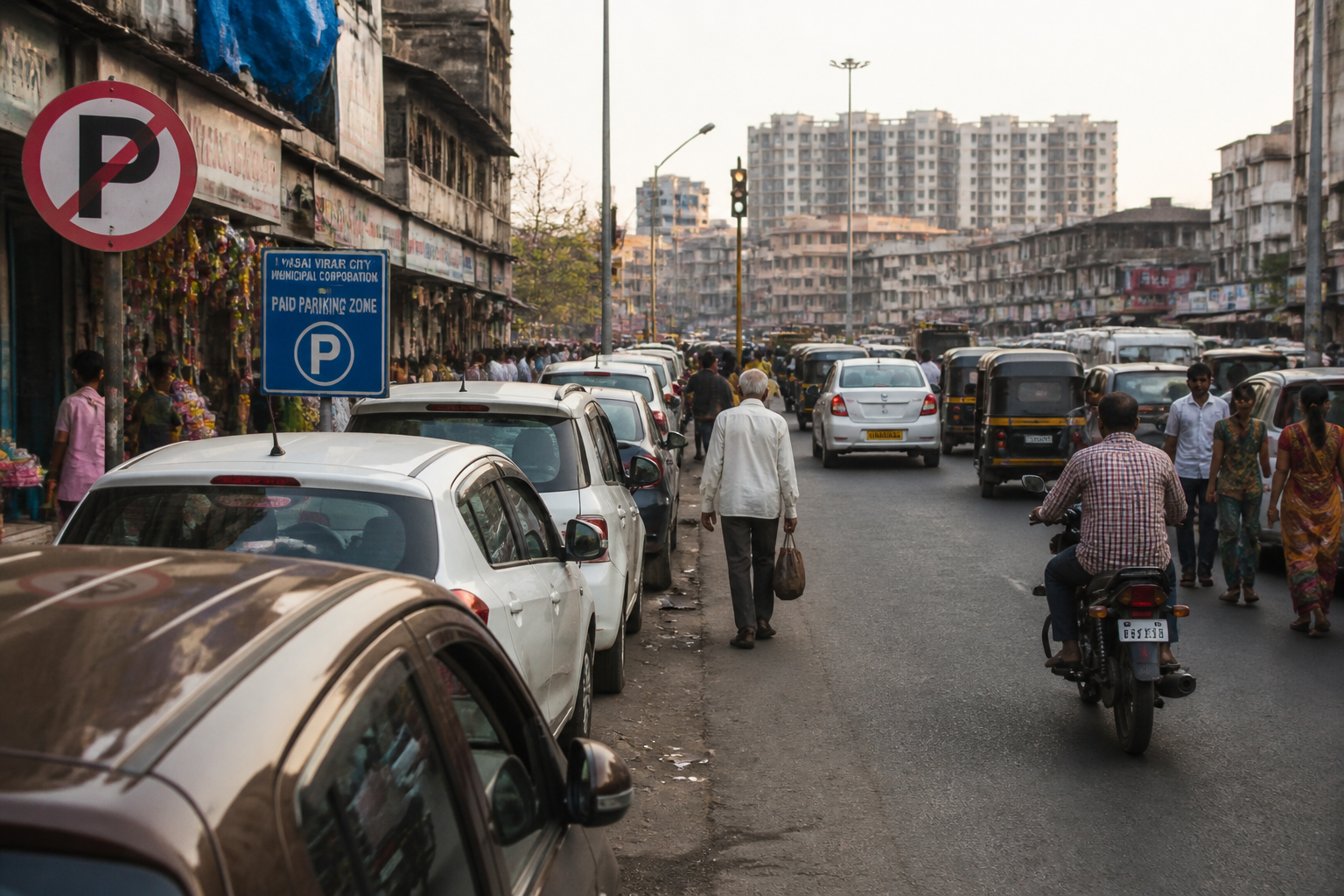
Vasai-Virar parking rules were introduced to bring order to parking on busy roads, market streets and traffic junctions. Two years later, a report published by Loksatta says the system has failed to produce effective compliance, with vehicles being parked on both sides of roads regardless of the date and parking spaces increasingly occupied by commercial activity.
The reported breakdown is not simply a question of motorists ignoring signs. It points to a larger urban management problem: a parking rule can exist on paper, and a city can install hundreds of signs, without creating a functioning system unless enforcement, space management and institutional coordination operate together.
According to the report, the odd-even parking arrangement was introduced jointly by the Vasai traffic control branch and the Vasai-Virar City Municipal Corporation. The stated objective was to improve traffic planning and bring greater order to roadside parking. Under the system, vehicles were required to park on one side of a road on even dates—such as the second, fourth or sixth—and on the other side on odd dates—such as the first, third or fifth.
The municipal area reportedly received more than 481 signs covering different parking categories, including two-wheeler parking, four-wheeler parking, no-parking zones and parking based on odd and even dates. The scale of sign installation suggested an attempt to create a citywide framework rather than a limited intervention on one road.
The report now describes a different reality on several important roads. These include Vasai East station road, the 100 Feet Road, Manikpur, Ambadi Road, Shriprastha in Nalasopara, Achole Road and Central Park, as well as major roads in Virar. Vehicles are reportedly being left on both sides of roads without regard to the date-based restriction. The result, according to the report, is continued encroachment on road space and traffic congestion.
The distinction between a parking rule and a parking system is important here. A rule tells motorists what they are expected to do. A system must also provide visible and usable spaces, define who may occupy them, prevent unauthorised commercial use and impose consequences when the rule is ignored. The Loksatta report indicates that the first element exists in Vasai-Virar, while the other elements remain weak or inconsistently implemented.
The report attributes the poor functioning of the policy partly to public indifference and the annual increase in the number of vehicles. However, the more significant issue is the competition for the same roadside space. Parking areas are reportedly being occupied by garage operators, businesses, shops and hawkers. Vehicles brought in for repair, along with tools and other material, are allegedly being placed in areas intended for public parking.
This changes the nature of the problem. If marked parking space is unavailable because it is being used for commercial storage or vehicle repair, motorists may disregard the odd-even system not only because they are unwilling to follow it, but also because the designated space is no longer available for ordinary parking. The supplied report does not establish how much parking capacity has been lost in this way, but it identifies the conflict between public parking and private or commercial use as a central feature of the current situation.
The issue also exposes the limits of signage-led traffic management. More than 481 signs may communicate a policy, but signs alone cannot regulate a road if they are not maintained, understood and backed by regular enforcement. The report does not provide details on the number of parking officers, the frequency of inspections, the number of penalties issued or the institutional responsibility for removing commercial obstructions. Those gaps matter because they determine whether the policy’s failure is primarily one of enforcement, design, public communication or insufficient parking supply.
The joint role of the traffic control branch and the municipal corporation adds another layer of complexity. Traffic authorities typically deal with movement, violations and road discipline, while municipal bodies manage local streets, public spaces and civic infrastructure. A parking policy that depends on both institutions requires a clear division of responsibility. The supplied material does not state which agency is responsible for enforcing the date-based rule, clearing encroachments, managing garage-related occupation or responding to complaints.
Without that clarity, residents encounter a policy but may not know where to report violations or which authority can act. Businesses and garage operators may also continue using roadside areas if enforcement is irregular or responsibilities overlap. The report records the visible outcome—vehicles on both sides of roads and parking areas occupied by other uses—but does not establish the administrative chain behind those outcomes.
The geography described in the report is significant. The affected locations include station roads, major connectors, market areas and roads in both Vasai and Virar. Such locations carry different kinds of demand. A station road is shaped by passenger movement and short-term stopping. A market street experiences deliveries, customer parking, pedestrian movement and commercial spillover. A major connecting road must preserve vehicle flow. Applying one odd-even principle across these different environments may require local operating rules, even if the broad objective is uniform.
The source material does not say whether the policy was supported by separate arrangements for loading and unloading, short-term stopping, residential parking or vehicle repairs. It also does not state whether off-street parking alternatives were created. These are unresolved questions, but they are essential to judging the policy fairly. A date-based system can reduce roadside pressure only when users have a realistic alternative and when competing uses are controlled.
The reported increase in vehicle numbers creates additional pressure. The article does not provide registration data or a measured growth rate, so the scale of that increase cannot be quantified from the supplied evidence. It does, however, identify rising vehicle ownership as one factor associated with the policy’s declining effectiveness. More vehicles competing for unchanged road space can make a system more difficult to enforce, particularly in built-up areas where roads also serve pedestrians, shops, service businesses and informal vending.
This is why the Vasai-Virar case should be read as a governance test rather than only a compliance story. The policy was visible enough to receive hundreds of signs, but its effectiveness depends on what happens after installation. Are the signs placed where drivers can understand them? Are the markings still visible? Is parking checked every day? Are violations penalised consistently? Are commercial occupations removed? Does the system distinguish between a parked vehicle and a vehicle stopped briefly for passengers or deliveries? The report does not answer these questions, but its account of continued congestion suggests that implementation has not kept pace with the original policy design.
The absence of an authority response in the supplied material is also important. There is no statement from the Vasai-Virar City Municipal Corporation or the traffic control branch explaining the current enforcement position, the number of violations recorded or the next corrective step. There is likewise no data on whether the 481-plus signs remain in place and functional. These facts would be necessary before drawing a definitive conclusion about the policy’s overall performance.
What the available evidence does establish is narrower but still significant. Vasai-Virar introduced an odd-even roadside parking framework two years ago. More than 481 signs were reportedly installed across different parking categories. A report now says that motorists commonly park on both sides of several prominent roads without following the date-based rule, while garages, shops, businesses and hawkers occupy parking areas. The reported result is that ordinary users have fewer places to park and road congestion continues.
The larger urban question is whether the city is managing parking as public infrastructure or treating it as a signposted restriction. The experience described by Loksatta suggests that the policy cannot be assessed by the presence of signs alone. Its performance must be measured through available parking space, enforcement activity, control of commercial encroachment and traffic conditions at the locations where the rule applies.
For now, the evidence supports a conclusion about implementation failure as reported, but not a complete diagnosis of its causes. The next useful public information would be an official review by the municipal corporation and traffic authorities, including current enforcement data, the status of designated parking spaces and a response to the reported occupation of those spaces by commercial users. Until those details are available, Vasai-Virar’s odd-even parking policy remains an example of how a formal urban rule can lose effectiveness when the institutions responsible for making it work are not visible in everyday street management.
