


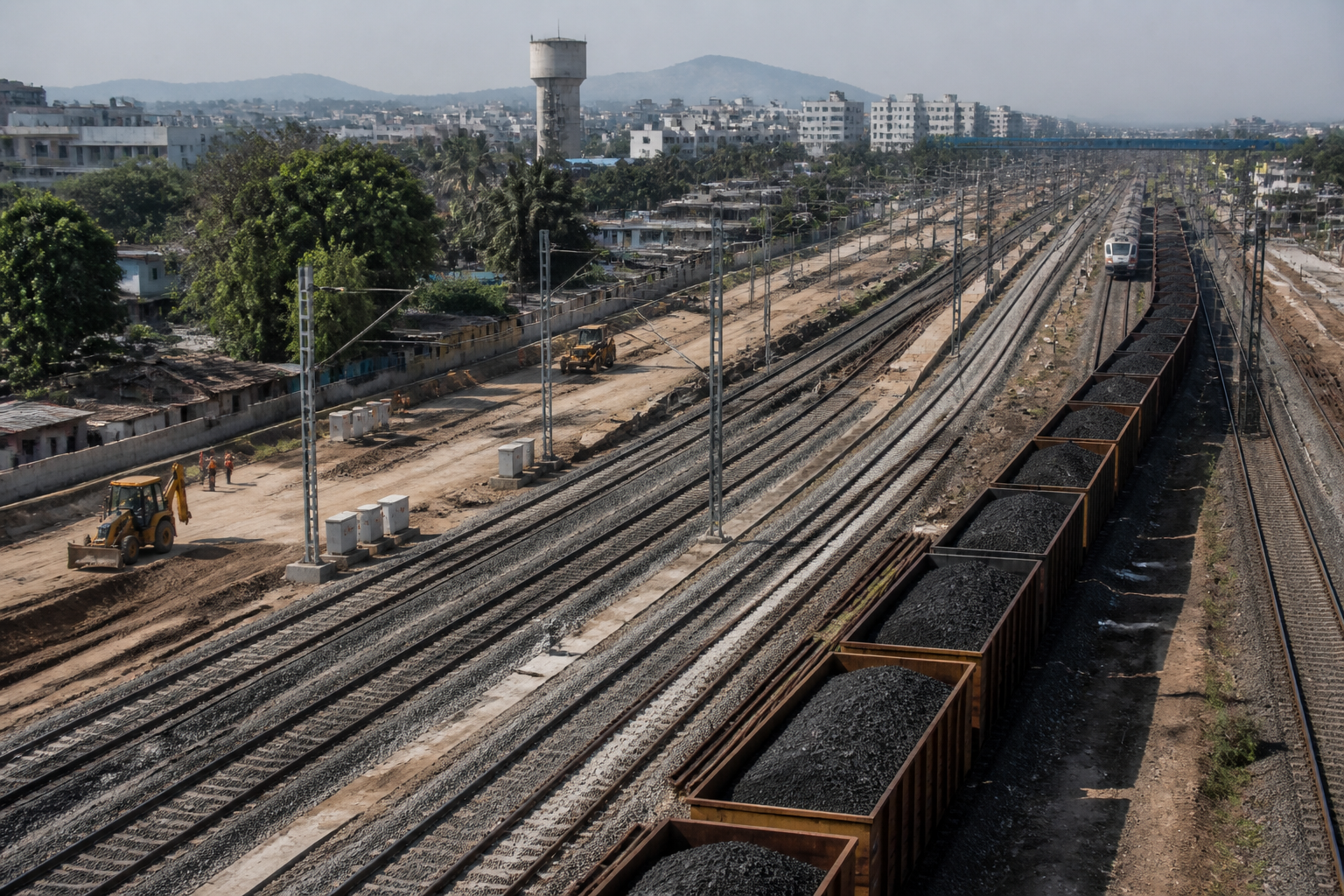
Subheadline: Eight projects approved across nine states will add about 1,196 km of railway capacity, connect thousands of villages and support additional freight movement by 2029-30.
Standfirst: The Cabinet Committee on Economic Affairs has approved eight railway multitracking projects with a combined estimated cost of about Rs 20,804 crore. Five projects in Tamil Nadu, Andhra Pradesh, Karnataka and Telangana account for around Rs 10,021 crore and 540 km, while three projects across West Bengal, Jharkhand, Odisha, Madhya Pradesh and Chhattisgarh account for Rs 10,783 crore and another 656 km. The immediate market reaction focused on railway-linked companies, but the more significant question is what the approvals reveal about India’s attempt to expand rail capacity along congested passenger and freight routes. The available project details point to a coordinated infrastructure push under the PM Gati Shakti National Master Plan. They also show how line expansion is being tied to commodity movement, village connectivity and the capacity of existing corridors to handle additional traffic.
The approval of eight railway multitracking projects places network capacity at the centre of India’s latest rail infrastructure push. The projects, cleared by the Cabinet Committee on Economic Affairs, are expected to add about 1,196 km to the Indian Railways network and are planned for completion by 2029-30. Their stated objectives include easing congestion, improving operational efficiency and strengthening service reliability.
The first group comprises five projects across Tamil Nadu, Andhra Pradesh, Karnataka and Telangana. Together, these works are estimated to cost around Rs 10,021 crore and cover approximately 540 km. They include the construction of third and fourth lines between Arakkonam and Renigunta, third and fourth lines between Whitefield and Bangarapet, doubling between Hosur and Omalur, doubling between Salem and Karur and Dindigul, and multitracking between Secunderabad’s Ghatkesar section and Kazipet.
The second group includes three projects across West Bengal, Jharkhand, Odisha, Madhya Pradesh and Chhattisgarh. These works are estimated to cost Rs 10,783 crore and will add around 656 km to the network. The projects are described as important freight routes, particularly for coal, cement, iron and steel, and are also expected to improve line capacity and operational reliability.
The combined scale matters because multitracking is intended to increase the number of trains that can use an existing route without relying only on timetable adjustments or operational efficiencies. A route with additional lines can separate or better coordinate passenger and freight services, although the supplied material does not establish how each project will be operated after completion. The immediate effect of the approvals, therefore, is a sanctioned construction programme rather than a completed capacity increase.
The government’s stated timeline places completion in 2029-30. That date gives the projects a defined implementation horizon, but the material supplied does not provide individual construction schedules, tender dates, land-acquisition details, cost-breakdown information or the status of clearances for each route. Those details will be important in assessing how quickly the approved capacity can become operational.
The southern package illustrates the range of urban and regional systems connected by the programme. The Arakkonam-Renigunta route links locations in Tamil Nadu and Andhra Pradesh, while the Whitefield-Bangarapet and Hosur-Omalur sections connect important parts of Karnataka and Tamil Nadu. The Salem-Karur-Dindigul project extends the focus further across Tamil Nadu, and the Secunderabad-Ghatkesar-Kazipet section adds capacity in Telangana.
The projects are expected to benefit 2,121 villages with a combined population of about 52 lakh, according to the government release cited in the source material. This places the programme beyond a narrow railway-operations story. The approved works are also a connectivity intervention affecting settlements along the corridors, although the supplied information does not specify the nature of the expected passenger, employment or service-access benefits for these villages.
The freight dimension is more clearly defined. The southern projects are expected to support additional freight traffic of 47 million tonnes per annum. The commodities identified include coal, cement, iron and steel, containers, automobiles, food grains, petroleum products and fertilisers. The three projects in the eastern and central regions are expected to enable incremental freight movement of around 27 million tonnes per annum and are described as key routes for coal, cement, iron and steel.
Taken together, the stated additional freight potential is about 74 million tonnes per annum. This is a capacity expectation associated with the approved projects, not a reported increase in freight already being carried. The distinction is important: the infrastructure may enable additional movement, but the supplied material does not establish how much traffic will eventually shift to these routes, when it will do so or whether the full stated potential will be realised.
The commodity list also shows why the projects have been grouped within a broader infrastructure strategy. Coal, cement, iron, steel, petroleum products and fertilisers require large-volume transport, while containers, automobiles and food grains connect rail capacity to manufacturing, logistics and distribution networks. Additional lines can reduce conflicts between different train movements, but the effectiveness of that expansion will depend on how the routes are integrated with terminals, sidings, stations and onward road connections. The source material does not provide details on those associated facilities.
The projects have been planned under the PM Gati Shakti National Master Plan. In the supplied account, that framework is linked to the development of additional railway networks and improved connectivity. The approval therefore presents multitracking not as isolated route work but as part of a coordinated infrastructure approach. However, the available information does not specify the funding structure beyond the announced project costs, nor does it identify the implementing agencies or contracting arrangements for individual works.
That institutional detail will shape the programme’s delivery. The Cabinet approval establishes the projects and their broad scope, while later stages would ordinarily require the sequencing of engineering works, procurement and construction activity. For readers tracking the built environment, the main issue is how the approved package moves from an administrative decision into a sequence of physical interventions across multiple districts and states. The current material confirms the approval and intended completion period, but not the status of execution.
The geography of the package reveals two related infrastructure priorities. In southern India, the approved routes include corridors serving expanding metropolitan and industrial regions, as well as intercity connections across Tamil Nadu, Karnataka, Andhra Pradesh and Telangana. In eastern and central India, the emphasis is more explicitly tied to freight corridors and mineral-based commodities. The projects therefore combine regional connectivity with network capacity for industrial movement.
The railway network’s capacity problem is expressed in the announcement through congestion, operational efficiency and service reliability. These are system-level measures rather than individual project outputs. A new line may add physical capacity on a particular section, but the wider benefit depends on whether adjacent sections, junctions and terminals can accommodate the resulting traffic. The supplied material does not provide corridor-level bottleneck data, existing utilisation rates or performance comparisons, so the precise scale of improvement cannot yet be measured.
The same limitation applies to the expected freight gains. The 47 million tonnes per annum cited for the southern projects and the 27 million tonnes per annum associated with the other three projects offer a clear target for the programme, but no baseline is provided. Without current route volumes or a project-wise allocation of expected traffic, the figures cannot be used to determine the percentage increase in freight capacity or the likely distribution of benefits between commodities.
The market response underscores the commercial attention around railway construction and operations. Shares of IRCTC, Ircon International, Titagarh Rail Systems, RVNL and IRFC were reported to have risen during Thursday’s trading session, with some gains reaching more than 4% among railway-linked stocks. Those share movements reflect investor response to the announcement, but they do not establish the financial impact of the projects on any individual company. The supplied material contains no contract awards, company-specific order details or earnings estimates.
For cities and settlements along the routes, the more durable question is whether added rail capacity changes the distribution of movement. Improved reliability can support passenger journeys and freight scheduling, while better access can affect the relationship between villages, industrial locations and larger urban centres. Yet the approval alone cannot demonstrate those outcomes. They remain dependent on construction, commissioning, operating plans and the integration of the railway works with other infrastructure.
What the evidence confirms is a substantial, geographically distributed railway expansion programme with a combined estimated cost of about Rs 20,804 crore, approximately 1,196 km of additional network and a stated potential for roughly 74 million tonnes per annum of incremental freight movement. It also confirms that the projects are scheduled for completion by 2029-30 and are being presented within the PM Gati Shakti framework.
What remains uncertain is equally important. The supplied material does not establish project-wise execution milestones, procurement progress, land requirements, clearance status, financing schedules or the precise operational arrangements that will follow construction. It also does not show whether the expected freight capacity will be fully used. The next evidence to watch is therefore not another market reaction, but the release of detailed implementation schedules, tender information, construction progress and eventual commissioning updates for each corridor.
