


The Greater Bengaluru Authority has issued guidelines for the 2026 Ganesha festival, banning the manufacture and sale of idols made with plaster of Paris, thermocol and chemical colours while requiring organisers to obtain approvals through a single-window system. The authority said inspections and enforcement measures would be carried out across the city to protect lakes, tanks and other water bodies from pollution.
GBA Chief Commissioner Maheshwar Rao said residents should install and worship only environmentally friendly Ganesha idols during celebrations in homes, streets, public grounds and other locations. The authority has warned that criminal proceedings may be initiated against those found manufacturing Ganesha idols using plaster of Paris.
The guidelines also prohibit the use and sale of chemical colours, thermocol and plaster of Paris for idol production. Violators may face fines, criminal cases and seizure of the prohibited materials, according to the measures reported by Vijay Karnataka. The authority has also prohibited the use of banned plastic during the festival and said city-level inspections would be conducted daily against its use and sale.
For public installations, ward-level nodal officers will be appointed across the jurisdiction of the five city municipal corporations. The police, Bengaluru Electricity Supply Company, fire services and other relevant departments will coordinate through the single-window process to review applications and issue permissions. Applications are expected to be processed within 24 hours, subject to compliance with government rules and National Green Tribunal guidelines.
Organisers will also be required to obtain permission for loudspeaker use by paying the prescribed fee and submitting the necessary documents. Municipal commissioners and the designated nodal officers will supervise implementation of the festival measures, while the police department may assist civic officials during inspections where required.
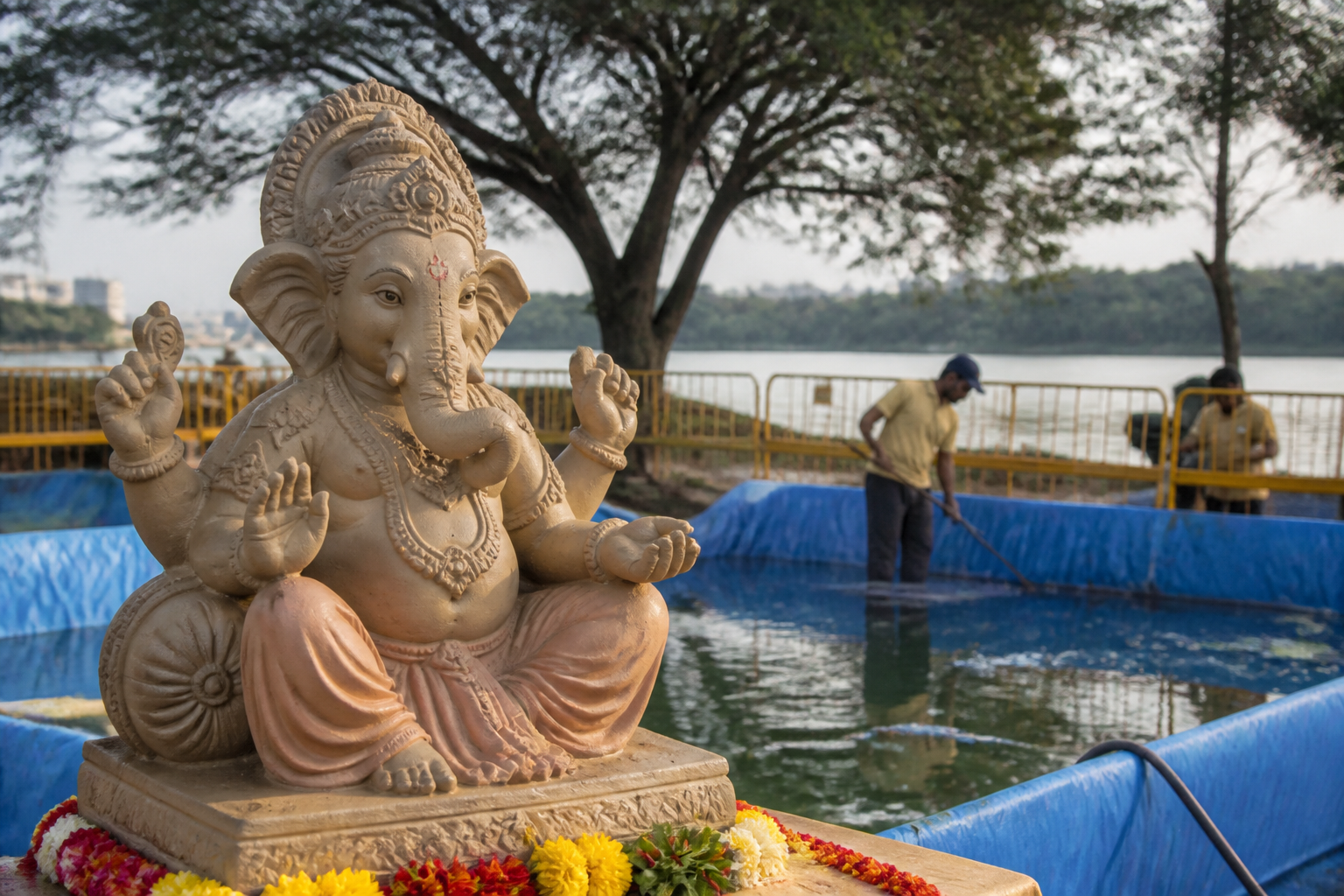
The authority has asked residents to immerse environmentally friendly idols at home in buckets where suitable and reuse the remaining soil in kitchen gardens and flowerpots. For larger idols, officials will identify appropriate immersion locations and arrange mobile vehicles, temporary tanks, drums and barricades wherever necessary.
The guidelines call for preventive measures at lakes and tanks to avoid pollution during immersion. Officials have also been instructed to ensure that soil, flowers and other waste generated during immersion are separated into wet and dry waste. The Bengaluru Solid Waste Management Limited authorities have been asked to send the segregated material to the relevant collection and processing centres.
Seized prohibited materials will be disposed of according to applicable rules. The authority’s stated measures cover idol production, public-event permissions, loudspeaker use, immersion facilities, waste handling and enforcement, with municipal commissioners and nodal officers responsible for overseeing implementation.
