


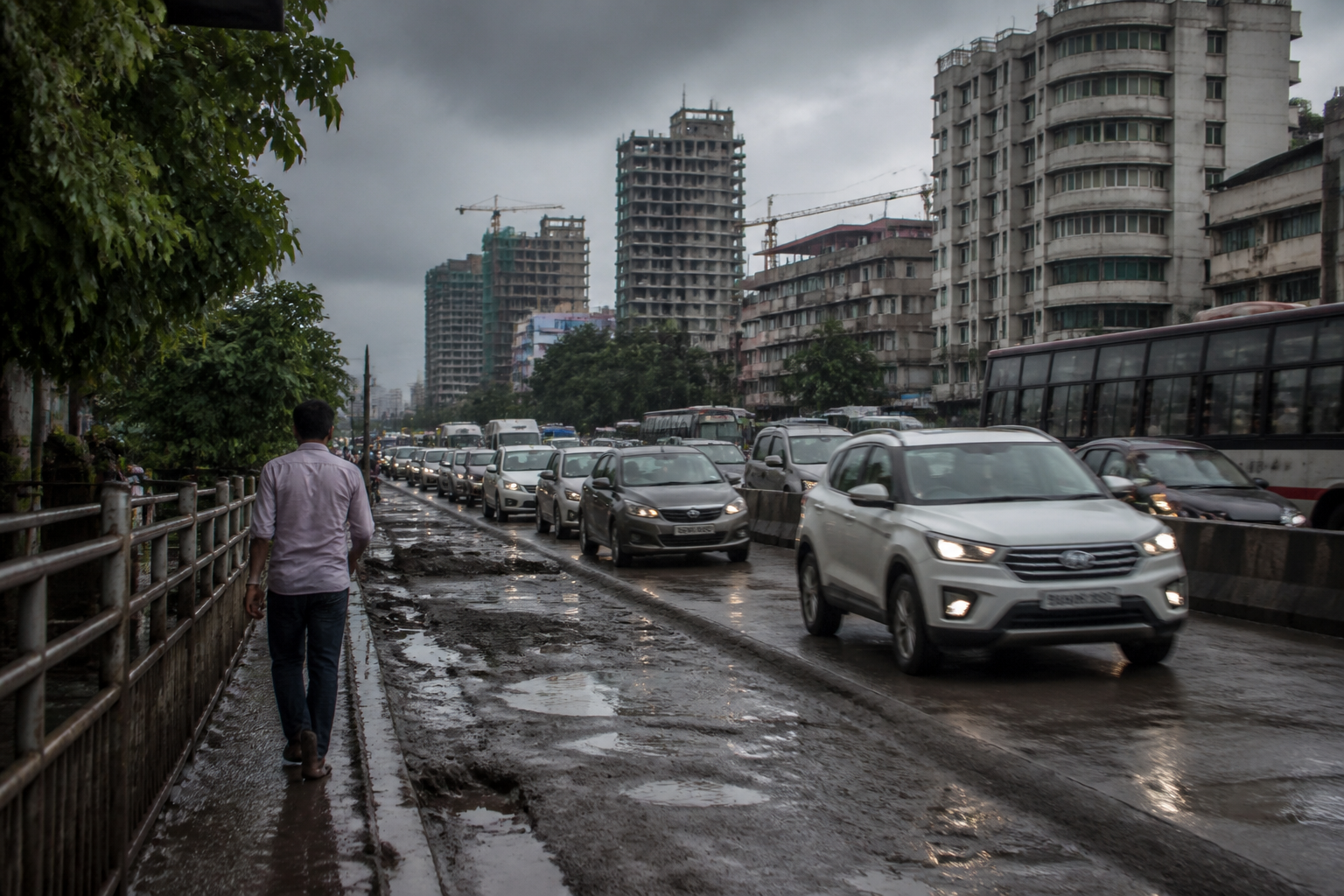
India’s urban crisis is no longer only a question of congestion, housing shortages or deteriorating public services. It is increasingly a question of whether metropolitan regions can remain economically productive and liveable as unplanned construction, shrinking green cover and climate-related risks place greater pressure on their infrastructure. Speaking at the Dr P. R. Dubhashi Lecture at the Gokhale Institute of Politics and Economics in Pune, former civil servant and urban administration expert Dr Ramnath Jha warned that a continuing decline in the quality of life in cities could produce consequences far beyond the urban boundary, including wider economic losses.
Jha’s central argument was that metropolitan planning must develop the capacity to respond to climate change. He pointed to unauthorised and unregulated construction, inadequate housing, falling green spaces, rising heat, changing rainfall patterns and sudden flooding as interconnected pressures that are increasing the vulnerability of cities. The warning is important because these problems are often handled separately by different institutions, even though they are experienced together by residents.
A city with inadequate housing may push households towards informal or poorly serviced settlements. A city that permits construction without matching drainage, road and sewage capacity can increase flood exposure and traffic congestion. The loss of green areas can intensify heat while also reducing the landscape’s ability to absorb rainwater. These are not isolated failures of individual projects; they reflect the difficulty of coordinating land use, infrastructure investment, environmental protection and municipal services at metropolitan scale.
The lecture, titled “The Crisis Before Metropolises: The Imperative of Reforms”, placed these concerns within the rapid expansion of India’s major urban centres. According to figures presented by Jha, more than 550 million people live in 80 major cities, which have become important engines of the country’s economic development. However, he said infrastructure and civic services in many cities have not expanded at the same pace as urbanisation.
That mismatch is the defining institutional problem. Urban growth creates demand for roads, public transport, water supply, sewage treatment, solid waste management, housing, public spaces and emergency services. If these systems are planned after development has already occurred, governments are forced to retrofit them into dense and expensive urban environments. Land acquisition becomes harder, construction disrupts established neighbourhoods, and the cost of correcting earlier planning decisions rises.
The source report identifies several visible outcomes of this capacity gap: deteriorating air quality, impacts on public health, inadequate sewage treatment, poor roads, insufficient pedestrian facilities, traffic congestion and weak public transport. Each issue affects daily life directly, but their cumulative effect is more consequential. Time lost in traffic, illness associated with pollution, unreliable mobility and exposure to flooding reduce the effective productivity of households and businesses. They also make access to jobs, education and healthcare more unequal.
The quality of urban infrastructure is therefore tied to economic performance. Jha warned that if the standard of living in cities continues to fall, young people and capital may increasingly move outside the country in search of better infrastructure, public services and living conditions. The report presents this as a warning rather than an established trend. It does, however, underline a policy reality: cities compete not only for investment but also for skilled workers, entrepreneurs and institutions.
The housing question sits at the centre of this competition. The report describes inadequate housing as one of the major concerns facing metropolitan regions, alongside unauthorised and uncontrolled construction. When formal housing supply does not keep pace with demand, households are pushed towards locations where land is cheaper but services are weaker. This can increase commuting distances and place additional pressure on roads and public transport.
Unregulated construction also creates a governance problem. Building activity is not inherently a sign of urban failure; cities need continuous construction to accommodate population growth and economic expansion. The issue is whether construction is aligned with land-use plans, environmental limits, infrastructure capacity and enforceable safety standards. Where those links are weak, new buildings can add demand without contributing adequately to the systems that support them.
Climate change makes this planning gap more dangerous. Rising heat, changing rainfall and sudden floods can expose weaknesses that remain invisible during ordinary conditions. Drainage systems designed without accounting for changing rainfall patterns may fail during intense events. The loss of green cover can remove natural cooling and water absorption. Poorly planned development can block natural drainage channels or place more people and assets in vulnerable areas.
The report does not provide city-level flood, heat, housing or sewage data, so it cannot establish the scale of these problems in Pune or compare performance across the 80 cities cited by Jha. It also does not identify specific projects, agencies or planning decisions responsible for particular failures. The evidence supports a broad diagnosis of institutional and infrastructure stress, but more detailed assessment would require municipal records, climate data, service-level information and project-level documentation.
Transport capacity is another significant indicator of the gap between urban growth and public investment. Jha noted that metro rail services are operational in only 17 cities in the country and argued that stronger urban transport systems are needed. Metro expansion alone cannot resolve metropolitan mobility problems. It must be connected to walking infrastructure, feeder services, buses, land-use planning and affordable access. The source material does not provide data on ridership, network length or modal share, but the limited number of cities with operational metro services points to the uneven availability of high-capacity public transport.
The reference to pedestrian facilities is equally important. Mobility planning often focuses on large capital projects, while walking remains the basic mode that connects residents to public transport, workplaces, schools and local markets. Inadequate footpaths, unsafe crossings and encroachments can make even a well-funded transport network difficult to use. A city’s transport system is experienced at street level, not only through its largest infrastructure projects.
The policy challenge is distributed across multiple levels of government. Metropolitan planning requires coordination between municipal corporations, development authorities, state departments, transport agencies, housing bodies and environmental regulators. Public services may be financed and delivered by different institutions, while residents experience them as one urban system. Weak coordination can result in roads being laid before utilities are upgraded, housing being approved without transport capacity, or drainage decisions being separated from land-use planning.
This fragmentation also complicates accountability. A flooded road may reflect a drainage design issue, blocked channels, unregulated construction, inadequate maintenance or an extreme rainfall event. Poor air quality may be linked to transport, construction, industry, waste burning and regional conditions. Without shared data and clear institutional responsibility, authorities may respond to symptoms while the underlying urban pattern remains unchanged.
Jha’s remarks point towards a planning model in which climate resilience is built into ordinary urban decisions rather than treated as a separate environmental exercise. Housing approvals, road design, drainage, public transport expansion and protection of green areas all influence how a city responds to heat and rainfall. The report does not detail a specific reform programme, funding model or institutional blueprint, but it establishes the need to connect these policy areas.
The economic argument strengthens the case for such coordination. The 80 major cities cited in the lecture are described as central to India’s economic development. Their performance depends on reliable movement, healthy residents, accessible housing, functioning utilities and public spaces that support everyday life. If these systems deteriorate, the cost is borne not only by municipal budgets but also by households and businesses through lost time, higher health risks and reduced productivity.
The bigger urban question is whether India’s metropolitan institutions can plan for growth before infrastructure deficits become crises. The concerns raised in Pune are familiar across rapidly expanding cities: construction is visible and immediate, while sewage networks, drainage upgrades, green protection and pedestrian infrastructure are less politically prominent and often slower to deliver. Yet these less visible systems determine whether urban expansion produces a functioning city or a larger accumulation of vulnerabilities.
The available evidence confirms a serious mismatch between the pace of urbanisation and the development of infrastructure and civic services, according to the expert cited in the report. It also establishes climate risk, housing inadequacy, transport shortages and weak public services as connected metropolitan challenges. What remains unclear is the precise scale of the deficit in individual cities, the responsibilities of specific agencies and the funding required to address it. Those are the questions that city governments, planning authorities and public institutions will need to answer if metropolitan growth is to remain economically productive and liveable.
