


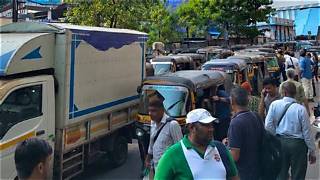
Commuters at Bhayandar railway station’s west entrance are facing traffic congestion and restricted access after the main two-wheeler parking facility near the station was shut, with vehicles now being left on roads, footpaths and beneath the station’s escalator area.
The disruption was reported on September 9, 2026, in the area outside Bhayandar West railway station. The closure has left regular two-wheeler users without sufficient parking space and has affected movement around the station entrance, according to a report by Loksatta – Vasai-Virar.
Many passengers use two-wheelers to reach the station, park them and continue their journeys by train. With the principal parking facility unavailable, commuters have reportedly begun leaving vehicles along the road, on footpaths and in open areas near the station. The resulting obstruction has contributed to congestion outside the station and made it difficult for passengers to enter and leave the premises.
The parking facility was operated by Sakshi Enterprises on a plot in the Mithagar area near the station. According to the report, advocate Khush Khandelwal of the Hindu Task Force had complained about the facility. The Mira-Bhayandar Municipal Corporation subsequently cancelled the parking facility’s licence, following which it was closed.
Two other parking facilities are available near the station, but their capacity is limited. The report states that they cannot accommodate the large number of vehicles previously parked at the main facility. As a result, roadside parking has increased and the pressure has shifted from the designated parking area to the station’s surrounding streets and pedestrian spaces.
The congestion has prompted the traffic department to take action against vehicles in the area. However, enforcement has not resolved the underlying shortage of parking capacity created by the closure of the main facility. The immediate conflict is therefore between keeping access routes clear and accommodating commuters who continue to arrive at the station by two-wheeler.
The parking disruption also highlights the dependence of suburban rail access on facilities outside the station boundary. When parking capacity is withdrawn without an equivalent replacement, vehicles can spill into spaces used by pedestrians and moving traffic. At Bhayandar, that spillover is now affecting the approach to the station and the daily movement of passengers.
The report did not specify when a replacement parking arrangement would be created or whether the municipal corporation plans to restore, relocate or expand parking capacity. For now, traffic action is continuing around the station while commuters remain without access to the main two-wheeler parking facility.
