


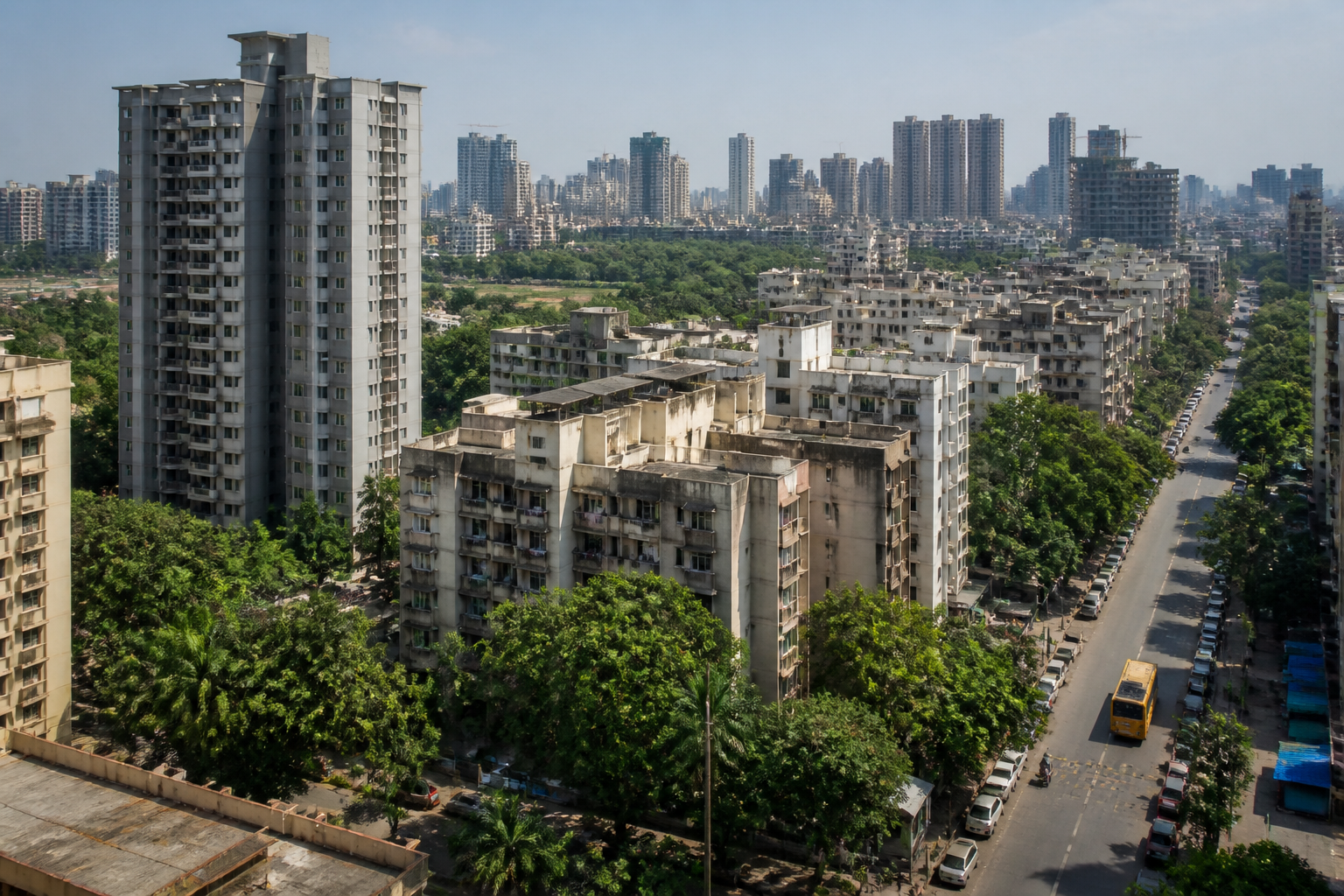
Navi Mumbai cluster redevelopment is now at the centre of a larger urban question: how can cities provide safer and more spacious homes without approving additional density faster than their infrastructure can support it?
The question has resurfaced after Maharashtra Deputy Chief Minister and Urban Development Minister Eknath Shinde backed the proposed redevelopment of the Simplex Housing Condominium in Ghansoli. His remarks came as Forest Minister Ganesh Naik raised concerns about the impact of increased floor space index, or FSI, on Navi Mumbai’s water supply, transport network, parking capacity, sewage system and other civic infrastructure.
The disagreement is not simply about one housing society. It reflects two competing objectives within urban redevelopment. The first is the promise of better housing for residents living in small one-room-kitchen and one-bedroom units. The second is the need to ensure that additional built-up space is matched by roads, public utilities, open areas and the institutional capacity to operate a denser neighbourhood.
According to the report, Shinde expressed support for the Simplex cluster project during the Navi Mumbai Dahikala Utsav 2026 in Ghansoli on September 5. He said residents living in smaller homes should receive larger and more spacious houses through redevelopment. Referring to the cluster model in Thane, he said poor and needy residents had received rightful homes through the process and expressed confidence that Navi Mumbai residents could also benefit from redevelopment.
The political significance of the remarks lies in their timing. The municipal process for the Simplex cluster had already advanced, while the question of increased FSI remained contested. The issue has therefore moved beyond a straightforward redevelopment proposal and become a test of how the state and local authorities balance housing aspirations with the carrying capacity of an established city.
The immediate administrative background is a proposed urban renewal plan for Cluster Number Four. A high-powered committee meeting held on June 17 recommended notifying a civic renewal plan for the Simplex Housing Condominium. Navi Mumbai Municipal Corporation Commissioner Dr Kailas Shinde subsequently issued a notification on July 14 for the plan. The notified area includes approximately 67,146 square metres in Sector 7, Ghansoli, and residents were invited to submit suggestions and objections within 30 days.
That process is important because a notification and a public-objection period create a formal route for residents and other stakeholders to respond. However, the material available in the report does not establish the final development control parameters, the precise additional FSI proposed, the expected population increase, the infrastructure capacity assessment or the final status of the objections. Those details will determine whether the project is merely a housing replacement exercise or a substantial intensification of the neighbourhood.
FSI is central to the dispute because it determines how much floor space can be built on a given plot. In redevelopment, higher FSI can make a project financially viable while also allowing existing residents to receive larger replacement homes. It can help accommodate rehabilitation housing, project costs and additional development within the same urban area. But a higher permissible built-up area can also increase demand for water, electricity, road space, parking, waste management and sewage treatment.
The report attributes concerns over these pressures to Naik and says the ruling Bharatiya Janata Party group in the municipal corporation has sought a scientific study of the effects of increased FSI. The cluster scheme has reportedly been put on hold until that study is completed. The supplied material does not specify who will conduct the study, what indicators it will measure, whether it will examine the entire cluster or a wider Ghansoli area, or when its findings are expected.
Those omissions are significant. A credible density assessment would need to establish the current population and built-up area, the proposed number and size of new units, the likely number of additional residents, and the capacity of existing networks. It would also need to clarify whether the redevelopment would alter traffic patterns, parking demand, public-space requirements or the load on local sewage and water systems. None of these technical findings is included in the report, so the infrastructure concern remains a stated position rather than a quantified conclusion.
At the same time, the housing argument cannot be reduced to a demand for larger apartments. Residents of older or inadequate housing may face overcrowding, limited privacy and poor living conditions. Shinde’s remarks frame redevelopment as a route to more dignified homes, particularly for households currently living in one-room-kitchen or one-bedroom units. The available report, however, does not provide a detailed account of the existing buildings’ structural condition, the number of affected households, the proposed rehabilitation entitlement or the mechanism for protecting residents during construction.
This is where cluster redevelopment differs from an isolated building redevelopment. A single-building project can often be assessed within the boundaries of one plot. A cluster project changes the scale of intervention. It may combine multiple buildings or parcels, alter the distribution of open space and create a larger concentration of residents after construction. The public value of such a project therefore depends not only on the size of the replacement homes but also on how the entire neighbourhood is planned and serviced.
The institutional structure adds another layer. The state urban development department, the municipal corporation, the high-powered committee and local political representatives appear in the account, but their separate responsibilities are not fully set out. The municipal notification establishes a local planning process, while the state minister’s public support gives the proposal political backing. Naik’s objections introduce a demand for technical review before the scheme proceeds. The material does not establish whether the reported pause is a formal statutory stay, an administrative decision or a political direction.
That distinction matters for residents. A formal suspension would have a different legal and procedural effect from a request to wait for a study. It would also affect the timeline for consent, approvals, tendering, temporary relocation and construction. The report does not provide those dates or explain whether residents have already consented to the redevelopment. These are among the facts that require confirmation from the municipal corporation and the relevant project documents.
The available numbers show the scale of the notified land area but not the scale of the final project. The approximately 67,146-square-metre area gives the proposal a substantial spatial footprint. It does not, by itself, reveal the number of towers, total floor area, rehabilitation units, sale units, parking spaces or expected population. Without those figures, it is not possible to determine whether the proposed density would exceed existing neighbourhood capacity.
This is the larger lesson from the Ghansoli dispute. Urban redevelopment cannot be evaluated only through the promise of better homes or the commercial feasibility created by additional FSI. It must also be evaluated through the systems that make those homes habitable: reliable water, functioning sewage networks, road access, public transport, parking management, waste collection and public space. The case also shows why infrastructure assessments need to be available early enough for residents and elected representatives to examine them before a project becomes politically irreversible.
The immediate evidence confirms that the Simplex Housing Condominium is included in a notified urban renewal plan, that public objections were invited, that Shinde has publicly supported the redevelopment and that concerns over increased FSI have prompted a call for a technical study and a reported pause. It does not yet establish the final development plan, the infrastructure impact, the legal status of the hold or the implementation timeline.
The next developments to monitor are the publication of the FSI assessment, the municipal response to suggestions and objections, clarification of the project’s approval status, and disclosure of the proposed housing and infrastructure numbers. Until those documents are available, the Navi Mumbai cluster redevelopment debate remains a conflict between two valid but incomplete promises: better homes for existing residents and a city system capable of supporting the density required to build them.
