


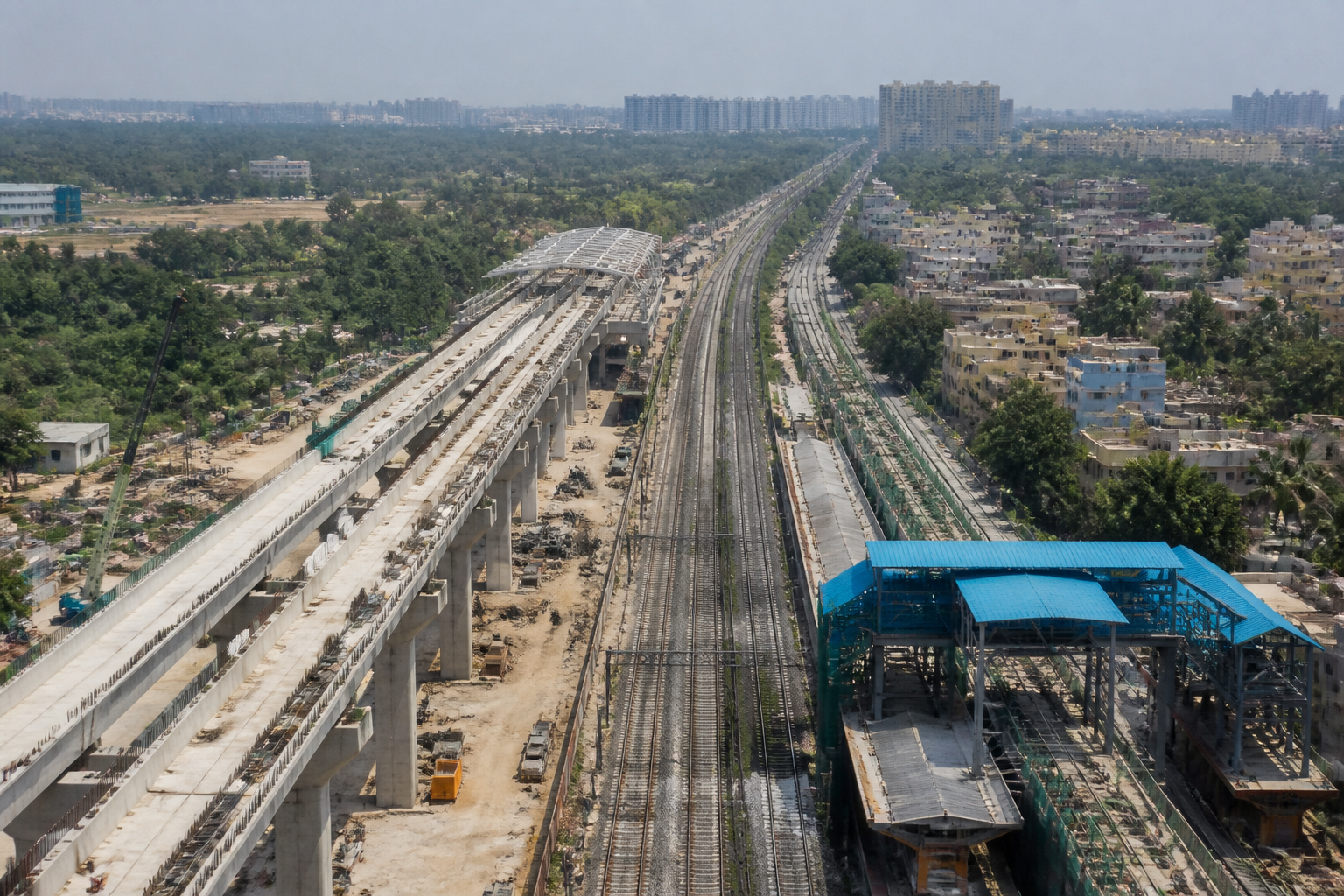
Bengaluru’s suburban rail project is showing visible progress after years of delays, with construction under way on the Mallige and Kanaka corridors and a target for trains to begin running between Chikkabanawara and Yeshwanthpur by 2028. But the project’s latest phase also exposes a familiar infrastructure problem: civil works can move ahead faster than land acquisition, systems integration and train procurement.
According to a report by Vijay Karnataka, the Karnataka Rail Infrastructure Development Company, or K-RIDE, is currently advancing construction across two corridors with a combined 30 stations. The work includes elevated and ground-level sections, bridges, drainage structures, retaining walls and depot development. K-RIDE managing director Laxman Singh said several processes were still pending, but that recent progress showed the project was moving in the right direction through coordination between the state government, the Railway Ministry and other partner agencies.
The immediate test is the 27-kilometre Mallige corridor, which runs between Baiyappanahalli and Chikkabanawara. The corridor has 12 planned stations at Benniganahalli, Kasturi Nagar, Seva Nagar, Banaswadi, Nagawara, Kanakanagar, Hebbal, Mattikere, Yeshwanthpur, Shettihalli, Myadarahalli and Chikkabanawara. Station construction has been divided into two packages, with Semindia India and NCC reported to have received the contracts.
The reported cost of the Mallige corridor construction is Rs 1,025.77 crore. A separate Rs 106.29-crore package covers 5.80 kilometres of ground-level and elevated route between Yeshwanthpur and Chikkabanawara. Work is also continuing on sections between Benniganahalli, Banaswadi and Hebbal after L&T withdrew from the earlier contract. Small and large bridges, drainage works and retaining walls are under construction, with completion targeted within two years, according to the report.
That target gives the Chikkabanawara-Yeshwanthpur section particular importance. The reported expectation is that suburban trains could begin operating on the seven-kilometre stretch in 2028. The date, however, is presented as an expectation rather than a confirmed commissioning schedule. The project must still coordinate civil works with railway systems, stations, signalling, rolling stock and operational testing before passenger service can begin.
The Yeshwanthpur-Mattikere section adds another layer of engineering complexity. A double-decker structure has been awarded to Semindia India, with the work order expected shortly. At Soladevanahalli, a tender has been invited for a depot spread across 26 acres, with an estimated cost of Rs 200 crore. The depot will be essential to the operating system, but its tendering also indicates that not every supporting facility has reached the same stage as the route and station works.
The 46-kilometre Kanaka corridor is being developed in two station-construction packages. Its ground-level stations include Heelalige, Singena Agrahara, Huskur, Ambedkar Nagar, Carmelaram, Bellandur, Doddanekkundi, Kaggadasapura, Channasandra, Horamavu, Thanisandra, Jakkur, Muddanahalli and Rajanukunte. Elevated stations are planned at Marathahalli, Hennur, Hegde Nagar and Yelahanka. The range of locations shows the corridor’s intended role in linking several rapidly urbanising parts of Bengaluru, although the supplied report does not provide a passenger forecast, operating frequency or opening date for the full route.
Land acquisition is one area where K-RIDE says progress has been made. The company has completed the acquisition required for the two corridors and their stations, while land needed for road overbridges and railway overbridges remains to be acquired. This distinction matters because a route can appear substantially complete while unresolved structures at crossings continue to delay continuity, safety approvals or final commissioning.
The project’s history also explains why the current construction push is significant. Work had slowed after L&T, which initially held a construction contract, withdrew from it. The unfinished portions have since been taken forward through new arrangements. This means that the present phase is not simply a linear construction programme. It is also an exercise in contract reorganisation, package management and recovery of delayed works.
The next stage of the suburban rail network is expected to involve the 41-kilometre Sampige corridor between KSR Bengaluru and Devanahalli through Kempegowda International Airport. The 35.5-kilometre Parijata corridor, connecting Kengeri and Whitefield, is expected to follow. The report says Indian Railways has approved both corridors and that a joint survey for land acquisition is under way. After the survey, acquisition is expected to begin under the Karnataka Industrial Areas Development Board Act, subject to the statutory notification process.
The reported estimate is that the notification process could take about a year, with land acquisition expected to start by the end of the year or early next year. These stages show how the network’s expansion depends not only on construction budgets but also on administrative sequencing. Approval, survey, notification, acquisition, tendering and construction each create a separate timetable, and delay at one stage can affect the following stages.
The central implementation question is whether the project can align its civil construction with the supply of trains and railway systems. Vijay Karnataka reports that a train supply contract has now been signed, with deliveries scheduled to begin within 18 months. The report also cites transport expert Rajkumar Dugar, who warned that delivery could take more than two years. If that happens, completed routes and stations could remain unused while trains are awaited.
The concern is not only about manufacturing time. The project is also adopting a European-style signalling system, and the report notes that trial operations and other technical requirements could create additional delays. The comparison with the Yellow Line is therefore about sequencing: infrastructure may be physically ready before the operating system is ready for passengers. The supplied material does not establish that such a delay will occur, but it identifies rolling stock, signalling and testing as risks that will need to be monitored.
This is the larger urban issue raised by Bengaluru’s suburban rail project. The city is attempting to build a metropolitan-scale rail network across corridors that include established neighbourhoods, industrial areas, technology districts, peripheral growth zones and airport-linked development. The network’s usefulness will depend on whether its stations, trains, signalling, depots, crossings and connections are delivered as one functioning system rather than as separate construction achievements.
The project’s current status therefore presents both progress and uncertainty. K-RIDE has reported faster construction on the Mallige and Kanaka corridors, station works are under way, and land acquisition for much of the core construction has been completed. At the same time, bridge-related land, depot construction, contract transitions, train delivery and systems testing remain part of the delivery chain.
For Bengaluru residents, the next meaningful milestones will be the completion of the Chikkabanawara-Yeshwanthpur works, issuance of the Yeshwanthpur-Mattikere work order, progress on the Soladevanahalli depot and the start of rolling-stock deliveries. The evidence currently supports a conclusion of renewed construction momentum, not a confirmed network opening date. The difference will depend on whether the project can keep civil works, land processes, trains and technical commissioning on the same timetable.
