


Chalet Hotels is planning to expand from approximately 3,389 operational hotel keys to about 5,500 by FY30, while changing the way it builds and operates its hospitality portfolio. The company’s stated strategy combines hotels operated by third parties, franchise properties and projects under its own Athiva brand. That shift makes the announcement more than a room-count target: it offers a view of how a large Indian hospitality company is attempting to scale its urban real estate platform without relying exclusively on owning and operating every asset itself.
The company’s managing director and chief executive officer, Shwetank Singh, described the business as having moved beyond a “pure asset-ownership model”. In an interview with PTI reported by Moneycontrol, he said Chalet would continue with all three formats: third-party-operated properties such as the Ritz-Carlton, franchise properties such as Taj hotels, and hotels developed under the company’s Athiva brand.
The announced pipeline consists of close to 2,300 keys. If delivered as described, it would take the company’s total portfolio to approximately 5,500 keys by FY30. The supplied account does not provide a project-wise capital expenditure figure, land-acquisition cost, expected room revenue or an independently verified construction schedule. What it does show is a portfolio being assembled through multiple contractual and brand relationships rather than a single ownership template.
That distinction matters in the urban real estate context. A hotel is not only an operating business; it is also a land-use decision, a large building project, a contributor to local employment and a component of an airport, business district or mixed-use development ecosystem. The commercial logic of a hotel can influence how high-value urban land is assembled and how projects are phased. In Chalet’s case, the expansion is occurring alongside a substantial commercial property portfolio, giving the company exposure to both hospitality operations and income-generating office space.
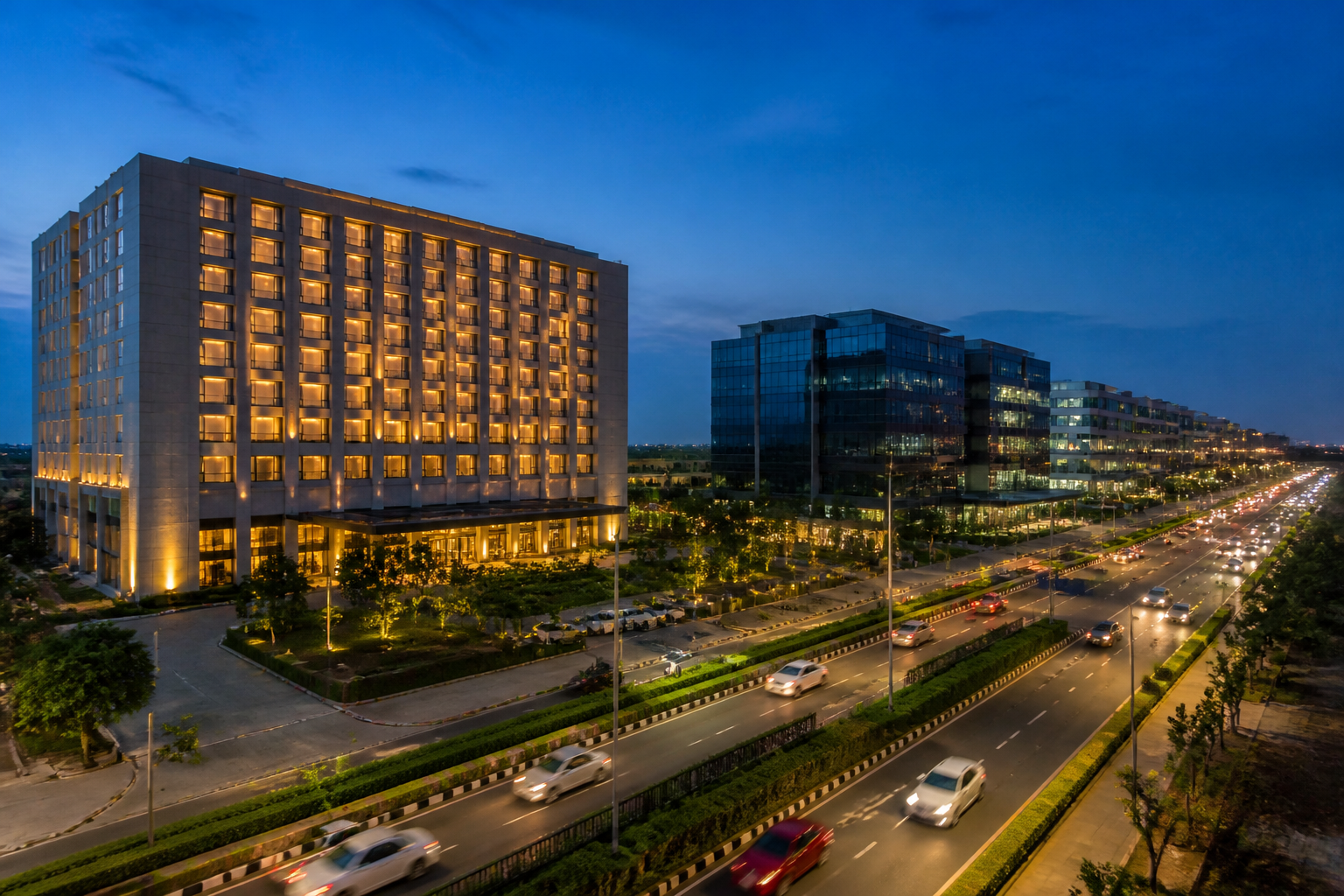
The most immediate project in the announced pipeline is a 380-room Taj hotel at Delhi Airport. Approximately 70 rooms are expected to open by the end of the current financial year, according to the report. The location places the project within an airport-linked urban environment, although the supplied material does not specify the site’s total built-up area, transport connections, development partners or expected opening date for the remaining rooms.
Other projects are scheduled further out. Ritz-Carlton Hyderabad, Hyatt Regency Airoli and a hotel in Udaipur are expected to come online in FY29. The recently announced Pune Yerawada project is targeted for FY31. These locations represent different urban and regional settings: an airport district, major metropolitan markets and a tourism-oriented city. However, the announcement does not establish whether the projects are at identical stages of planning, construction or approvals. The stated timelines should therefore be read as company targets rather than confirmed delivery dates.
The expansion of Athiva is the clearest sign of Chalet’s attempt to create an internal brand platform. Launched in 2025, Athiva initially had a pipeline of around 900 keys. The company has since added approximately 380 keys through projects announced in Pune and Hyderabad, taking the brand’s total pipeline to roughly 1,200-1,300 keys. Singh said Chalet was not conceptualising another hotel brand and would focus on establishing Athiva.
That decision suggests a preference for concentrating brand investment rather than widening the number of labels in the portfolio. The supplied material does not describe Athiva’s price segment, design standards, operating model or target customer. It therefore cannot establish how the brand will differentiate itself from the franchise and third-party-operated hotels that make up the broader pipeline. What is clear is that Athiva is intended to give Chalet a proprietary presence within a portfolio that will otherwise include established external brands.
The three-part model also distributes responsibilities differently. In a third-party-operated hotel, the property owner and the hotel operator may be separate entities, with the operator bringing brand recognition and management expertise. A franchise arrangement can give the property access to an established brand while leaving more operational responsibility with the franchisee. An own-brand project gives the developer greater control over positioning, but also requires it to build and maintain the brand itself. The report does not provide the precise contractual structures for Chalet’s projects, so the financial and operational consequences of each format cannot be quantified from the available evidence.
The company’s commercial real estate portfolio adds another layer to the strategy. Chalet currently has around 2.4 million square feet of commercial space in operation and another 900,000 square feet under construction. The overall portfolio is expected to reach approximately 3.2-3.3 million square feet. Singh said hospitality would remain the company’s main focus despite this commercial expansion, describing Chalet as “fundamentally a hospitality-first company”.
The figures indicate that Chalet is not expanding through hotels alone. Its operating portfolio includes both rooms and commercial floor space, two asset classes with different leasing, management and demand characteristics. The supplied report does not disclose the locations, occupancy levels, tenant mix or completion schedule of the commercial projects. It therefore cannot show how the office portfolio supports the hotel business, or whether the two segments are being developed as integrated mixed-use districts. It establishes only that commercial real estate is a significant and growing part of the company’s built-asset base.
The funding statement is central to the expansion plan. Singh said Chalet was well funded on its balance sheet and believed it could execute the announced projects without substantially increasing debt. This is a company assessment rather than an independently tested financing analysis. No debt level, cash balance, project cost, funding allocation or return target is provided in the supplied material. The statement does, however, indicate that the company sees its current pipeline as financially manageable without a major change in leverage.
The absence of a separate target for additional projects is also significant. Chalet is evaluating further greenfield and brownfield opportunities, but Singh said the announced pipeline remained the immediate focus. Greenfield development generally involves creating a project on previously undeveloped land, while brownfield opportunities involve an existing asset or developed site. The report does not identify any of the additional opportunities under evaluation, and none should be treated as part of the committed 5,500-key plan.
For cities, the key issue is not simply whether a hotel company adds rooms. It is how hospitality projects interact with land, mobility, employment, commercial development and local planning systems. Airport hotels depend on access and connectivity; hotels in major business districts depend on commercial activity; and properties in tourism-oriented locations depend on a different pattern of demand. Chalet’s pipeline spans these different contexts, but the available report does not provide enough information to compare their urban impacts or operating assumptions.
The expansion also illustrates the institutional complexity of hotel development. A project may involve a landowner, developer, hotel operator, brand owner, lenders, local authorities and planning agencies. In a hybrid model, these roles can be divided among different parties. That can allow a company to scale through partnerships, but it can also make accountability for construction, operations and service standards less straightforward. The supplied material does not detail the approval process or responsibilities attached to each project, so those questions remain open.
What the evidence confirms is a clear strategic direction. Chalet Hotels wants to increase its room inventory by roughly 62 per cent from its current operational base, based on the company’s stated figures, while expanding Athiva and retaining external hotel brands in its portfolio. It is also building a larger commercial real estate platform and evaluating further opportunities without adding them to the official pipeline.
What remains uncertain is equally important: whether the announced timelines will hold, how much of the pipeline is under construction, how the projects will be financed individually, and how the different operating models will perform. The next meaningful indicators will be the opening of the initial Delhi Airport rooms, progress on the FY29 projects, development milestones at Pune Yerawada and any updated disclosure on Athiva’s operating structure. Until then, the announcement is best understood as a strategic expansion plan rather than evidence of completed urban supply.
