


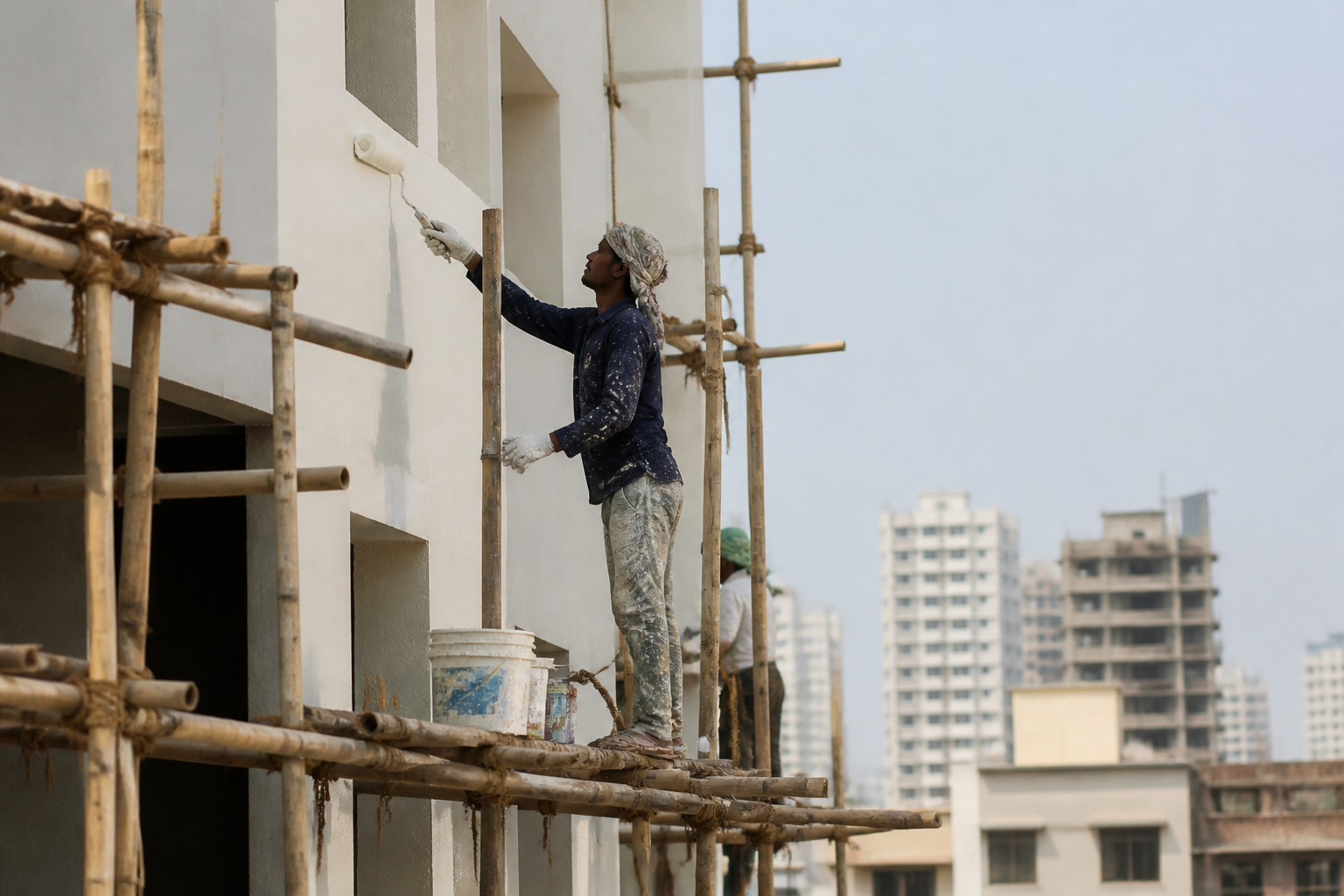
India’s leading paint manufacturers are entering the festive season with expectations of continued growth, but their outlook is being shaped by two opposing forces: sustained demand from housing, infrastructure and construction, and a more difficult operating environment marked by rising input costs and intensifying competition.
Asian Paints, Berger Paints, Kansai Nerolac Paints and JSW Dulux have indicated that demand remains supportive across important end-use markets. Their latest comments, reported by Moneycontrol from earnings calls and an interaction with company executives, suggest that the paint industry is still benefiting from activity linked to new homes, renovation, infrastructure projects and industrial applications. At the same time, companies are relying on price increases to protect revenue and margins as crude-linked raw materials become more expensive and competitors fight for market share.
The immediate story is therefore not simply one of festive demand. It is a reading of the wider construction and housing cycle through a material that sits at the intersection of new development, repair, renovation and industrial production. Paint demand can rise when homes are completed, occupied or refurbished, but the companies’ comments also show that demand growth does not necessarily translate into easier market conditions. Manufacturers are reporting healthy volumes while simultaneously facing pressure to discount, raise prices and manage uncertain costs.
Asian Paints, the country’s largest paintmaker, expects volume growth of 8-10 per cent for FY27. Managing Director and CEO Amit Syngle described demand conditions during the June quarter as “decent” and said the company expected the festive period to support sales, particularly from September. He also said the company expected volume growth to remain in the 8-10 per cent range through the third and fourth quarters.
The company’s reported financial performance was stronger than its volume guidance. Consolidated net profit rose 39.6 per cent to Rs 1,559.45 crore in the June quarter of FY27, while revenue from operations increased 18 per cent to Rs 10,541.94 crore. The difference between volume growth and revenue growth reflects the importance of pricing in the current cycle. Price increases taken during the first quarter are expected to support revenues in subsequent months, even as companies continue to compete for demand.
Syngle’s comments also point to a geographical shift in the pattern of demand. Growth in metro and large urban markets, described as T1 and T2 markets, trailed growth in smaller towns, or T3 and T4 markets. According to his assessment, the shortfall in larger cities was offset by strong government-led business-to-business spending. The observation does not establish a uniform slowdown in metropolitan construction, but it does indicate that demand is not moving at the same pace across India’s urban hierarchy.
This distinction matters for the built environment. Large cities contain substantial construction activity, but they also have higher levels of market saturation and more developed distribution networks. Smaller towns may offer a different combination of housing expansion, first-time purchases, repair work and dealer-led demand. The comments from Asian Paints suggest that the next phase of growth is not being driven only by the largest metropolitan markets.
Berger Paints expects double-digit revenue growth to continue through FY27. Its Managing Director and CEO Abhijit Roy said volume growth in the second quarter could be approximately 7.5-8 per cent, compared with 8.5 per cent in the first quarter. The company also referred to a price increase ranging from 7.5 per cent to 8.59 per cent. The full-quarter effect of earlier price increases is expected to support reported revenue.
Berger’s guidance illustrates the distinction between demand and pricing power. A company can maintain revenue growth even when volume growth moderates, provided price increases are absorbed by the market. But that relationship becomes more difficult when customers, contractors and dealers have multiple brands to choose from. Roy described competition as intense and challenging, suggesting that price increases are being implemented in a market where companies cannot assume that demand will automatically follow.
Asian Paints described competition as intense across economy, premium and luxury categories. The economy segment is particularly contested because companies use discounts to attract contractors and dealers. However, Syngle said the difference in competitive pressure between economy and premium products was not substantial. That assessment is significant because it indicates that competition is not confined to the most price-sensitive end of the market.
Over the past five to six years, new participants have entered the industry, including Pidilite through Haisha Paints, Grasim through Birla Opus and JSW Paints. The arrival of these players has widened the contest across price segments and distribution channels. For established manufacturers, the challenge is not only to preserve demand but also to defend relationships with dealers, contractors and other intermediaries who influence product choice.
The contractor and dealer network is especially important in the economy segment. Higher discounts can be used to convert contractors, making the market more competitive even when overall demand is healthy. This creates a structural tension for paintmakers: stronger demand can attract more companies, while greater competition can limit the extent to which manufacturers pass rising costs on to consumers.
Raw-material risk adds another layer of uncertainty. Petroleum-derived resources account for a large share of production costs, leaving paintmakers exposed to crude prices, geopolitical tensions and supply-chain disruptions. Kansai Nerolac Managing Director Pravin Chaudhari identified elevated crude prices, uncertainty over raw-material availability, rupee depreciation and higher import costs as key risks for the sector.
Kansai Nerolac had already taken an approximately 5 per cent price increase in the first quarter. Chaudhari indicated that decorative paints could see an additional increase of about 3 per cent in the second quarter, while industrial paints could see another increase of approximately 3-5 per cent. These increases show how companies are attempting to respond to cost pressures, but they also raise questions about how much of the increase can be absorbed across housing, construction, automotive and industrial markets.
The company nevertheless said demand from infrastructure, construction and automotive sectors remained supportive. This mix is important because it reduces the industry’s dependence on a single source of demand. Decorative paints are linked closely to housing and renovation, while industrial coatings are connected to manufacturing, infrastructure and automotive activity. The two categories can face different cycles, but both are exposed to the cost and supply conditions identified by the companies.
JSW Dulux, formerly Akzo Nobel India, also reported a positive demand environment. Joint Managing Director and CEO Rajiv Rajgopal said growth remained “fairly strong” and that July, typically a weak month because of a delayed monsoon, still produced healthy numbers. The company continued to target double-digit growth in both volume and value and said it expected festive demand to remain strong.
The reference to July and the monsoon highlights the seasonal character of the sector. Paint sales are influenced by weather, construction schedules and the timing of festive purchases. A delayed monsoon can affect activity, but the company’s comments suggest that the month still delivered healthy performance in the period under discussion. The evidence does not establish whether this pattern will continue, but it shows why companies are watching both seasonal demand and broader construction activity.
Taken together, the companies’ statements describe an industry with supportive demand but limited room for complacency. Housing, infrastructure, construction and automotive activity are providing a base for growth. Yet the same market is becoming more crowded, while crude-linked inputs, currency movements and import costs are creating pressure on pricing and supply planning.
For the built environment, the paint sector provides a useful indicator of how demand is distributed across cities and towns. The strongest growth is not necessarily concentrated in metropolitan markets, and government-led business-to-business spending appears to be supporting activity in larger cities. At the same time, smaller towns are recording stronger growth according to the Asian Paints assessment. The contrast suggests that India’s construction and housing cycle is geographically uneven rather than moving as a single national trend.
The available evidence confirms that paintmakers remain confident about festive demand and medium-term growth. It also confirms that volume expansion is occurring alongside price increases and intensified competition. What remains uncertain is how long companies can sustain double-digit value growth if input costs continue to rise, discounts remain high and volume growth moderates in some markets. The next earnings updates, further price movements and demand data from housing, infrastructure and automotive segments will show whether the current balance between growth and cost pressure holds.
