


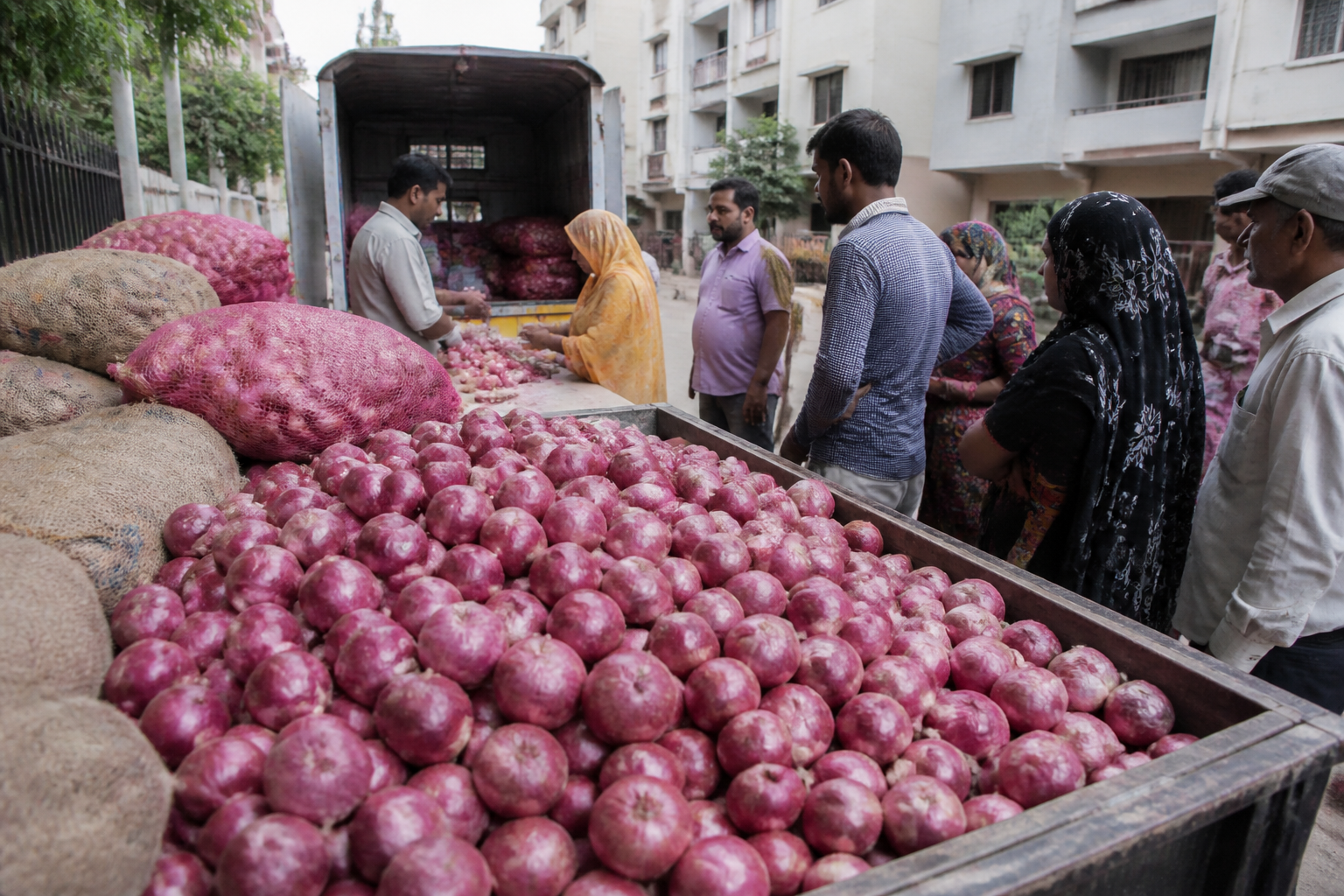
A government operation to release buffer onions into urban markets has moved 4,000 tonnes in its first 10 days, offering a limited test of how quickly public stocks can respond to food-price pressure. The intervention, reported by Aaj Tak Business from statements attributed to senior Consumer Affairs officials, has taken place across 17 cities, with onions sold at a subsidised retail price of Rs 35 per kilogram.
The immediate trigger was a sharp rise in onion prices across the country. The Union government used the National Cooperative Consumers’ Federation and the National Agricultural Cooperative Marketing Federation of India to move onions from its 2026 buffer stock into retail markets. The distribution has involved bulk movement from producing states to consumption centres, including a special train service called Kanda Express and road transport.
The reported figures show both the value and the limits of such an intervention. The government had built a 2026 onion buffer of 1.21 lakh tonnes through NCCF and NAFED. Of that stock, around 4,000 tonnes had been sold in the first 10 days of the retail operation. This represents a relatively small share of the total reserve, but its deployment has been concentrated in cities identified as price-sensitive markets.
The government’s stated objective is to moderate prices by placing lower-cost onions directly into the retail chain. According to the report, Consumer Affairs Secretary Nidhi Khare said the buffer onions had been distributed in 17 cities and that the exercise had provided some relief to consumers. The reported national average retail price declined from Rs 50.79 per kilogram before the release to Rs 48.50 per kilogram on August 28.
That change is significant as an indication of movement, but it does not establish that the buffer release alone caused the decline. Retail prices are shaped by supply arriving from producing regions, wholesale costs, transport, local distribution and daily demand. The supplied information records the timing of the government intervention and the subsequent average price movement, but does not provide a control comparison with cities that did not receive buffer onions or a breakdown of how much the public stock contributed to the national change.
The city-level figures also show why a national average can conceal uneven urban conditions. On September 5, the reported retail price was Rs 58 per kilogram in Delhi, Rs 53 in Mumbai, Rs 63 in Chennai and Rs 40 in Ranchi. The average wholesale price was reported at Rs 42.79 per kilogram. These numbers point to a substantial difference between cities, even while the government’s retail programme was operating across multiple markets.
The gap between wholesale and retail prices is particularly important for understanding how a buffer-stock policy reaches households. A public agency may release onions at a controlled rate, but consumers do not experience the national wholesale average. They encounter the price in a neighbourhood market, cooperative outlet, mobile van or other authorised sales point. The final price can therefore vary by city and by distribution channel.
The reported intervention also illustrates the logistical dimension of food-price management. Onions are a high-volume, perishable commodity whose prices can change quickly when supply and demand are out of balance. Moving them from producing states to large consumption centres requires coordination between procurement agencies, transport operators, local administrations and retail outlets. The use of Kanda Express indicates that the government is treating freight movement as part of the price-control response rather than relying only on stock release at the source.
According to the report, large consignments had reached Delhi and Chennai by rail, while a third consignment was being loaded for Guwahati. The reference to these destinations suggests that the distribution effort is being extended beyond the largest northern and western markets to the Northeast as well. However, the supplied material does not specify the quantity sent to each city, the number of retail outlets involved or the frequency with which individual consumers can purchase the subsidised onions.
NCCF’s reported role provides another view of the programme. Its managing director, Anees Joseph Chandra, said the federation had sold 1,500 tonnes at Rs 35 per kilogram through retail operations in different cities. Sales were being conducted through NCCF outlets, mobile vans, cooperative societies and platforms identified by local administrations. Agreements had also been made with some states to facilitate distribution.
The difference between the 4,000 tonnes reported as sold across the wider operation and the 1,500 tonnes attributed to NCCF indicates that more than one institutional channel is involved. It also underlines the importance of distinguishing between the total quantity released or sold through the programme and the quantity handled by an individual agency. The supplied report does not provide a complete agency-wise or city-wise accounting, so the precise distribution of the remaining volume cannot be established from the available information.
The use of multiple retail channels reflects a practical problem in urban food distribution. A centrally managed buffer cannot influence household prices unless it is physically available where people shop. Permanent stores may provide continuity, while mobile vans can move stock into localities without a fixed cooperative outlet. Local administrations can identify additional platforms, but the report does not state how these locations were selected or how the government is monitoring access and resale.
The programme therefore operates at two levels. At the national level, the buffer is a reserve created before a price shock becomes more severe. At the city level, it is a distribution system that must move stock through transport corridors and make it available through recognisable points of sale. The first level concerns how much onion is held. The second concerns whether that stock reaches consumers quickly, affordably and in sufficient quantity.
The price data supplied in the report show that the intervention has not produced a uniform retail outcome. Delhi, Mumbai and Chennai remained above the Rs 50-per-kilogram mark on September 5, while Ranchi was reported at Rs 40. Chennai’s reported price of Rs 63 was the highest among the four cities cited, despite the report also stating that a heavy consignment had reached the city through Kanda Express. This does not by itself demonstrate a failure of the programme, because the quantity, timing and retail coverage of the Chennai consignment are not provided. It does show that the arrival of public stock does not automatically translate into a single price across the entire urban market.
The figures also suggest that the government’s retail price of Rs 35 per kilogram is functioning as a targeted relief price rather than a new market-wide price. The reported retail rates in the four cities were higher, and the average wholesale rate was Rs 42.79 per kilogram. This distinction matters: subsidised sales can provide an alternative for consumers who can locate and access them, while ordinary private-market prices continue to reflect broader supply and distribution conditions.
The 1.21-lakh-tonne buffer gives the government room to continue releasing stocks if prices remain elevated. But the report does not establish how long the reserve will last, what quantity authorities plan to release next, or whether additional procurement will be needed. It also does not provide information on the cost of procurement, transport, storage or the fiscal burden of selling onions below prevailing retail prices. Those unanswered questions are central to assessing whether the measure is a short-term stabilisation tool or part of a longer food-supply strategy.
The policy framework relies on public agencies that combine procurement, storage, transport and retail distribution. NCCF and NAFED hold the buffer stock, while the Consumer Affairs Department oversees the broader price-management response. State governments, cooperative societies and local administrations become important at the point of sale. This arrangement spreads responsibility across institutions, but it can also make accountability difficult unless authorities publish clear information on volumes, destinations, prices and retail outlets.
For urban consumers, transparency is not a secondary issue. A subsidised price has practical value only when people know where the product is being sold and can purchase it without excessive travel or uncertainty. The supplied report identifies several channels but does not state their operating hours, geographic coverage or daily availability. Nor does it say whether the Rs 35 price applies uniformly at every participating outlet or whether limits are imposed on the quantity purchased by each household.
The onion intervention consequently offers a narrow but useful lesson in urban price governance. A buffer stock can create a supply cushion, and rapid transport can move that cushion toward cities experiencing higher prices. Yet the effect depends on the scale of the release, the timing of arrival, the reach of retail channels and the price conditions in each local market. National stock figures alone cannot show whether households are receiving meaningful relief.
What the available evidence confirms is that the government has released buffer onions in 17 cities, sold around 4,000 tonnes in the first 10 days, offered part of that stock at Rs 35 per kilogram and recorded a decline in the reported national average retail price. It also confirms that prices remained uneven, with major cities still recording rates above the subsidised price. What remains uncertain is the programme’s full city-wise impact, its cost, the quantity still available and whether the observed price decline will continue. Further official data on distribution volumes, outlet access and subsequent retail prices will determine how far the intervention has moved from emergency relief to sustained price stabilisation.
