


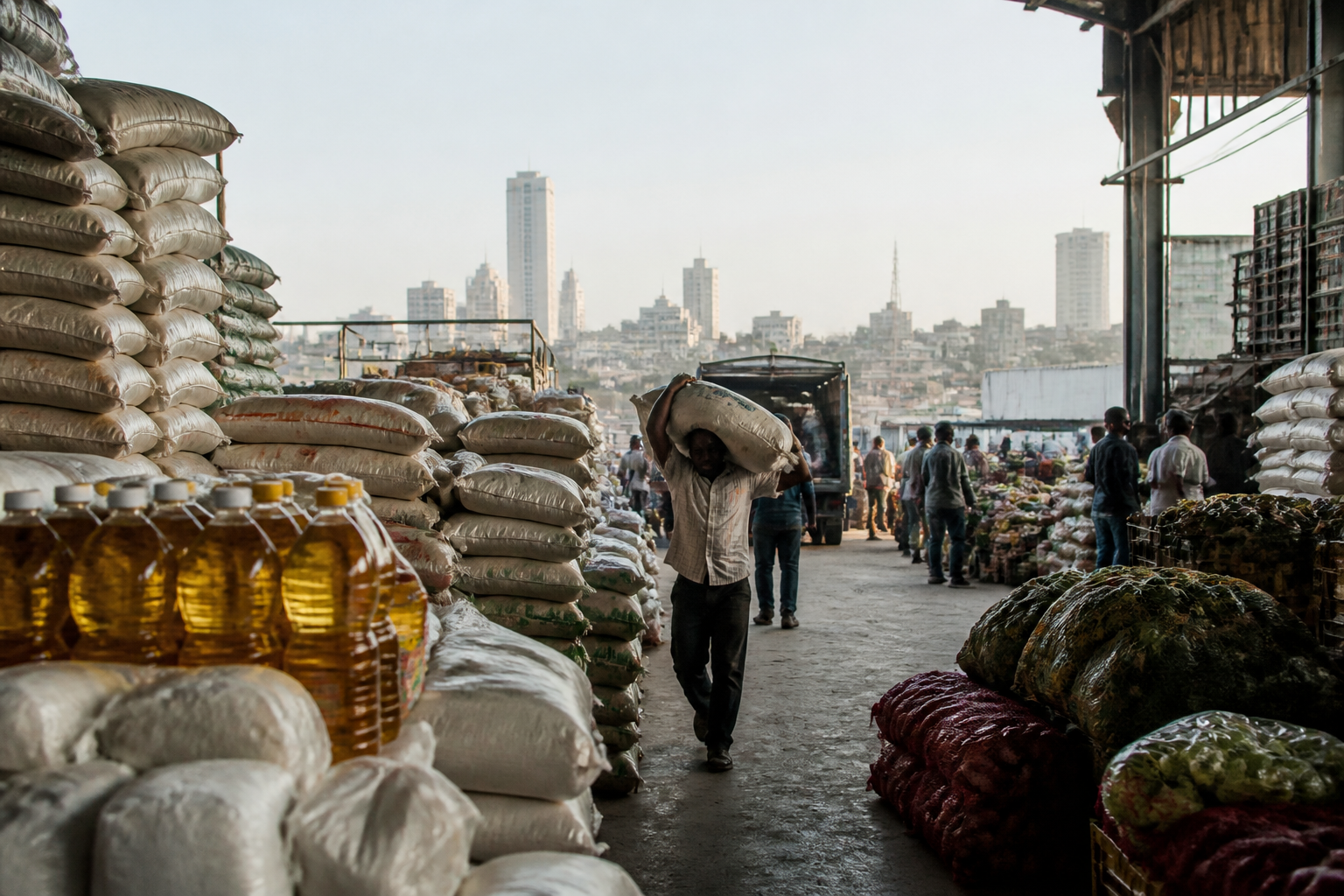
The latest rise in global food prices is not simply a commodities-market update. It is a signal that the systems feeding cities are becoming more exposed to simultaneous shocks: extreme weather, geopolitical conflict and disrupted trade routes. The Food and Agriculture Organization’s Food Price Index rose 1.9% in August to 133.3 points, its highest level since November 2022. The increase covered cereals, vegetable oils, sugar, meat and dairy.
The immediate event is clear. Internationally traded food commodities became more expensive during the month, while the FAO also reduced its forecast for global cereal production in 2026. But the significance for cities lies in the interaction between global supply and urban dependence. Cities rely on long, complex chains connecting farms, ports, storage facilities, processors, wholesalers, retailers and households. When several links face pressure at the same time, higher international prices can become a question of urban affordability and supply security.
The FAO index remains nearly 17% below its record level reached in March 2022 after Russia’s full-scale invasion of Ukraine. That comparison provides important context: the latest increase does not represent a return to the previous peak. It does, however, show that the risk premium in food markets is rising again after a period in which prices had moved lower from their record level.
FAO chief economist Maximo Torero described the development as a convergence of climate shocks, geopolitical tensions and disrupted trade logistics. That combination matters more than any single monthly movement. A drought can reduce harvest expectations. Conflict can interrupt shipments. Damage to a trade route can delay deliveries or raise freight and insurance costs. When these pressures occur together, markets begin pricing in uncertainty about whether supplies will arrive, when they will arrive and at what cost.
For urban consumers, those uncertainties usually appear after several stages of transmission. Importers and processors first face higher procurement or transport costs. Wholesalers and retailers then adjust purchasing and inventory decisions. Households encounter the result through prices for staples, cooking oils, sugar, dairy and other food products. The supplied FAO data does not establish how much prices changed in any particular Indian city, but it does identify the international pressures that can affect food systems serving urban populations.
The category-level movements show why the story cannot be reduced to one commodity. The cereal price index increased 2.2% in August from July, reaching its highest level since May 2024. Vegetable oils rose 0.6% to their highest level since June 2022. Sugar recorded the sharpest increase among the major categories, with its benchmark rising 11.9% to its highest level since June 2025.
These different movements suggest that food inflation can be driven by several distinct supply problems at once. Cereals are exposed to production forecasts and shipping disruptions. Vegetable oils are influenced by expectations for crops such as palm oil. Sugar prices are affected by output in major producing regions as well as weather conditions elsewhere. For cities, the practical consequence is that a broad food basket can face pressure even when the supply problem is concentrated in different places and products.
The climate-related risks described by the FAO report are geographically dispersed. Extreme heat and drought in Europe have raised concerns about maize and sugar beet harvests and livestock production. An anticipated El Nino weather pattern has contributed to fears of lower palm oil and sugar output in Asia. The report does not quantify the eventual production losses from these conditions, but it shows how weather expectations are already influencing market perceptions.
This is an important feature of modern food systems. Markets do not wait for a harvest failure to become fully visible before responding. Expectations about future production can affect prices, purchasing and stockpiling decisions in advance. For urban authorities and food businesses, that means resilience cannot be assessed only by looking at current shelves or current inventory. The capacity to monitor conditions, maintain storage and move supplies quickly becomes equally important.
Geopolitical disruption adds another layer. The continuing war between Russia and Ukraine has affected agricultural trade, while intensified attacks in the Black Sea have curtailed grain shipments from two major exporters, according to the report. The supplied material also says that the US-Iran conflict has placed additional pressure on fertiliser flows, with possible consequences for crop production. These disruptions connect food prices to transport corridors and agricultural inputs, not only to farmland.
That connection is particularly relevant to urban planning and governance. A city may have extensive retail infrastructure and a large consumer market, but it cannot be insulated from disruptions that occur before food reaches its distribution network. Ports, roads, railways, warehouses, cold chains and wholesale markets all form part of the urban food system. The FAO findings do not measure the performance of these assets in any specific city, but they underline how dependent urban populations are on infrastructure beyond municipal boundaries.
The production forecast adds a longer-term dimension to the monthly price increase. The FAO cut its forecast for global cereal production in 2026 by 3.4 million metric tons from its July estimate, bringing the projection to 2.980 billion tons. The revised figure is 2% below 2025 production and represents the largest annual decline since 2018. At the same time, production would still be the second-highest on record.
Those figures present a mixed picture rather than a simple shortage narrative. The expected decline is significant because it marks a reversal from the previous year and the largest annual reduction in several years. Yet the projected output remains historically high. This means the evidence supports a conclusion about tightening expectations and increased vulnerability, not a claim that global cereal supplies have entered an unprecedented collapse.
The stock forecast points in the same direction. The FAO lowered its estimate for global cereal stocks at the end of the 2026-27 season by 1.1% to 947.2 million tons. The revised level is only marginally above the previous season. A reduction in coarse-grain stocks outweighed an upward revision to wheat inventories. The agency said the higher wheat estimate reflected expectations of stockpiling in Russia and Ukraine as shipping disruptions hamper exports.
Stocks provide a buffer when production or transport is interrupted, but the supplied material does not establish how those reserves are distributed across countries, markets or income groups. A global stock figure therefore cannot by itself show whether a particular city or household is protected from price volatility. What it does show is that the margin above the previous season is limited, while some producers are accumulating wheat partly because trade routes are under pressure.
This distinction matters for public policy. Food security is not only a question of producing enough food globally. It also involves access, movement, storage and affordability. The report’s evidence is strongest on the first stages of the chain: international prices, production expectations, stocks and disruptions affecting exporters. It does not provide data on urban retail prices, municipal food procurement, household expenditure or the effect on vulnerable residents. Those gaps should be acknowledged rather than filled with assumptions.
The institutional landscape is correspondingly distributed. The FAO tracks internationally traded commodities and produces forecasts on production and stocks. National governments and their agencies manage domestic trade, imports, food reserves and agricultural policy. State and municipal authorities are more directly connected to wholesale markets, local distribution, transport conditions and welfare delivery. Private firms operate much of the procurement, storage, processing and retail network. The latest data shows how these responsibilities intersect, but it does not establish how any particular government or city is responding.
For urban systems, the central lesson is that resilience has multiple layers. A city can face pressure even when its own boundaries contain no farm affected by drought or conflict. It can be exposed through imported commodities, fertiliser shortages, shipping delays, fuel and logistics costs, or decisions by suppliers to hold inventory. The infrastructure visible to residents—markets, shops and delivery networks—is the final part of a much longer chain.
The August increase therefore deserves attention not because it proves a universal food crisis, but because it reveals how quickly different risks can converge. The index rose across all the major categories identified in the report. Cereal production forecasts were reduced. Stock projections were lowered. Trade routes remained vulnerable. Climate concerns affected expectations in Europe and Asia. Taken together, the evidence describes a food market with less room for complacency than the record comparison alone might suggest.
What remains uncertain is how these international movements will translate into national and city-level prices. The supplied material does not provide country-specific data, details of domestic policy responses or evidence on how retailers and households are adapting. It also does not establish whether the projected production decline will materialise at the forecast level. Those questions require the underlying FAO reports, domestic price data and information from relevant authorities.
The developments to monitor are therefore specific: future FAO revisions to cereal production and stocks, the progress of harvests affected by heat and drought, sugar and palm-oil output, grain shipments through the Black Sea, fertiliser flows and the movement of international food-price indices. For cities, the corresponding indicators are wholesale and retail prices, inventory levels, transport reliability and the affordability of essential food baskets. The latest evidence confirms renewed pressure in global food markets; it does not yet establish the full local impact.
