


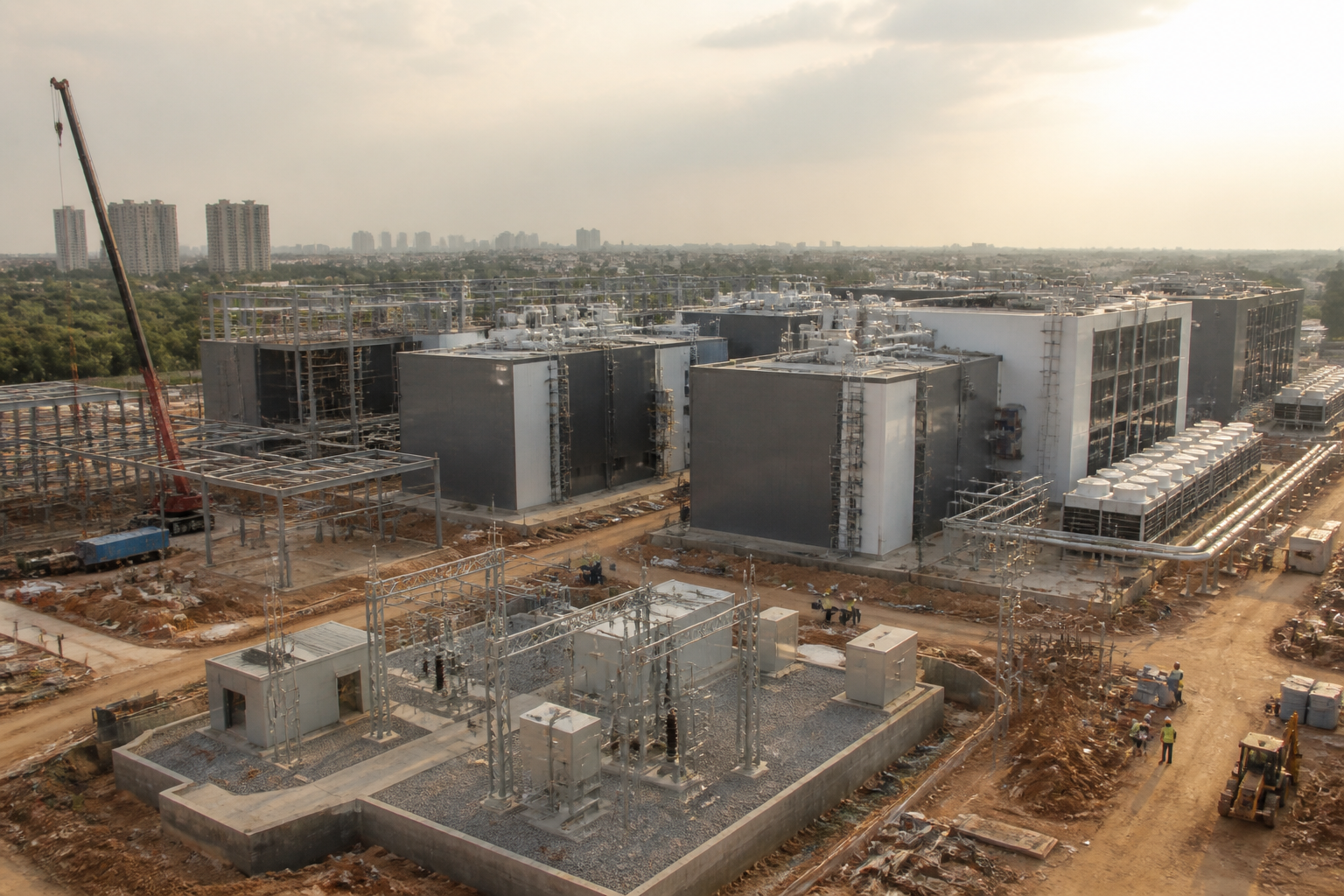
Hyderabad’s selection for HyperVault’s proposed 1 GW artificial intelligence data centre campus places the city at the centre of a new infrastructure race—one in which land, electricity, cooling systems, water management, construction capacity and specialised talent must be assembled at the same location.
HyperVault, the data centre subsidiary of Tata Consultancy Services (TCS), has secured 264 acres in Hyderabad for the campus. The company and its partners are expected to invest up to ₹70,000 crore to develop and manage the infrastructure. The project will be built in phases, with the pace of construction linked to customer demand and technology requirements.
The announcement is significant not only because of its scale, but also because it points to a change in what large urban infrastructure must support. The campus is intended for frontier artificial intelligence companies and hyperscalers, with high-density graphics processing unit deployments for AI training, inference and advanced computing workloads. That requirement is different from building a conventional office or a standard server facility. It involves concentrated computing capacity, large power blocks, advanced cooling and networks capable of handling demanding workloads.
TCS Chief Executive Officer and Managing Director K Krithivasan said HyperVault would advance the company’s “Infrastructure-to-Intelligence strategy” by combining AI-ready infrastructure with TCS’s cloud, engineering, enterprise transformation and AI capabilities. He said Hyderabad offered the scale, talent and ecosystem needed to serve global customers.
The statement places the project within a broader corporate strategy, but the urban consequences will depend on how the campus is planned and connected to the city. The supplied announcement does not specify the site’s precise location, the schedule for each construction phase, the expected power demand at different stages, or the infrastructure investments required outside the 264-acre campus. Those details will determine how far the project’s benefits extend beyond its boundary and what additional demands it places on Hyderabad’s systems.
## A new kind of urban infrastructure
Data centres have traditionally been understood as specialised technology facilities. An AI data centre, however, is also a major industrial and utility project. The campus announced by HyperVault is designed around high-density GPU deployments and larger power requirements. Its physical performance will therefore depend on the reliability of electricity supply, the availability of suitable cooling systems, network connectivity, construction expertise and a workforce able to operate the facility.
HyperVault Chief Executive Officer and Managing Director Deepesh Kiran Nanda said the company was building infrastructure for “higher density, liquid cooling, larger power blocks and faster deployment”. The statement identifies four design priorities, but it does not quantify the capacity or configuration of the systems involved. It does establish that the campus will be planned for a different operating environment from lower-density computing facilities.
The project also highlights the land question. Securing 264 acres gives the company room to create a large campus and develop it in phases. At the same time, the scale means that site access, construction logistics, utility corridors and connections to existing urban infrastructure will become important parts of implementation. The announcement does not disclose whether those requirements will be handled entirely within the campus or through new public and private infrastructure around it.
For Hyderabad, the project creates an opportunity to deepen the city’s role in advanced computing and related industries. Telangana Chief Minister A Revanth Reddy described the development as historic and said access to AI models and compute was becoming public infrastructure. His statement frames the campus not merely as a private real estate or technology investment, but as part of a wider competition to attract the infrastructure that supports digital production.
That framing raises a practical question: how much of the project’s capacity will serve local and national users, and how much will be dedicated to global customers? The announcement identifies frontier AI companies and hyperscalers as the intended users, but does not provide a customer list, contracted capacity or operating model. Those factors will be necessary to assess the campus’s wider economic role.
## Power, water and the resource footprint
The most consequential urban issue is likely to be the relationship between computing demand and basic utilities. The announcement says the campus will use green energy and water-neutral design principles. These commitments indicate that energy sourcing and water management have been considered in the project’s design, but the supplied material does not define how green energy will be procured, how water neutrality will be measured, or what technologies and supply arrangements will be used.
That lack of detail is important because the project will be built in phases and its final capacity could reach 1 GW. The difference between an initial phase and full build-out may be substantial. Power procurement, backup systems, cooling infrastructure and water management will have to expand alongside the computing capacity. The announcement does not state the construction schedule, the expected commissioning dates or the milestones that will govern expansion.
The water-neutrality commitment also requires a clear operational definition. It could involve reducing freshwater use, recycling water, using alternative sources or balancing consumption through other interventions, but the report does not specify which approach HyperVault will adopt. Without those details, the commitment remains a stated design principle rather than a measurable performance standard.
The same applies to green energy. The announcement identifies it as part of the build-out but does not indicate whether the campus will rely on dedicated renewable generation, contracted renewable power, a combination of sources or other arrangements. The project’s environmental performance will depend on these choices as well as on the efficiency of its cooling and computing systems.
## From campus investment to city-wide ecosystem
The project is expected to create several thousand direct and indirect jobs and catalyse activity across power, cooling, networking, construction, engineering and operations. Those sectors are closely connected to the built environment. A campus of this scale will require civil works, electrical systems, mechanical equipment, specialised installation, network infrastructure and long-term maintenance.
The employment claim is significant, but the announcement does not provide a breakdown between construction-period jobs and permanent operational roles. Nor does it specify the skills required, the share expected to be filled locally or the training mechanisms that may support recruitment. Those distinctions will matter when evaluating how the investment changes Hyderabad’s labour market.
The project’s institutional history also shows how quickly large infrastructure deals can move from political contact to a formal partnership. Telangana Industries and Information Technology Minister D Sridhar Babu said the agreement developed from a conversation between the Chief Minister and Tata Sons Chairman N Chandrasekaran at Davos in January. He said officials, HyperVault and TCS advanced the partnership within a few months.
That speed may help Hyderabad compete for capital and technology infrastructure. It also places greater importance on the implementation framework that follows an announcement. Land has been secured, but the public information available in the report does not yet establish the detailed approvals, utility commitments, construction packages, financing structure or accountability mechanisms for the full campus.
TCS announced its entry into the data centre segment last year through the formation of HyperVault. Private equity player TPG is investing $1 billion in the business. The new campus therefore forms part of a larger corporate expansion rather than an isolated real estate project. Its eventual scale will depend on how that business develops, how quickly customer demand materialises and how the planned phases are financed and executed.
## What the announcement confirms—and what remains open
The announcement confirms that HyperVault has selected Hyderabad, secured 264 acres and plans a phased AI data centre campus with capacity of up to 1 GW. It also establishes the stated investment potential of ₹70,000 crore, the intended focus on high-density AI workloads, and the company’s commitments to green energy and water-neutral design principles.
It does not yet establish when the first phase will be operational, how much capacity it will contain, where the campus is located within Hyderabad, or what utility infrastructure will be required outside the site. It also does not provide independently reported data on expected power consumption, water use, job composition, customer commitments or the project’s financing beyond the reported TPG investment in the broader HyperVault business.
Those unanswered questions are not peripheral. They will determine whether the campus functions as a self-contained technology facility or becomes the anchor for a wider industrial and infrastructure cluster. They will also shape the city’s responsibilities around power reliability, water management, transport access, construction oversight and workforce development.
Hyderabad’s AI data centre plan is therefore best understood as an infrastructure proposition whose importance will be decided during implementation. The next significant milestones will be the disclosure of the project’s phased capacity, construction and commissioning timetable, utility arrangements, environmental design metrics and the institutional agreements that connect the campus to the city. Until then, the announcement signals ambition and scale, while many of the conditions for delivery remain to be specified.
