


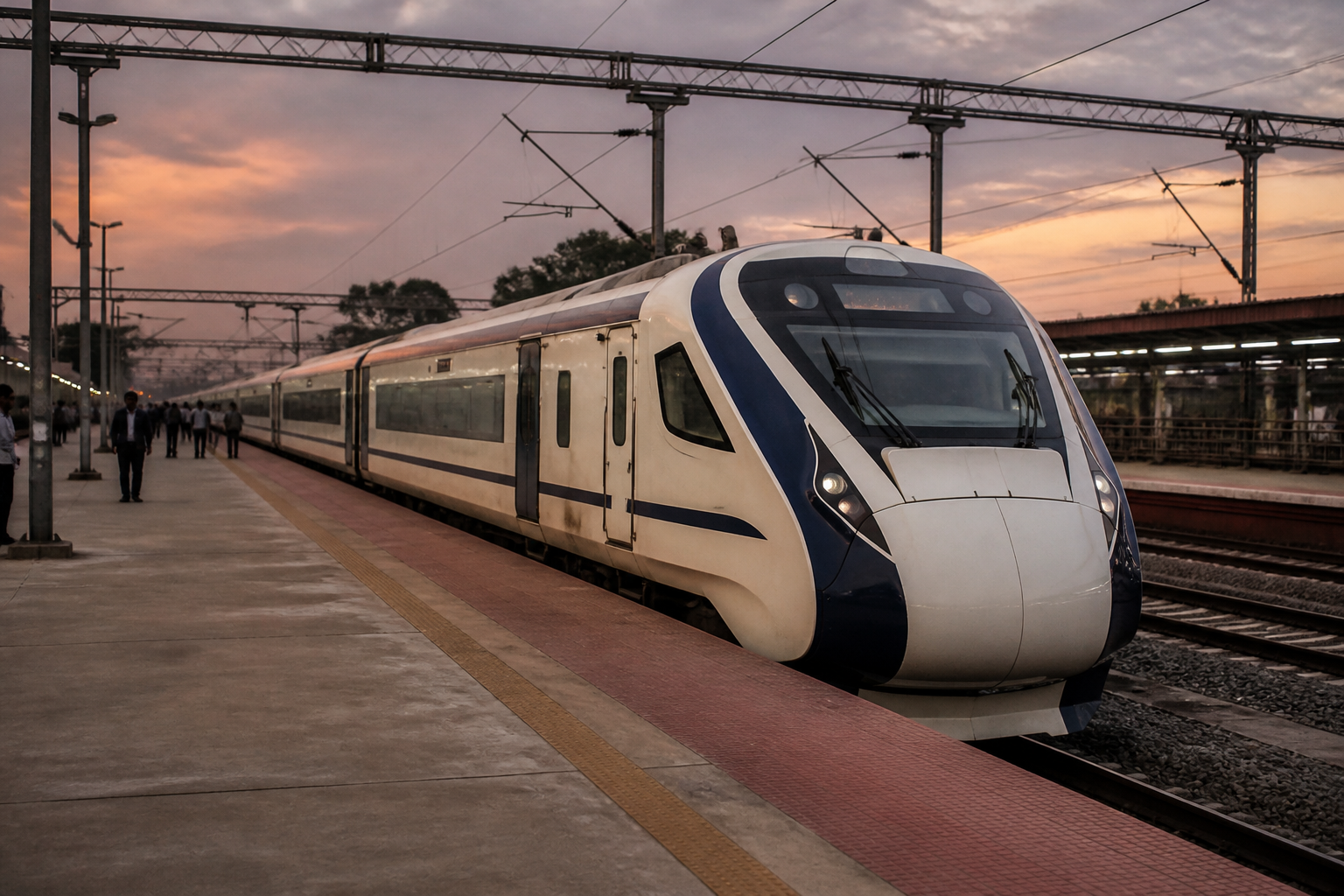
The planned production of 260 Vande Bharat sleeper trainsets marks a significant expansion of Indian Railways’ effort to bring semi-high-speed services to long-distance overnight travel. The programme is larger than the current operational footprint of the sleeper variant and places equal emphasis on train design, manufacturing capacity and the railway infrastructure needed to use its speed potential.
The Vande Bharat programme began in 2019 with daytime chair-car services. Its sleeper version extends the model to routes where passengers travel overnight and where the value of a faster train depends not only on onboard comfort, but also on track capability, signalling, maintenance and timetable integration. The first Vande Bharat sleeper trains entered service on the Guwahati-Howrah route earlier this year, according to the supplied report. A second trainset is undergoing trials, while reports have mentioned Bengaluru-Mumbai as a possible route without official confirmation from the railway authorities.
Under the current production plan, 260 Vande Bharat sleeper rakes will be built by multiple companies and railway production units. Bharat Earth Movers Limited, or BEML, has been assigned 10 trainsets. Chennai’s Integral Coach Factory is to produce 50, while Kinet Railway Solutions is responsible for 120 and the Titagarh-BHEL partnership for 80. The distribution indicates that the expansion is not being treated as a single-factory programme. It involves public-sector production units, state-linked companies and private-sector manufacturing partnerships.
BEML’s initial trains are planned as 16-coach sets. The Integral Coach Factory’s allocation involves 24-coach trains, including a pantry car. The variation matters because a trainset’s length, seating and sleeping capacity, catering provision and maintenance requirements affect which routes it can serve and how it can be incorporated into existing railway operations. The supplied report says production drawings for the ICF sets have been prepared.
The largest allocation is linked to Kinet Railway Solutions, a joint venture between Rail Vikas Nigam Limited and Russia’s Transmashholding. The 120 trainsets are planned for manufacture in Latur, with each set comprising 16 coaches. According to the report, manufacturing has begun. It also cites RVNL chairman Salim Ahmed as saying at the company’s 23rd annual general meeting that the prototype deadline had been revised from June 2026 to March 31, 2027.
That revised deadline is important because the expansion cannot be measured only by the number of trainsets included in a plan. Before a new train can carry passengers, the prototype must complete testing, certification and operational preparation. The supplied material does not establish when all 260 sets will enter service, which routes will receive them or how the production schedule will be sequenced after the prototype stage. Those details remain central to assessing the programme’s practical reach.
The sleeper train has a design speed of 180 kilometres per hour. Its actual operating speed may be up to 160 kilometres per hour, depending on the route and the available railway infrastructure. This distinction separates the train’s engineering capability from the speed passengers will experience in regular service. Track geometry, signalling, level-crossing arrangements, curves, station approaches and other route conditions determine how much of the design capability can be used.
The train uses a distributed-power system rather than relying on a separate locomotive to haul the coaches. Traction equipment is distributed across the train, allowing it to accelerate and brake differently from a conventional locomotive-hauled rake. The supplied report describes this as a system intended to support faster acceleration, quicker braking and higher average speeds. These benefits, however, depend on the wider railway system being able to accommodate them. A faster train operating on infrastructure with frequent speed restrictions may not deliver a proportionate reduction in end-to-end journey time.
The 16-coach prototype described in the report includes 11 air-conditioned three-tier coaches, four air-conditioned two-tier coaches and one air-conditioned first-class coach. Its passenger features include cushioned berths, a redesigned arrangement for reaching upper berths, night lighting, integrated announcements, display panels, closed-circuit television, a modular pantry, reading lights, charging points and refreshment tables.
The design also includes sealed gangways and automatic interconnecting doors. Automatic passenger doors are intended to open at designated stations. Bio-vacuum toilets and a separate washroom for passengers with disabilities are listed among the facilities. The first-class coach is reported to include showers and hot water. These features position the sleeper variant as a premium overnight service, but the supplied material does not provide fares, occupancy assumptions or a comparison of operating costs with existing Rajdhani or other long-distance services.
Safety systems identified in the report include Kavach, regenerative braking, centralised coach monitoring and an emergency communication system. Their presence is part of the train’s stated technical configuration. It does not, by itself, establish the readiness of every route on which the trains may eventually operate. The deployment of any train equipped with modern safety systems still requires compatibility with the route’s signalling, track and operational arrangements.
This is the central infrastructure question raised by the 260-rake plan. The expansion of sleeper train production creates the possibility of more overnight services, but the number of trains manufactured will not automatically translate into a comparable number of faster passenger journeys. The system must match rolling stock with routes that can support the relevant speeds, depots that can maintain the trainsets, stations that can handle their formations and schedules that allow them to operate efficiently.
The manufacturing structure also creates an institutional coordination challenge. ICF, BEML, Kinet Railway Solutions and the Titagarh-BHEL partnership will be working with different production capacities and trainset configurations. A programme involving 16-coach and 24-coach sets will require consistent standards for passenger information, maintenance, spare parts, crew training and operational procedures. The supplied report does not provide a consolidated delivery calendar or identify how the different production streams will be integrated into a national deployment plan.
For passengers, the immediate significance is that overnight rail is being treated as a field for higher-speed and more modern rolling stock rather than only for incremental upgrades to conventional trains. A sleeper service can connect distant cities while using night-time travel to reduce the time passengers spend away from their origin or destination. Whether that potential is realised will depend on route selection, punctuality, fare levels, service frequency and the capacity of the underlying railway network.
The Bengaluru-Mumbai possibility illustrates the difference between reported expectations and confirmed deployment. The route has been mentioned in connection with the second sleeper trainset, but the railway has not officially confirmed it in the supplied material. Treating it as final would therefore overstate the evidence. The same caution applies to the broader expansion: 260 trainsets are part of the reported plan, while the timing of passenger operations and the routes to be served remain subject to production, trials, certification and railway preparation.
The evidence currently confirms an ambitious manufacturing plan, an operating concept centred on semi-high-speed overnight travel and a set of prototype features aimed at improving comfort and safety. It does not yet establish the final network map, the complete delivery schedule or the journey-time gains passengers will receive on individual corridors. Those are the developments that will determine whether Vande Bharat sleeper trains become a broad transformation of overnight rail or remain concentrated on a limited number of infrastructure-ready routes.
