


Subheadline: A new ICCT study estimates that faster electric-vehicle adoption could cut India’s road-transport import bill by up to 82% by 2050, but the scale of the savings depends on how quickly the transition reaches every vehicle segment and how much battery manufacturing moves onshore.
Standfirst: India’s electric-vehicle transition is usually discussed through the language of emissions, charging networks and consumer adoption. The new International Council on Clean Transportation study adds another measure: the country’s exposure to imported oil and batteries. It estimates that accelerated EV adoption could reduce vehicle-related imports from USD 153 billion to USD 59 billion by 2050, even if batteries continue to be imported. If rapid electrification is combined with domestic battery manufacturing, the annual savings could reach about USD 125 billion, equivalent to an 82% reduction in the road-transport import bill. The analysis examines what those scenarios reveal about India’s mobility system, the timing of battery demand and the policy challenge of aligning vehicle adoption with manufacturing capacity.
The study, titled “India’s EV transition: Impact of electric vehicle battery demand on import payments from 2024 to 2050”, was released on Wednesday by the ICCT, a nonprofit research organisation. Its central finding is straightforward: replacing petrol and diesel vehicles with electric vehicles can reduce India’s dependence on imported oil by more than the country would spend importing batteries for those vehicles.
That conclusion shifts the terms of the EV debate. Battery imports are often presented as a new external vulnerability that could replace one form of dependence with another. The ICCT modelling suggests that, across the scenarios it tested, the reduction in imported petrol and diesel is substantially larger than the cost of imported batteries. Domestic battery manufacturing can increase the benefit, but the study identifies electrification itself as the first source of import savings.
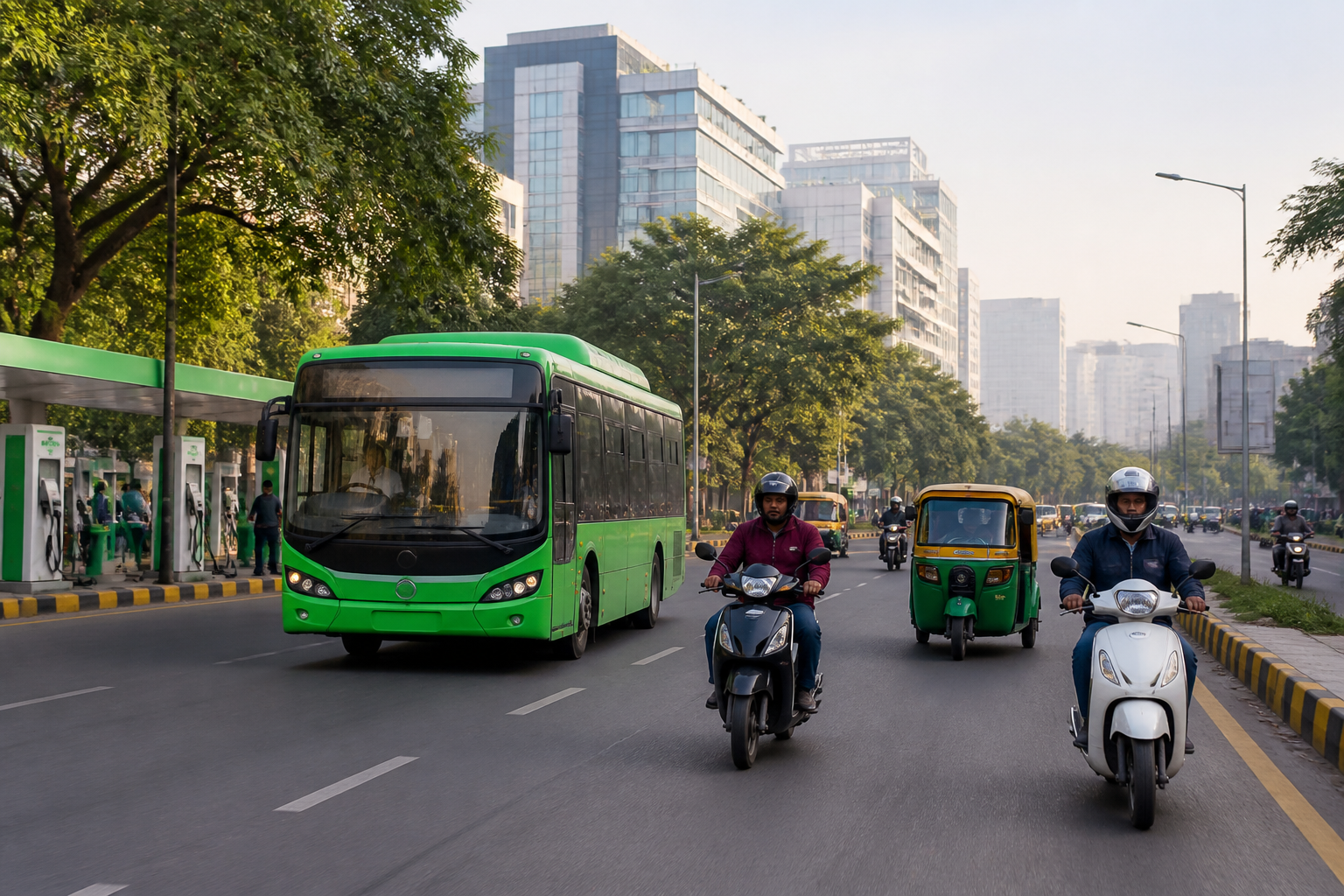
The findings apply across India’s on-road vehicle system rather than only to private cars. The study models battery demand for two-wheelers, three-wheelers, passenger cars, light commercial vehicles, buses and trucks. This is important for an urban transition in which the most widely used vehicles are not necessarily passenger cars. Two- and three-wheelers are central to everyday mobility and commercial activity, while buses and light commercial vehicles connect public transport and urban logistics to the wider transport economy.
The study tests three EV adoption pathways: baseline, momentum and ambitious. It also tests four levels of domestic battery supply: no localisation, slow localisation, announced localisation and high localisation. The localisation scenarios represent different levels of domestic cell-manufacturing capacity, based on India’s announced manufacturing-capacity targets. Together, the scenarios are designed to distinguish the effect of faster vehicle electrification from the additional effect of producing more batteries within the country.
Across all the pathways, battery demand rises steeply after 2030. Under the baseline scenario, it reaches roughly 340 gigawatt-hours by 2050. Under the momentum and ambitious scenarios, it reaches about 573 gigawatt-hours. The difference between these figures indicates the scale of the manufacturing and supply-chain challenge that accompanies a faster transition. More EVs reduce oil demand, but they also create a much larger requirement for batteries and the industrial systems needed to produce, transport and integrate them.
The import figures provide the study’s clearest measure of the stakes. Even without assuming that India manufactures its batteries domestically, faster EV adoption could reduce vehicle-related imports by around 61%, from USD 153 billion to USD 59 billion by 2050. The study attributes this reduction primarily to lower imports of petrol and diesel. In the model, the change in the vehicle fleet therefore matters more immediately than the location of battery production.
The higher savings scenario combines rapid EV adoption with domestic battery manufacturing. Under that pathway, the reduction in India’s road-transport import bill could reach 82%, equivalent to about USD 125 billion annually by 2050. The result does not mean that every vehicle segment will electrify at the same pace or that the savings will arrive evenly over time. It is a scenario-based estimate whose outcome depends on the adoption pathway, the evolution of battery demand and the amount of manufacturing capacity that is actually built.
That distinction is essential. Announced localisation is not the same as operational localisation, and battery demand is not the same as battery production. The study uses the announced manufacturing-capacity targets as the basis for its localisation scenarios, but the supplied material does not establish how much of that capacity has been commissioned, how competitive it will be or how quickly it can supply each vehicle segment. The import benefit from domestic production consequently remains linked to implementation, not merely to policy intent.
Amit Bhatt, the ICCT’s India managing director, framed the relationship between electrification and external economic risk in a statement accompanying the study. “The faster India electrifies, the less exposed it is to global crude price shocks, and the stronger its case for ‘Aatmanirbhar Bharat’,” he said. Bhatt added that localising battery manufacturing would add value, but that the pace of the transition was the first protection for India.
Namita Singh, a researcher and co-author of the study, made a similar point about the order of priorities. “Every electric vehicle India puts on the road reduces its dependence on imported oil, whether the batteries are manufactured domestically or imported,” she said. According to Singh, accelerated EV adoption alone could cut India’s road-transport import bill by 61% by 2050, while combining rapid manufacturing with domestic battery production could raise the savings to 82%.
The policy landscape implied by the study has two connected tracks. The first is vehicle adoption across all the road-transport segments included in the model. The second is the creation of domestic cell-manufacturing capacity. Treating the second track as a prerequisite for the first could slow the immediate reduction in oil dependence; treating it as unnecessary would leave India exposed to imported batteries as demand expands. The study’s scenarios suggest that the two objectives are complementary, but not interchangeable.
For cities, this matters because the transition will be experienced through fleets, streets and daily services rather than through national import accounts alone. Electric two- and three-wheelers can affect how people travel and how goods move. Electric buses can alter the energy requirements of public transport. Commercial vehicles can influence the operating costs and supply chains of urban businesses. The supplied study does not quantify these separate urban effects, but its decision to model multiple vehicle categories shows why passenger-car adoption alone cannot represent the full transport transition.
The timing of battery demand also complicates the policy question. Demand rises sharply after 2030 in every scenario, reaching hundreds of gigawatt-hours by 2050. That gives policymakers and manufacturers a long preparation window, but it also means that the scale of future demand is already embedded in current decisions about vehicle markets and industrial capacity. A transition that appears gradual in its early years can produce a much larger manufacturing requirement later.
The study therefore presents EV adoption as both a mobility shift and an import-management strategy. Its evidence supports three conclusions. First, faster electrification can reduce India’s dependence on imported oil even when batteries are imported. Second, domestic battery manufacturing can materially increase the size of the savings. Third, the largest effects depend on adoption across multiple vehicle segments, not on a single category of buyer or vehicle.
What the study does not establish in the supplied material is how quickly the transition will occur, which segments will lead it, or whether announced battery capacity will meet the projected demand. It also does not provide a city-by-city assessment of charging infrastructure, electricity supply, vehicle ownership or public-transport operations. Those questions remain important for implementation, but they are separate from the import-payment estimates presented by the ICCT.
The next phase of scrutiny will consequently concern delivery: the pace of EV adoption, the conversion of high-use vehicle categories and the development of domestic cell-manufacturing capacity. The ICCT’s modelling makes the economic opportunity clear, while its scenarios also show the scale of the industrial system India would need to build if it wants the full import savings by 2050.
