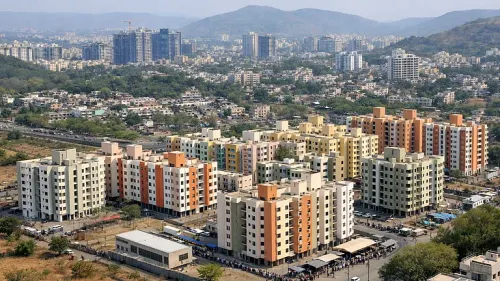
A new pool of 4,462 homes has entered Pune’s affordable housing market through a computerised lottery, giving eligible households another route to home ownership across Pune and Pimpri-Chinchwad. The scheme spans locations from Katraj and Hadapsar to Kharadi, Baner, Wakad and Punawale, placing public housing supply directly within some of the region’s fastest-growing urban corridors. MHADA’s Pune Board has opened registrations for the exercise.
Applications opened on August 24 and will remain available until 11:59 pm on September 15. Applicants can also submit the required earnest money deposit through the specified online channels within the prescribed deadline. The provisional applicant list is scheduled for September 29, followed by a window for objections. The final list is expected on October 8, with the lottery draw scheduled for October 13. The Pune housing lottery covers homes intended for economically weaker and lower-income households. The stated income ceiling is up to ₹6 lakh a year for the Economically Weaker Section and up to ₹9 lakh for the Low Income Group. Income documentation must relate to the specified assessment period, while married applicants are assessed on combined household income. Geographically, the housing stock reflects the changing shape of Pune’s urban economy. The Pune Municipal Corporation area includes established neighbourhoods such as Warje, Pashan, Bibwewadi and Kondhwa, alongside expanding areas including Manjari Khurd, Undri and Lohegaon. In Pimpri-Chinchwad, the list reaches growth centres such as Moshi, Tathawade, Ravet, Chikhali, Punawale and Wakad.
That spread matters because affordable housing is increasingly a question of location, not simply price. A lower-cost dwelling can become financially difficult if residents face long daily commutes, expensive transport or limited access to schools, healthcare and employment. Urban planners therefore see transport connectivity and neighbourhood infrastructure as critical complements to housing supply. The Pune housing lottery also arrives as development continues to move towards the city’s peripheral corridors. New residential construction in these areas can support broader housing access, but it can also increase pressure on roads, public transport, water systems, drainage and social infrastructure if population growth outpaces civic investment.
The lottery model provides a transparent mechanism for allocating a limited public housing stock, but the larger challenge remains supply. Pune’s expanding employment base continues to attract households across income groups, increasing pressure on both ownership and rental markets. The immediate milestone is the application and verification process. Longer term, the value of this housing programme will depend on whether affordable homes are connected to reliable public transport and essential services, allowing lower-income households to gain not only a dwelling but a practical place within Pune’s wider urban economy.