


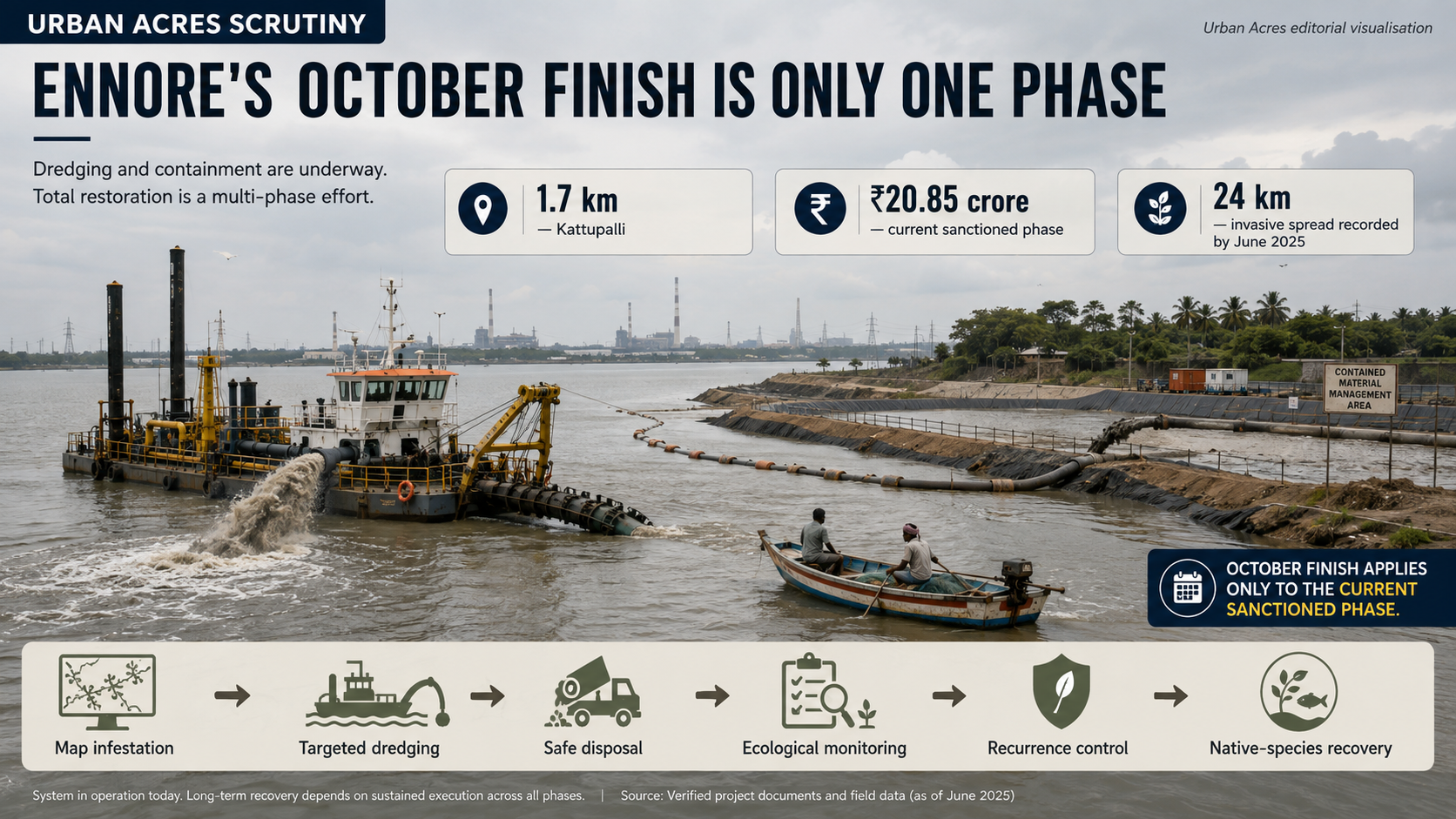
The Water Resources Department is targeting October 2026 to complete an ongoing phase of dredging in the Ennore backwaters, where an invasive mussel has spread through fishing grounds and altered the wetland ecosystem.
But the date requires an important qualification: October is not a completion deadline for restoring the Ennore backwaters. It applies to a currently funded intervention of roughly 2.2 km at Kattupalli and Puzhuthivakkam.
The distinction matters because the ecological problem is considerably larger.
The National Green Tribunal recorded in April that Mytella strigata, commonly known locally as Kakka Aazhi or Charru mussel, had expanded across as much as 24 km of the Ennore–Pulicat wetland system by June 2025. The Tribunal consequently ordered a comprehensive, phased response extending from Ennore Creek towards Pulicat rather than treating individual dredging packages as the final solution.
The work now under way
The current intervention covers approximately 1,700 metres at Kattupalli together with a 500-metre branch channel at Puzhuthivakkam in Ponneri taluk.
The latest reporting says dredging has been carried out since March to depths of up to about one metre and is expected to conclude in October. Material removed during dredging is being separated from invasive mussel biomass.
That follows earlier dredging along an approximately 1.7-km Athipattu reach. The NGT record says that section had been particularly affected by a combination of fly ash accumulation and mussel infestation.
The result is therefore better understood as a sequence:
Athipattu intervention → Kattupalli/Puzhuthivakkam intervention → remaining infestation hotspots → monitoring and recurrence control → ecological recovery.
October sits around the middle of that chain, not at its end.
₹20.85 crore funds this phase—not the entire restoration
Finance is another place where the story requires careful qualification.
Earlier Wetland Authority filings said WRD had estimated ₹20.85 crore for the Kattupalli and Puzhuthivakkam reaches and was seeking funding.
By April 2026, that financing hurdle had been crossed.
The NGT judgment records that TNPGCL sanctioned ₹20.85 crore under its Corporate Environmental Responsibility/CSR mechanism associated with the Ennore SEZ Supercritical Thermal Power Project, through an Energy Department government order dated March 3.
Urban Acres therefore classifies ₹20.85 crore as funding for the present dredging intervention, not as the total cost of the Ennore–Pulicat restoration programme.
Funding for remaining affected reaches was still being pursued when WRD reported to the Tribunal. The NGT subsequently directed the State to expedite sanction and release of money for the wider intervention.
Why dredging became necessary
The underlying problem is not ordinary silt accumulation.
Mytella strigata is a highly adaptable invasive mussel capable of establishing dense colonies over both hard and soft substrates.
Scientific material cited by the Tribunal documented colonies on mud banks and bridge structures, reductions in phytoplankton and dissolved oxygen, interference with bottom-dwelling organisms and losses to traditional fisheries.
A Fisheries Department subcommittee recommended large-scale dredging across roughly 23 km between Ennore Creek and Pulicat, followed by monitoring and restoration of native species.
The April judgment accepted the need for comprehensive dredging, but with an equally important qualification: it must be scientifically controlled.
Dredging itself carries ecological risk
Removing an invasive species from a wetland by disturbing the riverbed presents an obvious engineering dilemma.
The NCSCM material examined by the Tribunal warned that dredging may disturb benthic habitats, increase turbidity, mobilise sediment and contaminants and affect native organisms. Poor disposal of dredged material could create further ecological damage or even allow invasive biomass to re-enter the system.
That is why the NGT ordered dredged material to be placed only at scientifically identified locations away from sensitive coastal areas and required pre- and post-dredging ecological assessments.
This becomes particularly relevant to the latest description that dredged slurry is being pumped towards bunded areas.
That practice is not automatically improper. But Urban Acres could not verify from the public material reviewed whether every receiving bund is one of the scientifically approved disposal or containment locations contemplated by the Tribunal.
That should be disclosed.
Uniform depth matters to fishers
The physical quality of dredging is also a livelihood issue.
Earlier proceedings recorded complaints that dredging had produced sharply varying depths, creating difficulties for artisanal fishing boats. The Tribunal itself concluded that previous interventions had not been sufficiently uniform across all affected fishing grounds.
Completing a stated number of metres therefore tells only part of the story.
WRD should disclose:
- design depth for each reach;
- actual post-dredging bathymetry;
- the volume and type of material removed;
- paadu fishing grounds treated;
- residual infestation;
- recurrence after three, six and 12 months;
- navigation depth achieved.
Without those measurements, “dredging completed” remains primarily a construction-output statement.
And removal does not stop recurrence
The State itself has recognised that mechanical removal alone will not be sufficient.
NCSCM, fisheries institutions and the Wetland Authority have been examining biological control, community participation, recurrence monitoring and possible use of removed mussel biomass.
The NGT ultimately directed Fisheries authorities to pursue biological measures and to restore native aquatic species after dredging. Ports were separately directed to comply with ballast-water management requirements, while TNPCB was tasked with inspections and enforcement.
This creates a far more demanding definition of success.
The real outcome is not:
“2.2 km dredged.”
It is:
“The invasive population does not rapidly return, native species recover, fishing grounds become usable again and the estuarine system functions better.”
A wider water-quality problem remains
The distinction between engineering completion and ecosystem health has become especially important after the recent mass fish mortality reported around Ennore.
Tamil Nadu’s Environment Minister told the Assembly that preliminary sampling indicated low dissolved oxygen associated with human waste rather than industrial chemicals, and a joint Fisheries–TNPCB committee was constituted to investigate. Around 2,150 kg of dead fish was reported.
That investigation should not be prejudged, and Urban Acres finds no evidence establishing that the fish mortality was caused by the dredging programme.
But the episode reinforces a broader point: an estuary cannot be judged healthy simply because one invasive species is being physically removed.
Sewage, industrial pressures, sediment conditions, tidal exchange, native biodiversity and dissolved oxygen all remain part of the same urban ecological system.
September 30 may be more important than October
The next meaningful accountability point comes before the advertised completion target.
The NGT ordered a seven-agency Joint Committee to file its first status report by September 30, 2026. The matter is listed for compliance review on October 5.
That report should make it possible to test the October claim against measurable evidence.
It should reveal not simply how many metres have been dredged, but whether the intervention is scientifically uniform, where the material went, what infestation remains, whether native ecology is recovering, what funding has been secured for subsequent reaches and whether the broader Ennore–Pulicat order is moving from individual works towards a coherent restoration programme.
Until then, the correct description is straightforward:
A significant dredging package is approaching completion. Ennore’s ecological restoration is not.
