


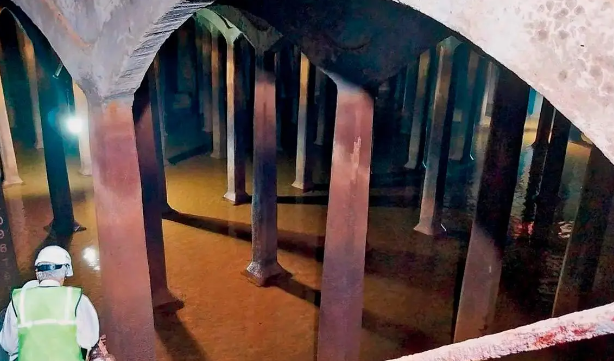
Mumbai: The Indian Institute of Technology (IIT) Roorkee team, tasked with inspecting the Malabar Hill reservoir, has submitted its findings to the Brihanmumbai Municipal Corporation (BMC). The report confirms that the reservoir, which dates back to 1887, can be repaired rather than needing complete reconstruction. However, due to the nature of the repairs, an alternate water tank has been suggested to ensure continuous water supply during the repair process.
Officials have indicated that the new tank would likely need to be constructed in the same vicinity, utilising gravity to facilitate water supply to the reservoir. “The specific course of action is yet to be finalised,” commented a BMC official. In June, the IIT-Roorkee team inspected compartments 1 and 2 of the reservoir after they had been drained in phases. The emptying of these tanks has resulted in reduced water supply to several wards, including A (Colaba and Cuffe Parade), C (Marine Drive and Mumba Devi), D (Malabar Hill and Tardeo), G-South (Lower Parel), and G-North (Dadar and Dharavi). The decision to opt for repairs over reconstruction follows a ten-month campaign led by Malabar Hill MLA MP Lodha. In early June, Lodha announced that the original Rs 698 crore reconstruction plan had been abandoned in favour of a repair strategy.
Civic authorities have assured that, should an alternative tank be constructed, efforts will be made to minimise the impact on the surrounding trees. The original tender for the reservoir project also included a provision for an alternative tank, but this would have required the use of Shantivan Gardens, adjacent to the existing Hanging Gardens (officially known as Pherozeshah Mehta Gardens), and would have significantly affected the trees in the area. The Malabar Hill Reservoir (MHR) was initially built in 1887 with three compartments (1A, 1B, and 2A), and was expanded in 1907 with two additional compartments (1C and 2B). It was converted into a storage reservoir in 1916. The surrounding gardens have a historical significance, having been first laid out in 1886-87, and then relaid in 1938-39 to unify the roof of the reservoir. The reservoir currently supplies water through 19 different distribution systems to various parts of Mumbai. Despite the challenges, BMC officials are committed to ensuring the repair process has minimal impact on both the water supply and the environment.
