Pune Mundhwa Corridor Faces Major Traffic Disruption
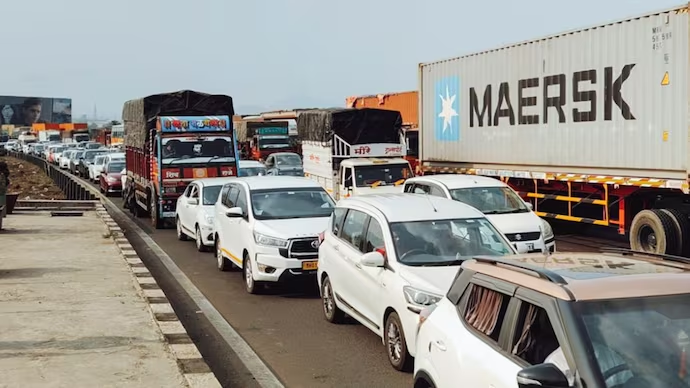
A freight vehicle breakdown on Pune’s Mundhwa bridge disrupted morning traffic movement across the eastern corridor on Monday, exposing the mounting pressure on the city’s overstretched transport infrastructure. The incident triggered long vehicle queues on the Hadapsar–Mundhwa–Kharadi route during peak office hours, affecting thousands of daily commuters travelling through one of Pune’s fastest-growing urban belts.
According to traffic authorities, the disruption occurred after a heavy truck suffered a mechanical failure while crossing the bridge, forcing police to introduce temporary diversions to prevent further congestion. Traffic personnel were deployed across key junctions as vehicles were redirected through interior roads linking Jahangir Nagar, Tadi Gutta Chowk and adjoining neighbourhoods. The Pune traffic diversion remained in effect for several hours as recovery teams worked to clear the stranded vehicle from the carriageway. Commuters travelling towards Kharadi, Hadapsar and nearby commercial districts reported delays amid slow-moving traffic and increased pressure on alternate routes.Urban mobility experts say the episode reflects a larger structural challenge confronting Pune’s eastern transport network, where rapid residential and commercial expansion has significantly increased dependence on a limited number of road corridors. Areas such as Mundhwa, Kharadi and Hadapsar have witnessed sustained growth in office developments, housing projects and logistics activity over the past decade, intensifying daily vehicle movement across ageing transport infrastructure.
Transport planners note that bridge bottlenecks and single-corridor dependencies create high vulnerability during emergencies, accidents or mechanical failures. In the absence of robust multimodal alternatives, even short-term disruptions can cascade into city-wide delays, affecting worker productivity, freight movement and public transport reliability. The Pune traffic diversion also renewed discussions around the city’s growing reliance on private vehicles and heavy freight movement through mixed-use urban zones. Analysts argue that rapidly urbanising cities require transport systems that balance road infrastructure with stronger public transit connectivity, dedicated freight planning and pedestrian-friendly mobility solutions. Environmental observers point out that prolonged traffic congestion contributes to increased fuel consumption and higher transport emissions, particularly in densely populated corridors already grappling with deteriorating air quality. Long idling times on arterial roads can also increase noise pollution and commuter stress, impacting overall urban liveability.
Civic officials have in recent months announced multiple road connectivity and missing-link projects aimed at easing traffic pressure across Pune. However, urban policy experts caution that infrastructure upgrades must be paired with integrated transport planning, including efficient bus systems, last-mile connectivity and resilient road maintenance strategies. Traffic movement on the affected corridor gradually improved after diversions were implemented and clearance operations progressed. Yet the incident has once again highlighted the fragile nature of mobility networks in rapidly expanding Indian cities, where infrastructure capacity often struggles to keep pace with urban growth and rising commuter demand.