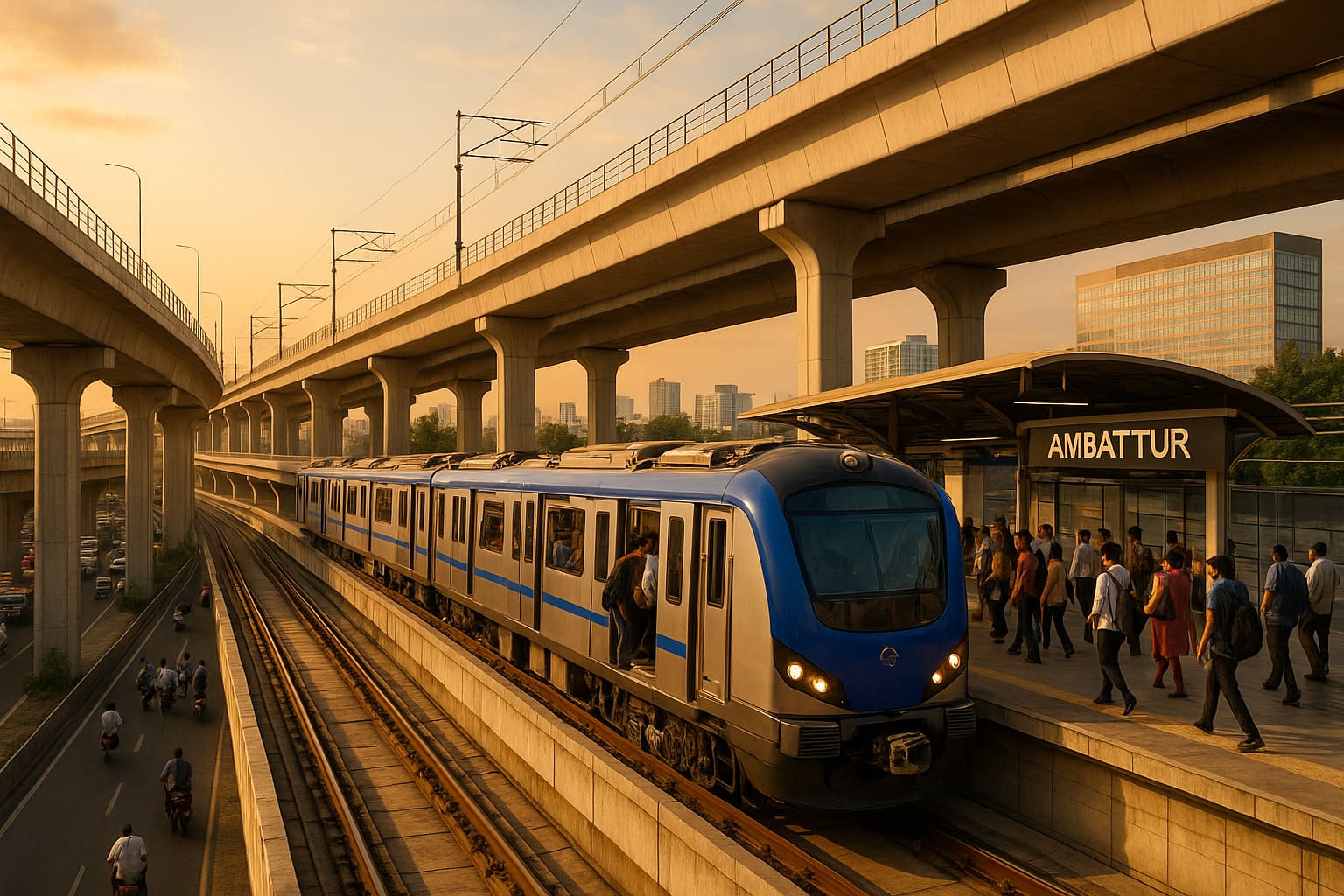
Chennai Metro Expansion Boosts Western Connectivity
Chennai is preparing to operationalise a key section of its long-awaited Metro Phase II network, with driverless train services between Poonamallee Bypass and Vadapalani expected to begin shortly. The new corridor is likely to reshape mobility patterns across the city’s western suburbs, where rapid urbanisation and rising vehicle ownership have intensified congestion and stretched existing transport infrastructure.
The 15.8-km stretch forms part of Corridor 4 of the Chennai Metro Phase II project, which is designed to connect Poonamallee with Light House through several dense residential and commercial zones. Stations along the route include Kattupakkam, Iyyappanthangal, Porur Junction and Vadapalani areas that have witnessed substantial real estate growth but continue to depend heavily on road-based transport. Senior officials familiar with the project indicated that discussions are underway regarding the formal inauguration schedule. Once opened, the corridor will introduce fully automated train operations, marking another step in India’s gradual transition towards advanced urban transit systems aimed at improving operational efficiency and reducing dependence on fossil fuel-driven mobility.
Urban planners say the Chennai Metro Phase II corridor could significantly reduce travel uncertainty for daily commuters travelling between the city’s western edge and established business districts. The extension of services beyond Porur Junction to Vadapalani is considered strategically important because it enables interchange access with Chennai’s operational Metro network through pedestrian connectivity infrastructure, including elevated walkways.Transport analysts note that western Chennai has evolved into a mixed-use urban belt with growing residential clusters, healthcare facilities, educational institutions and office developments. However, public transport integration has struggled to keep pace with this expansion. The Chennai Metro Phase II project is therefore being viewed not only as a transport intervention but also as an urban restructuring exercise capable of influencing land use, commuting behaviour and economic activity.
The introduction of driverless Metro services also reflects a broader shift among Indian cities towards lower-emission mass transit systems. Experts believe such investments are increasingly critical as metropolitan regions face mounting climate pressures, deteriorating air quality and rising fuel consumption linked to private vehicle use. By encouraging higher public transport adoption, the Chennai Metro Phase II network could contribute to lowering transport-related emissions while improving accessibility for workers and students across income groups.
At the same time, mobility experts caution that the long-term success of the corridor will depend on last-mile connectivity, pedestrian safety and affordable feeder services. Without integrated urban planning, they argue, high-capacity transit systems often struggle to maximise ridership potential despite major capital investments. With additional stretches of Phase II still under construction, the upcoming launch is expected to serve as an early test of how effectively Chennai can align infrastructure expansion with sustainable and people-centric urban growth. The operational readiness of the corridor may also shape future investment confidence in transit-oriented development across the metropolitan region.