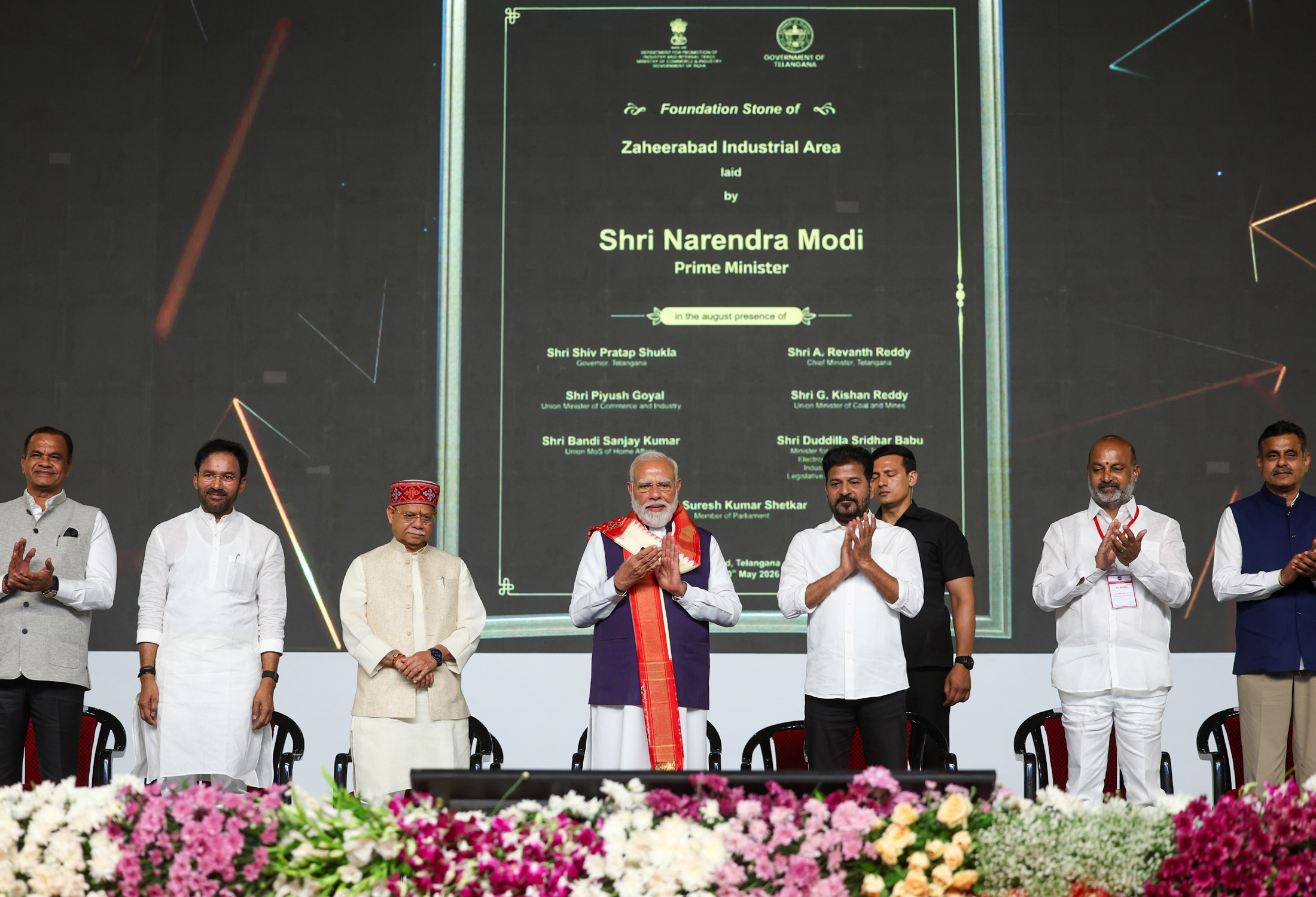
A fresh wave of infrastructure and industrial investments announced in Hyderabad on Sunday has placed Telangana at the centre of India’s expanding urban manufacturing and logistics network, with projects worth nearly ₹9,400 crore expected to reshape mobility, industrial growth and regional connectivity across the state.
The development package includes highway expansion works, railway upgrades, industrial clusters, logistics infrastructure and healthcare facilities spread across Hyderabad, Warangal and Sangareddy districts. Urban policy experts say the scale of investment reflects a wider shift in India’s growth model, where secondary cities and industrial corridors are increasingly being positioned as engines of employment and economic diversification. Among the key announcements was the launch of a large textile manufacturing park in Warangal and a new industrial area in Zaheerabad aimed at strengthening supply chains and attracting manufacturing investment into Telangana’s hinterland. Officials said the projects are expected to improve industrial competitiveness while reducing freight movement costs for exporters and local businesses. Transport infrastructure formed a major component of the package. Highway expansion works along the Hyderabad–Panaji economic corridor and rail multi-tracking initiatives are intended to ease freight congestion and improve connectivity between industrial zones and ports. Analysts note that Telangana’s strategic location makes it increasingly important in linking southern and western trade routes. The Hyderabad infrastructure projects also included a fuel logistics terminal and a specialised cancer-focused healthcare facility, signalling a broader emphasis on urban service expansion alongside industrial development. Public health planners argue that rapidly growing metropolitan regions require stronger healthcare capacity and decentralised medical infrastructure to meet rising demand and climate-linked health risks.
Urban planners, however, caution that large-scale infrastructure growth must be matched with environmental safeguards and long-term civic planning. Hyderabad has experienced repeated episodes of urban flooding, heat stress and pressure on lakes and peri-urban ecosystems over the last decade as construction activity expanded beyond traditional city boundaries.Experts tracking Hyderabad infrastructure projects say future investments will need stronger integration with public transport systems, affordable housing strategies and water-sensitive urban planning to avoid deepening inequality and ecological stress. Industrial corridors and logistics hubs, they argue, can generate economic opportunity only if surrounding communities receive adequate civic infrastructure and mobility access.The investments are also expected to influence real estate development patterns across emerging industrial belts around Hyderabad. Improved road and rail connectivity often accelerates warehousing, residential construction and commercial activity in peripheral districts, creating new urban growth centres outside the metropolitan core.Political messaging accompanied the project launches, with both the Centre and the state government highlighting the economic importance of Telangana. Yet beyond electoral significance, the broader challenge for policymakers will be ensuring that rapid industrialisation translates into inclusive urban growth rather than fragmented expansion.
For Telangana’s cities, the next phase of development may depend less on the scale of infrastructure spending and more on whether growth can remain sustainable, climate-resilient and accessible to the communities expected to power it.