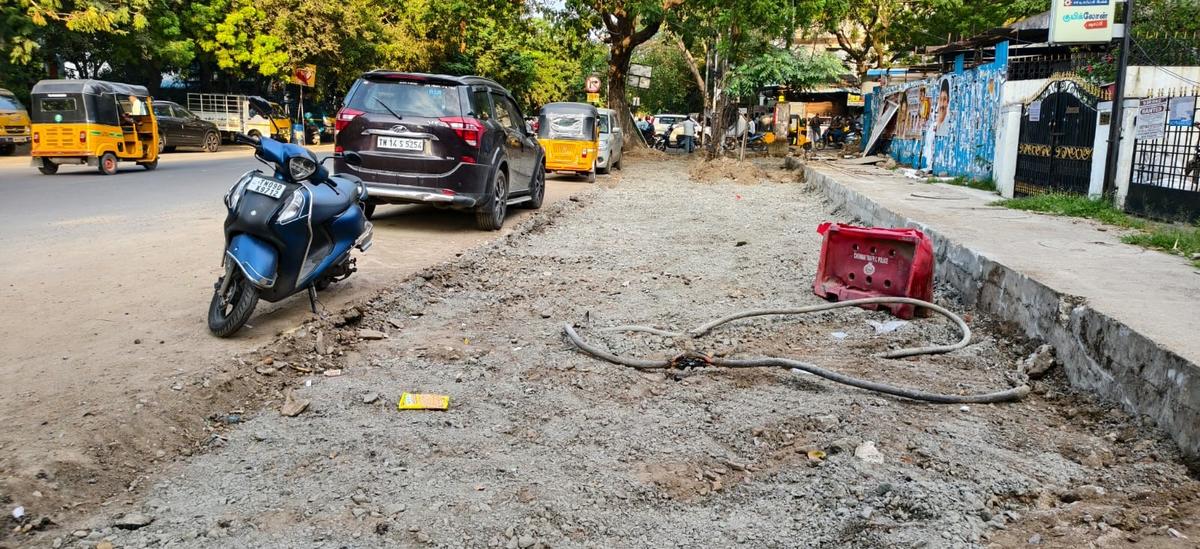
In parts of Tambaram under the jurisdiction of Ward 57 in Chennai’s southern urban fringe, residents are confronting deteriorating street conditions after recent utility works disrupted freshly laid roads. Local stretches across New Perungalathur, including internal roads in Krishna Road and adjoining residential corridors, have been left uneven and hazardous following partial restoration after underground cabling work. The emerging concern over Tambaram road damage highlights how fragmented infrastructure execution continues to undermine everyday urban mobility and safety.
The issue stems from trenching carried out for underground electricity cable installation on newly laid tar roads. While the utility lines were eventually placed and covered, residents report that restoration of the road surface was incomplete and poorly compacted. Over time, the backfilled sections have sunk, creating depressions, loose sand patches, and broken asphalt layers that interrupt continuous movement along key residential routes.What was intended as infrastructure modernisation has instead translated into recurring surface instability. In several locations, repeated subsidence has led to pothole formation and uneven gradients, making walking and two-wheeler travel difficult. Elderly residents are particularly affected, with multiple accounts of slips and near-falls reported in areas where the road surface has deteriorated sharply.
Urban mobility experts note that such outcomes often arise when coordination between utility agencies and civic bodies is weak. Inadequate compaction, absence of proper curing periods, and lack of post-work road audits are frequently cited as underlying causes. The present Tambaram road damage situation reflects these systemic gaps, where utility expansion projects are not fully aligned with long-term road durability standards.From a broader urban planning perspective, the incident underscores a critical sustainability challenge for fast-growing peri-urban zones. Repeated digging and patchwork restoration not only reduce road lifespan but also increase material waste and maintenance cycles, directly conflicting with climate-resilient infrastructure goals. Experts suggest that integrated trenchless technologies, stricter contractor accountability, and unified utility corridors could significantly reduce such disruptions.
Residents, meanwhile, are calling for immediate corrective resurfacing and a structured monitoring mechanism to prevent further deterioration. The lack of timely intervention has also raised concerns over commuter safety and accessibility within densely populated residential pockets.As Tambaram continues to expand as part of the Chennai metropolitan region, the need for coordinated infrastructure planning becomes increasingly urgent. Addressing Tambaram road damage is not merely a matter of local repair but a test of how effectively urban systems can balance expansion with safety, durability, and long-term environmental responsibility.