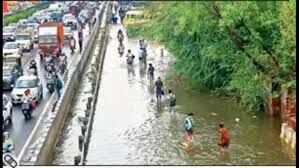
Gurugram’s efforts to strengthen its stormwater infrastructure have hit a critical setback, with authorities imposing a ₹5 crore penalty on a contractor for delays in a key drainage project along the NH-8 and Southern Peripheral Road (SPR) corridor. The lag threatens to leave several sectors vulnerable to flooding as the monsoon season approaches, raising concerns over the city’s preparedness for extreme weather.
The project, designed to build a 17.6-km stormwater drainage network across sectors 68 to 75, was intended to address long-standing waterlogging issues in newly developed residential zones. However, despite a defined completion timeline, only around 20% of the work has been completed so far, prompting regulatory action by the metropolitan authority. The Gurgaon drainage delay highlights a recurring pattern in the city’s infrastructure rollout, where execution bottlenecks undermine the effectiveness of planned investments. Conceived to channel rainwater into a larger master drain network, the system is critical for managing runoff in areas that have seen rapid real estate expansion but lagging civic infrastructure. Residents in affected sectors have consistently reported severe waterlogging during heavy rainfall, particularly at key intersections and arterial roads. Without timely completion of the drainage system, these disruptions are likely to persist, affecting mobility, property access, and emergency response during peak monsoon periods.
Urban planners point out that the Gurgaon drainage delay is not an isolated case but part of a broader structural issue. As Gurugram’s urban footprint expands, infrastructure development has struggled to keep pace with the speed of construction. Drainage networks, often treated as secondary systems, become critical only during extreme weather events—by which time corrective measures are limited. The delayed project is also linked to a larger drainage framework along the SPR, including a master drain designed to ease pressure on the Badshapur outfall channel, which frequently overflows during heavy rains. While parts of this broader system are nearing completion, delays in feeder networks reduce overall effectiveness, creating bottlenecks in stormwater flow. From a climate resilience perspective, such delays carry increasing risk. With changing rainfall patterns leading to more intense, short-duration downpours, cities like Gurugram require fully functional drainage systems to prevent urban flooding. Even partial gaps in the network can result in disproportionate impacts, including road submergence and traffic paralysis. The Gurgaon drainage delay also raises questions around contractor accountability and project monitoring. While financial penalties signal enforcement intent, experts argue that stronger oversight mechanisms, real-time progress tracking, and stricter contractual frameworks are necessary to ensure timely delivery of critical infrastructure. Economically, repeated flooding incidents can have cascading effects—disrupting daily commutes, affecting business operations, and lowering investor confidence in emerging residential corridors. For a city positioned as a major corporate and real estate hub, infrastructure reliability is central to sustaining growth.
Looking ahead, authorities have directed the contractor to accelerate work, but the timeline for completion remains uncertain. With the monsoon approaching, partial reliance may fall on parallel drainage projects currently under construction, though these may not fully compensate for the missing network. As Gurugram continues to urbanise, the episode underscores a key lesson: infrastructure delivery must keep pace with development. Without aligning construction timelines with climate realities, cities risk amplifying vulnerabilities rather than building resilience into their growth trajectory.