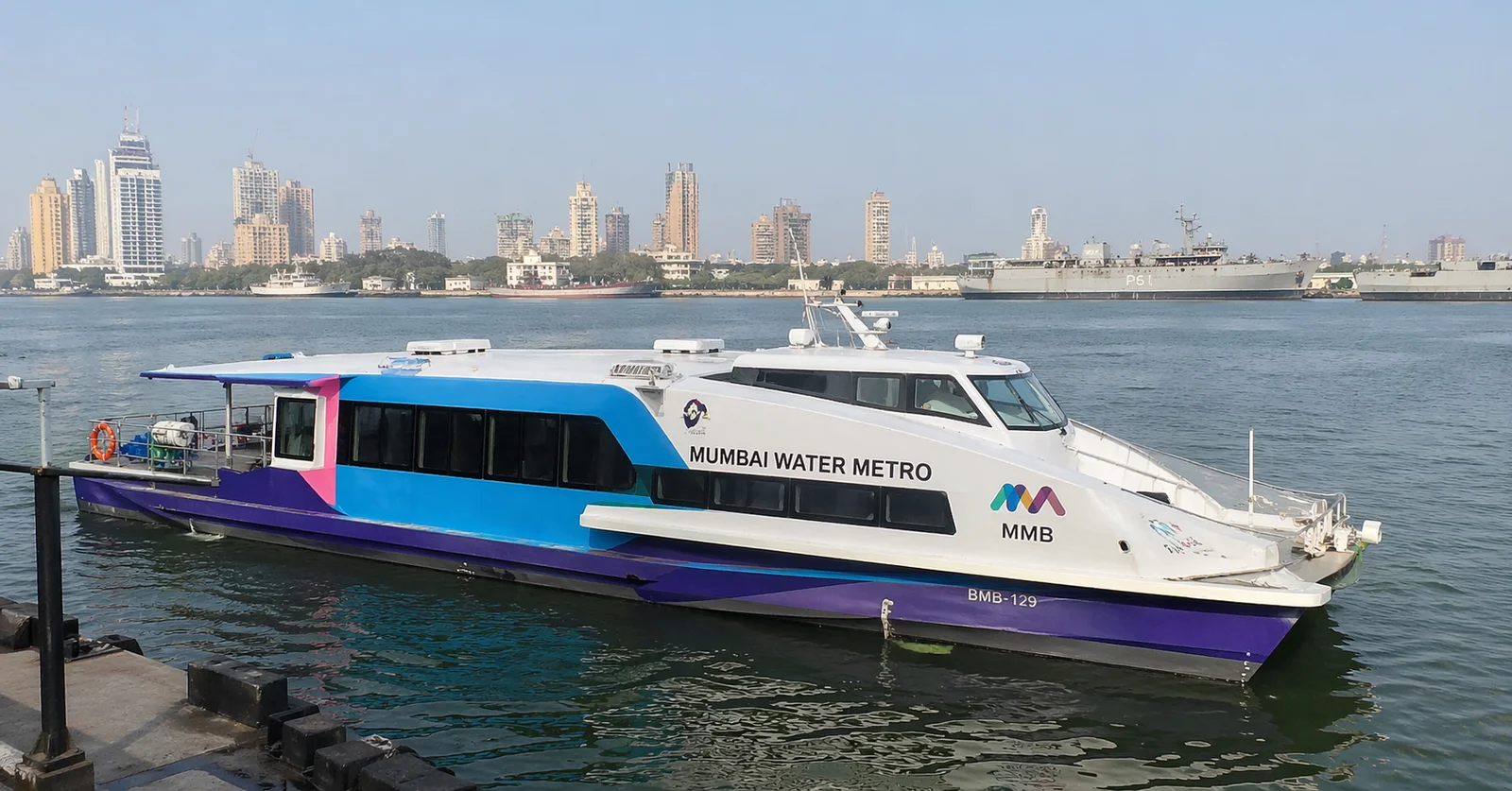
Mumbai’s commuters spend an average of three hours daily on roads and trains that stopped being fit for purpose a decade ago. Now the Maharashtra Maritime Board has issued the first tender for a Water Metro Project — 16 routes, 26 terminals, and a bet that the city’s creeks and coastline can do what concrete cannot. Phase 1 will link Mumbai with Navi Mumbai, Thane, Kalyan, Vasai, and Mira-Bhayandar, upgrading 8 existing ferry routes while adding 8 new ones. A transport official confirmed that the project will operate under a public-private partnership model. The maritime board will build terminals and civil infrastructure. Private concessionaires will procure and operate vessels. The detailed project report and feasibility study were prepared by Kochi Water Metro Limited — a rare instance of one Indian city learning from another’s experiment.
What makes this different from Mumbai’s existing ferry services is scale and structure. Current water transport moves approximately 1.6 crore passengers annually across 21 routes, but largely as an unorganised, weather-dependent afterthought. The Water Metro proposes scheduled, terminal-based, integrated services with navigational and emergency infrastructure. New routes include Vashi to the Navi Mumbai International Airport, Gateway of India to the airport, and a western corridor from Bandra to Worli to Nariman Point. Urban mobility analysts note that water transport offers something road and rail cannot: dedicated right-of-way that cannot be encroached. In a metropolis where every metre of road is contested, creeks and estuaries remain underutilised public assets. The environmental case is also clear. Shifting even 5 percent of suburban rail and road commuters to electric or low-emission vessels would measurably cut the city’s transport carbon footprint.
Yet challenges are substantial. Terminals require land-side connectivity — last-mile links that Mumbai has historically neglected. Weather disruptions during monsoon will test operational reliability. And fares must balance affordability for daily commuters with viability for private operators. The tender now seeks a consultant for project management, design, and supervision. That consultant will shape how 26 terminals — from Vasai to Elephanta, Kalyan to Nariman Point — actually serve citizens. For a city drowning in its own congestion, water offers an escape route. But building that route demands more than boats and jetties. It demands governance that treats creeks as transport corridors, not dumping grounds.
Mumbai Water Metro Tender Drops With 16 Routes