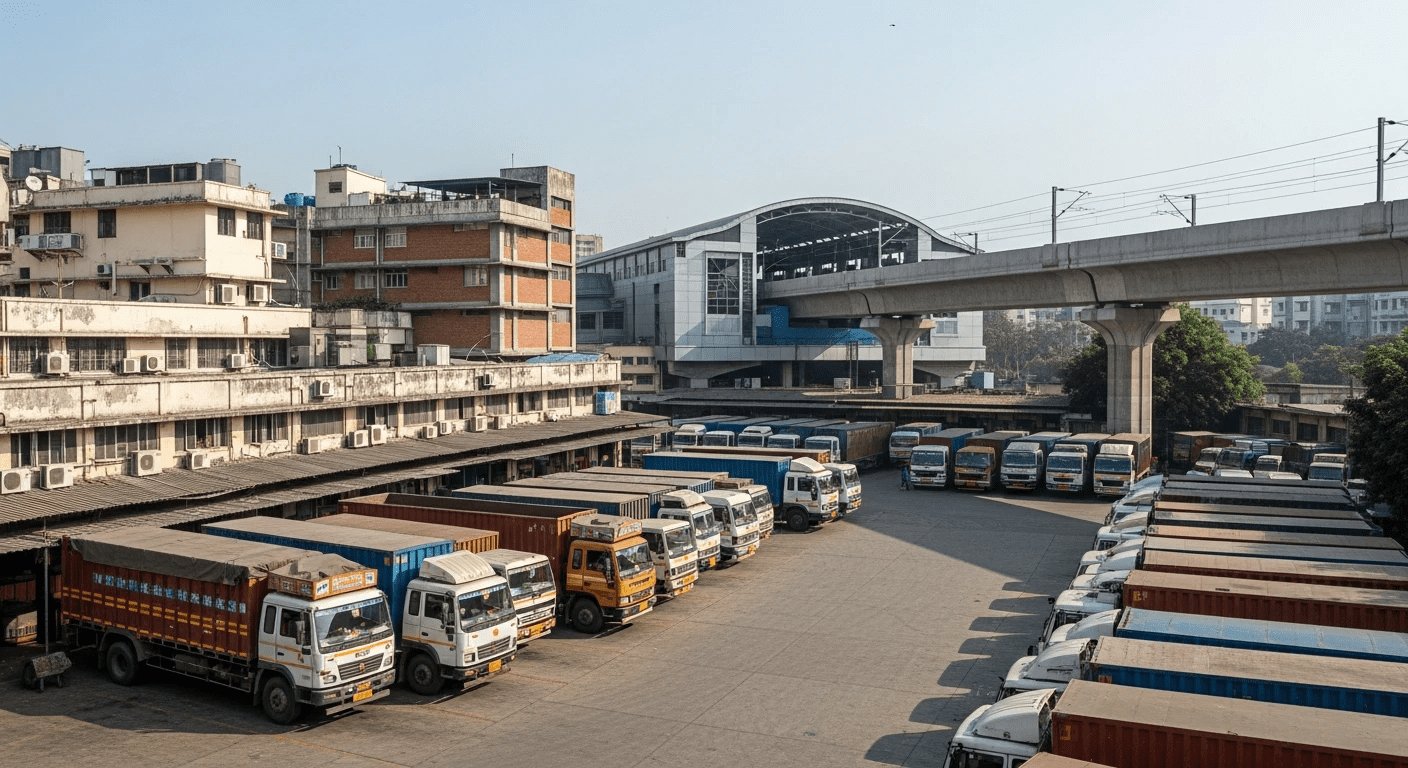
A major logistics intervention is nearing completion in Navi Mumbai, where two large truck terminals are being readied to address persistent congestion across the Thane-Belapur industrial corridor. Developed by Maharashtra Industrial Development Corporation, the ₹205-crore investment is aimed at reorganising freight movement and reducing the strain caused by unregulated heavy vehicle parking on city roads. The Navi Mumbai truck terminals project targets a long-standing infrastructure gap in one of the region’s busiest industrial zones. The Thane-Belapur belt, home to thousands of manufacturing and logistics units, sees continuous inflow of container trucks and trailers linked to port activity and regional supply chains. In the absence of dedicated holding areas, vehicles frequently occupy road shoulders and service lanes, narrowing carriageways and affecting both industrial operations and daily commuting.
Officials indicate that the two facilities—located in Turbhe and Airoli—are in advanced stages of readiness, with operational rollout expected shortly. The Turbhe terminal, positioned within an industrial cluster, is designed to accommodate vehicles waiting for warehouse access, thereby reducing roadside queues that often spill into adjoining commercial areas. Meanwhile, the Airoli facility is strategically placed near key entry routes, allowing authorities to intercept incoming freight traffic before it disperses into dense urban pockets. Urban mobility experts say the Navi Mumbai truck terminals could significantly improve traffic flow if integrated effectively with enforcement measures. By formalising truck parking and staging, the initiative has the potential to reclaim road space currently lost to informal halts, improving safety for pedestrians and smaller vehicles. It also aligns with broader efforts to separate freight and passenger traffic—an approach increasingly adopted in growing metropolitan regions. The move comes amid rising logistics demand driven by port-linked trade, warehousing expansion and upcoming infrastructure such as the Navi Mumbai International Airport.
Planners suggest that structured freight management will become critical as cargo volumes increase, particularly in areas where industrial and residential zones overlap. However, infrastructure alone may not fully resolve congestion challenges. Industry observers note that strict implementation, including penalties for unauthorised roadside parking and clear pricing mechanisms for terminal use, will be key to ensuring adoption. Without behavioural change among transport operators, the benefits could remain limited. From a sustainability perspective, reducing idle truck time on city roads can lower emissions and improve local air quality—an often overlooked advantage of organised logistics infrastructure. It also enhances economic efficiency by cutting delays in goods movement, benefiting both businesses and workers.
As the facilities prepare to open, attention will shift to how seamlessly they integrate into the broader transport network. For Navi Mumbai, the success of these terminals could serve as a template for managing freight in rapidly urbanising industrial corridors across India.