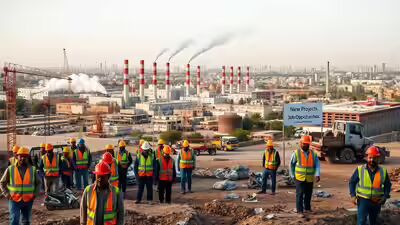
Uttar Pradesh is positioning itself as a major industrial and manufacturing hub, with large-scale corporate expansion plans signalling a shift in the state’s economic trajectory. A senior industry leader recently indicated that business operations across the state are expected to more than double in the coming years, reflecting growing investor confidence driven by infrastructure upgrades and policy support.
The announcement, made in Lucknow, highlights how improved connectivity, logistics networks, and industrial ecosystems are reshaping the state’s attractiveness for long-term investments. Officials and industry observers point to expressways, freight corridors, and urban infrastructure improvements as key enablers of this transformation. The Uttar Pradesh industrial expansion is being anchored in multiple sectors, including manufacturing, information technology, energy, and emerging technologies. Existing industrial facilities—such as long-standing automotive manufacturing units—are expected to scale up production significantly over the next few years, with targets indicating a sharp increase in output capacity. In parallel, workforce expansion is anticipated to play a central role in this growth. Technology and services sectors are projected to see a substantial rise in employment, with estimates suggesting that the workforce could double across key urban centres. This reflects a broader shift towards knowledge-based industries alongside traditional manufacturing. Urban development experts note that such expansion is closely linked to the state’s infrastructure push. Investments in highways, logistics parks, and industrial corridors are reducing transit times and improving supply chain efficiency—critical factors in attracting large-scale industrial operations. The integration of these systems is gradually positioning Uttar Pradesh as a viable alternative to established industrial regions.
However, the scale of the Uttar Pradesh industrial expansion also raises important planning considerations. Rapid industrial growth can place pressure on urban infrastructure, including housing, water supply, and public transport systems. Without coordinated planning, cities may struggle to absorb the influx of workers and economic activity, leading to congestion and service gaps. There are also sustainability dimensions to consider. As industrial activity increases, ensuring that growth aligns with environmental standards and low-carbon pathways will be essential. The shift towards electric, CNG, and potentially hydrogen-based manufacturing reflects an attempt to integrate cleaner technologies into future production cycles. From a regional development perspective, the expansion could help rebalance economic activity across northern India. By strengthening industrial capacity in Uttar Pradesh, policymakers aim to reduce over-reliance on traditional metropolitan centres while creating new employment hubs closer to smaller towns and rural areas.
The development also signals a maturing of the state’s investment ecosystem, where policy stability, infrastructure readiness, and workforce availability converge to support long-term growth. Industry observers suggest that sustained momentum will depend on execution—timely project delivery, regulatory clarity, and continued investment in urban systems. As Uttar Pradesh moves towards becoming a major manufacturing and export centre, the focus will increasingly shift to how growth is managed. The next phase will test whether rapid industrialisation can be aligned with inclusive urban development, ensuring that economic gains translate into improved living conditions and resilient city systems.