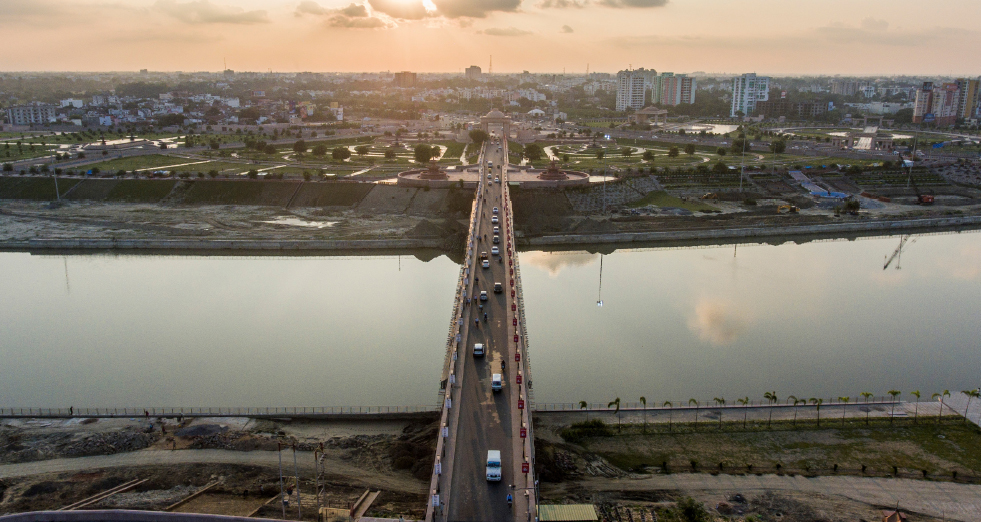
Lucknow is emerging as a central node in India’s evolving “economic corridor of innovation” strategy, with integrated infrastructure, manufacturing and technology ecosystems converging to reshape the city’s growth trajectory. The push reflects a broader national effort to build interconnected urban regions that combine logistics, industry and knowledge economies into a single development framework.
At the heart of this transition is the development of multi-modal corridors linking Lucknow to neighbouring industrial centres such as Kanpur and beyond. Projects like the Lucknow–Kanpur Expressway are expected to drastically cut travel time and improve freight movement, strengthening the city’s role as a regional logistics and production hub. The emerging Lucknow innovation corridor is also being anchored by high-value sectors such as defence manufacturing. Land allocations and industrial investments under the Uttar Pradesh Defence Industrial Corridor are attracting advanced manufacturing units, creating a base for technology-led growth and skilled employment. Policy signals suggest that the corridor is being designed as more than a transport network. It integrates economic nodes, logistics hubs and social infrastructure, aligning with national plans to develop interconnected growth clusters that support both industry and urbanisation. This model reflects a shift towards spatially distributed development, where cities like Lucknow act as anchors for regional economic expansion.
A key driver of this transformation is connectivity. The expansion of ring roads, expressways and urban corridors is enabling faster movement of goods and people, effectively extending Lucknow’s economic influence across a wider geography. Officials indicate that such infrastructure could position the city as a major supply centre within a 400-km radius, significantly enhancing trade efficiency and job creation potential. Urban development experts highlight that the Lucknow innovation corridor aligns with global trends where economic growth is increasingly organised along corridors rather than within isolated cities. By linking manufacturing, research institutions and logistics networks, such corridors create ecosystems that can support innovation, entrepreneurship and long-term competitiveness. The corridor is also expected to catalyse new urban forms. As connectivity improves, peripheral areas are likely to witness the development of industrial parks, logistics hubs and residential clusters, creating a more polycentric urban region. This could reduce pressure on the city core while enabling more balanced and inclusive growth across districts.
However, the scale of transformation brings challenges. Coordinating multiple infrastructure projects, ensuring environmental sustainability and managing land use changes will be critical. Without integrated planning, rapid corridor development risks triggering unregulated sprawl and infrastructure stress. There is also a growing emphasis on aligning such economic corridors with climate resilience. Efficient logistics, reduced travel times and planned industrial zones can lower emissions intensity, but only if supported by sustainable design and governance frameworks.
As investments accelerate, the trajectory of the Lucknow innovation corridor will depend on execution—particularly how effectively infrastructure, industry and urban planning are synchronised. If delivered as envisioned, the corridor could redefine Lucknow’s role from a state capital to a regional economic engine, shaping the next phase of growth in north India.