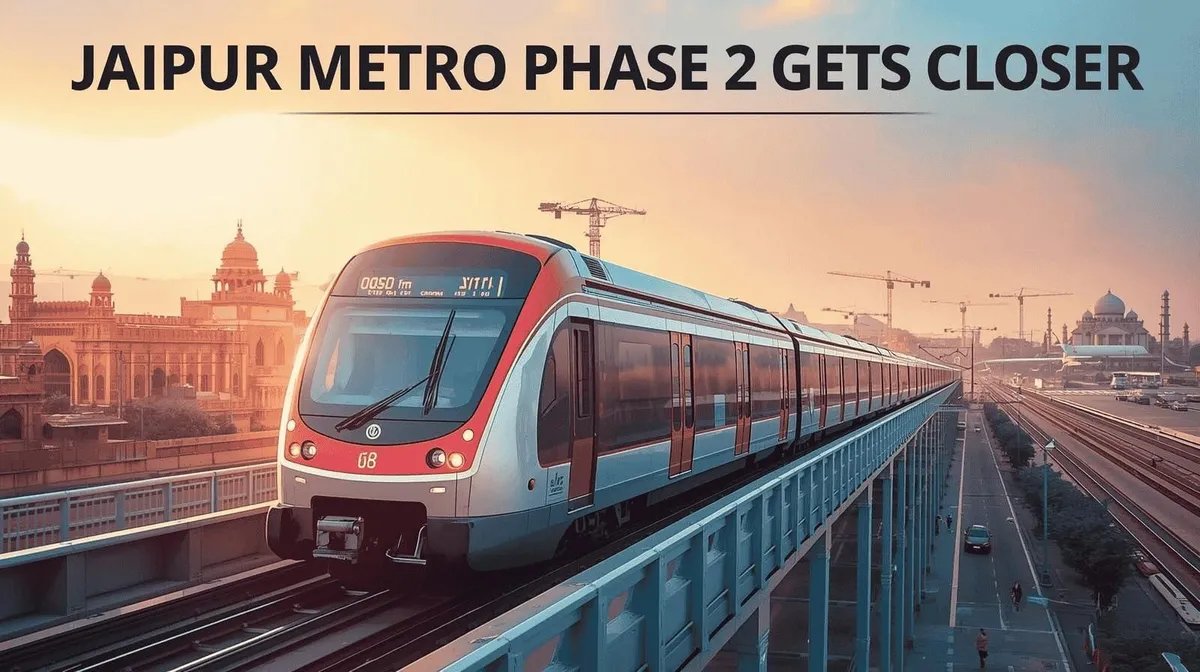
Jaipur Metro Phase Two Approved For City Expansion
Jaipur is set to significantly expand its mass transit network after the Union government cleared the long-awaited Jaipur Metro Phase 2 project, a 41-kilometre north–south rail corridor designed to reshape mobility across the Rajasthan capital. The project, estimated to cost more than ₹13,000 crore, is expected to connect key residential, industrial and institutional districts while strengthening the city’s public transport infrastructure. The approved Jaipur Metro Phase 2 corridor will run from Prahladpura in the south to Todhi Mod in the north, forming a critical transport spine across the expanding metropolitan region. The alignment will include 36 stations and integrate with the existing metro line to create a larger, interconnected urban transit network.
Urban planners say the project arrives at a crucial moment for Jaipur, which has witnessed rapid population growth, expanding industrial zones and rising traffic congestion in recent years. By linking employment hubs, residential neighbourhoods, healthcare centres and airport infrastructure, the corridor is expected to improve accessibility while reducing reliance on private vehicles. The metro expansion will be implemented by the state’s metro rail corporation under a joint ownership model involving both the central and state governments. Funding will combine public equity, subordinate debt and multilateral financing, reflecting a financing structure aligned with India’s national metro rail policy framework. Key locations expected to benefit from the Jaipur Metro Phase 2 alignment include the Sitapura industrial zone, Vishwakarma Industrial Area, the airport corridor along Tonk Road, major medical facilities, sports infrastructure and residential districts in northern Jaipur. Transit planners have indicated that underground stations will be developed in sensitive urban zones, including areas around the airport, to minimise surface disruption and maintain urban design continuity.
The new line will complement the city’s operational east–west metro corridor, which currently runs between Mansarovar and Badi Chaupar and handles tens of thousands of passengers daily. With the addition of a north–south route, Jaipur’s metro system is expected to evolve into a more comprehensive urban transport network capable of handling greater commuter demand. Transport economists note that metro systems often influence urban development patterns, particularly when integrated with transit-oriented development frameworks. The project is aligned with Rajasthan’s urban planning policies that promote higher-density development and mixed land use around transit nodes to reduce commuting distances and improve walkability. Beyond congestion relief, the project also carries environmental implications. Public transport systems such as metro rail networks typically contribute to lower vehicle emissions by shifting commuters away from fossil fuel-dependent travel modes. In cities like Jaipur, where traffic volumes have steadily increased, expanding rail-based transit can play a significant role in improving air quality and energy efficiency.
Authorities estimate that the construction timeline will extend through the end of the decade, with commissioning targeted around 2031. Once operational, the expanded metro network is expected to support the city’s long-term mobility strategy while accommodating future population growth. As Jaipur continues its transformation into a major economic and tourism hub, the Jaipur Metro Phase 2 project is expected to become a central element of the city’s efforts to build a more connected, efficient and sustainable urban transport system.