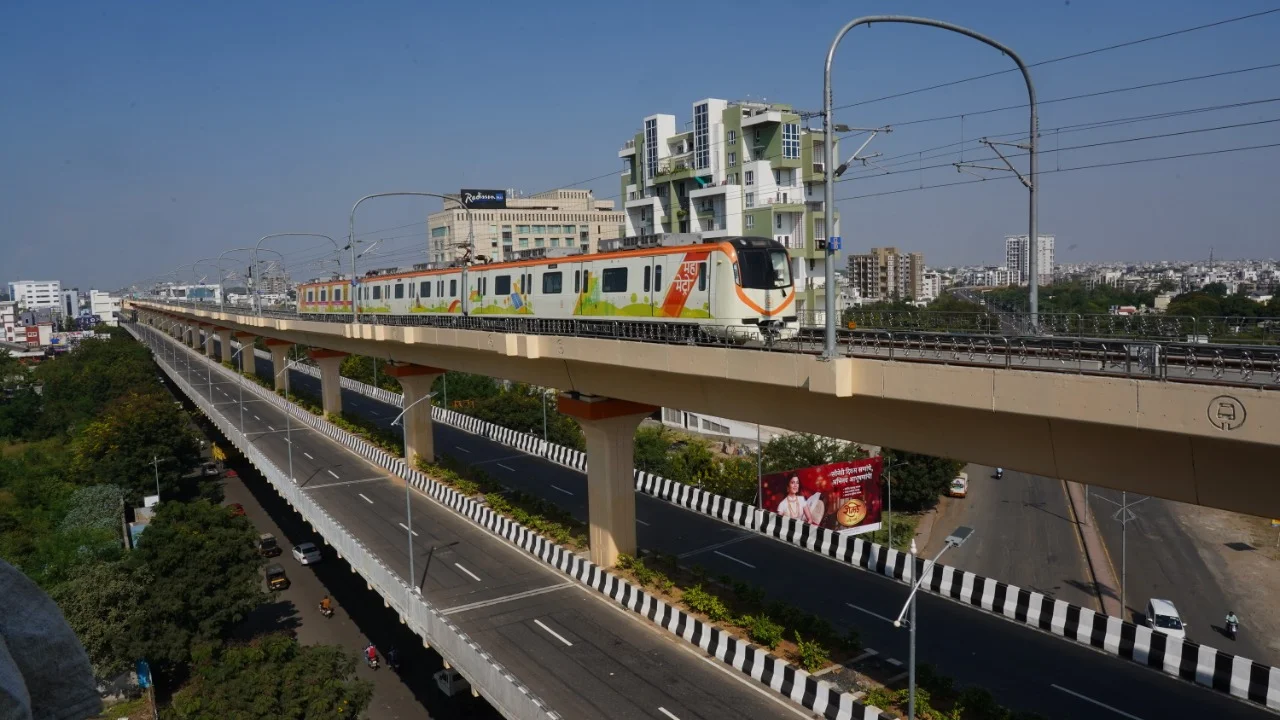
Construction activity is entering its final stage on a pioneering transport structure in northeast Delhi, where authorities are completing a double-layered corridor designed to carry both metro trains and road traffic. The project, located between Bhajanpura and Yamuna Vihar along the Pink Line alignment, represents one of the capital’s early experiments in high-density infrastructure planning aimed at maximising limited urban space. While metro services on the upper deck have already begun operating as part of the extended Pink Line network, the lower level of the structure—planned for vehicular movement—remains under construction. Transport authorities indicate that finishing works on ramps and structural spans are now being initiated, with the goal of bringing the entire corridor into operation within the year.
The double decker metro viaduct stretches roughly 1.4 kilometres and is engineered to accommodate two modes of transport within a single vertical structure. By placing a road flyover beneath an elevated metro track, planners hope to reduce land acquisition pressures and minimise disruption to densely populated neighbourhoods. Officials overseeing the project say the remaining work includes constructing approach ramps at both ends of the structure and installing additional spans required to complete the flyover segment. These elements are critical for connecting the elevated roadway to existing surface roads, enabling vehicles to move smoothly between neighbourhood corridors. Tender documents issued for the final phase also include works related to reinforced earth structures and retaining systems. Such engineering components are used to stabilise elevated approaches and ensure long-term structural integrity in areas where the viaduct meets the ground. Earlier delays in the project were linked to pending environmental approvals, including permissions required for removing trees along sections of the alignment. Infrastructure specialists note that such clearances often affect urban transport projects in built-up areas, where balancing ecological considerations with mobility needs becomes complex.
Despite these challenges, the double decker metro viaduct is expected to serve as a model for space-efficient transport infrastructure in rapidly growing cities. Delhi’s expanding population and vehicle ownership have placed increasing pressure on road networks, prompting planners to explore multi-layered solutions that combine public transit with road capacity improvements. Urban mobility analysts suggest the approach can also support climate-responsive city planning. By strengthening metro connectivity while simultaneously reorganising road movement, such projects may encourage more commuters to shift toward public transport, potentially reducing congestion and transport-related emissions. Beyond the Bhajanpura–Yamuna Vihar section, additional double decker metro viaduct structures are being planned or constructed along other corridors in the capital. These include projects in northwest Delhi and along a proposed airport-linked metro route, reflecting a broader strategy to integrate transport infrastructure vertically rather than expanding outward.
For residents and commuters in the surrounding districts, the completion of the dual-level corridor could improve travel times and reduce traffic bottlenecks in a part of the city where road capacity has struggled to keep pace with urban growth. Transport planners say the next phase will involve testing, road safety integration and final connectivity works before the structure becomes fully operational—marking a significant milestone in Delhi’s evolving urban mobility framework