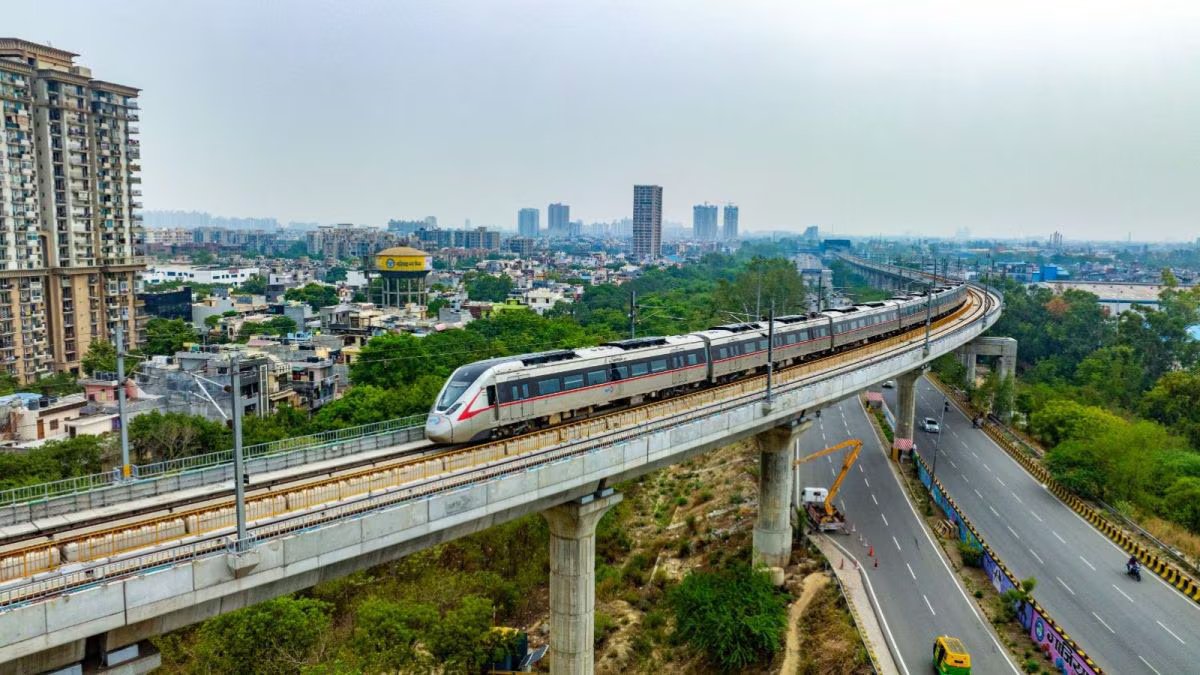
Delhi Meerut Namo Bharat Corridor Connectivity Review
Senior officials from the Prime Minister’s Office and the Union government recently assessed the operational progress of the Delhi Meerut Namo Bharat Corridor, highlighting its role in reshaping regional mobility across the National Capital Region (NCR). The review focused on the system’s integration with existing transport networks, commuter facilities and the broader objective of encouraging a shift towards sustainable public transport. The inspection took place at the Sarai Kale Khan terminal in Delhi, which has been planned as a major multimodal transit node connecting several transport systems. Officials from the National Capital Region Transport Corporation (NCRTC) presented updates on the functioning of the Regional Rapid Transit System (RRTS), designed to connect Delhi, Ghaziabad and Meerut through a high-speed commuter rail network.
Spanning around 82 kilometres, the Delhi Meerut Namo Bharat Corridor represents India’s first operational regional rapid transit system aimed at enabling fast, reliable and low-emission intercity travel. The corridor is expected to significantly reduce travel time between major urban centres within the NCR while easing congestion on highways and city roads that currently handle heavy commuter traffic. Urban mobility specialists say the corridor marks a significant shift in India’s transport planning, moving beyond city-level metro systems toward regional networks capable of linking multiple cities into a unified commuting zone. Such systems are widely used in global metropolitan regions to support economic integration and reduce dependence on private vehicles. During the review, officials examined the design and operational framework of the Sarai Kale Khan station, which is being developed as a large-scale interchange connecting regional rapid transit with metro lines, long-distance rail services, interstate bus terminals and city bus networks. Transport planners consider such integration essential to creating seamless journeys that allow passengers to switch between transport modes without significant delays.
Authorities also highlighted plans for multiple RRTS corridors to converge at this hub as part of the network’s first phase. Once operational, this convergence could enable cross-regional travel across different parts of the NCR without requiring commuters to rely on road transport for last-mile connectivity. The Delhi Meerut Namo Bharat Corridor has also been designed with several passenger-oriented features aimed at improving accessibility and comfort. Officials demonstrated onboard facilities and station design elements intended to accommodate a wide range of users, including provisions that can assist passengers requiring medical transport during emergencies. Urban development analysts note that large-scale regional transit systems often influence land-use patterns around stations, encouraging higher-density development and transit-oriented growth. In fast-growing regions like the NCR, such infrastructure can help distribute economic activity more evenly across cities while reducing pressure on central urban districts.
As the project progresses, policymakers say the focus will remain on expanding regional connectivity while ensuring efficient operations and commuter-friendly services. If the corridor achieves its expected ridership and integration goals, it could serve as a model for future regional transit systems in other metropolitan regions across India.