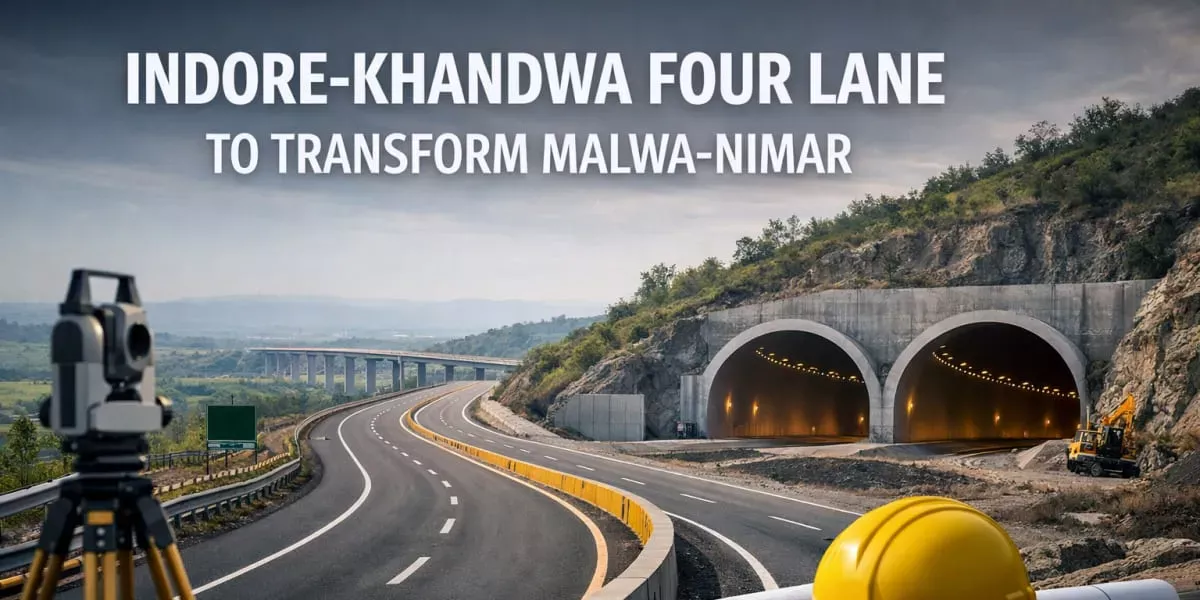
Indore Khandwa Four Lane Highway To Boost Connectivity
A major highway upgrade connecting Indore and Khandwa is expected to significantly strengthen mobility and economic integration between the Malwa and Nimar regions of Madhya Pradesh. The proposed Indore Khandwa four lane road project aims to expand an existing highway into a wider corridor designed to improve travel efficiency, reduce congestion, and support growing freight movement across central India.
Infrastructure planners say the corridor will play an important role in connecting agricultural, industrial, and commercial zones spread across the two regions. Once upgraded, the Indore Khandwa four lane road is expected to reduce travel time while improving road safety through better lane management and modern highway design.The Malwa plateau around Indore serves as a major commercial and logistics centre, while the Nimar region hosts agricultural markets, agro-processing activities, and industrial units. Strengthening connectivity between these areas could enhance trade flows and improve supply chain efficiency for goods moving between regional markets.Transport infrastructure experts note that highway widening projects are often critical for addressing rising traffic volumes. As economic activity increases, older two-lane roads can become bottlenecks for both passenger vehicles and heavy freight traffic.The Indore Khandwa four lane road project is therefore expected to support smoother traffic movement, particularly for trucks transporting agricultural produce, construction materials, and industrial goods between districts.
Urban development analysts say improved highway connectivity can also influence settlement patterns and regional investment trends. Better road infrastructure often attracts logistics parks, warehousing facilities, and small manufacturing units along major corridors.For communities located along the route, the Indore Khandwa four lane road could improve access to markets, healthcare facilities, and educational institutions located in larger urban centres such as Indore. Rural residents frequently depend on highway connectivity for commuting, trade, and essential services.Infrastructure specialists emphasise that modern highway design typically incorporates safety features such as service lanes, improved intersections, and clearer signage to reduce accident risks. Wider carriageways can also help separate local traffic from long-distance vehicles, improving overall road safety.
Environmental planners note that large infrastructure projects increasingly include measures aimed at minimising ecological impact. Highway development programmes often integrate tree plantation initiatives, drainage improvements, and noise mitigation strategies to balance mobility needs with environmental concerns.The Indore Khandwa four lane road also aligns with broader efforts to strengthen regional connectivity across Madhya Pradesh. Improved highways help integrate smaller towns into wider economic networks, supporting balanced development across districts.Transport economists say investments in road infrastructure often produce long-term economic benefits by reducing logistics costs and improving supply chain reliability.
For Indore, which continues to grow as a major commercial centre in central India, stronger road connectivity with surrounding regions will remain critical to sustaining trade and urban expansion.As planning and implementation progress, the Indore Khandwa four lane road is expected to emerge as a key transport corridor linking two important regions while supporting more efficient movement of people and goods across the state.