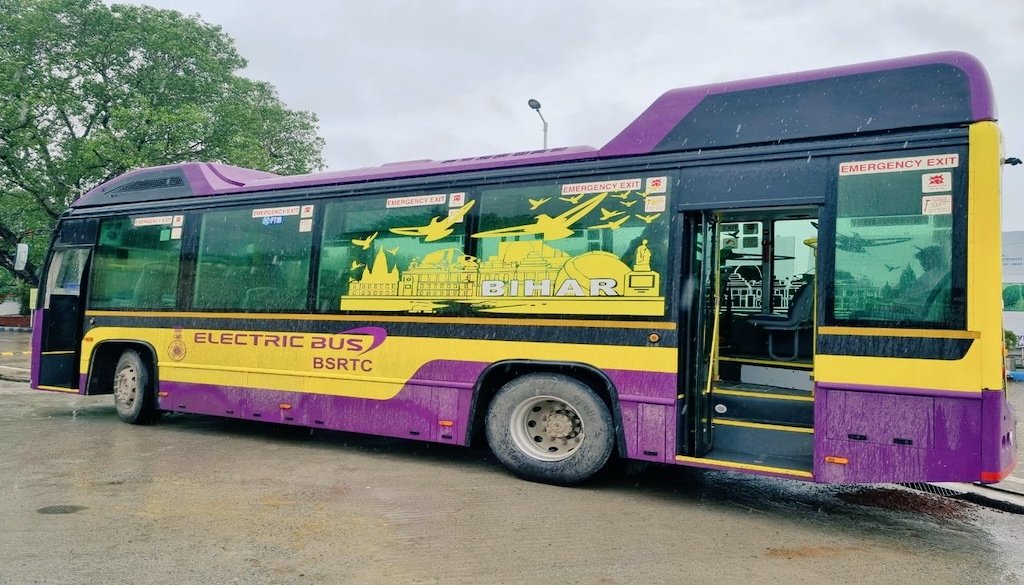
Patna Electric Bus Corridor Expands Regional Connectivity
A new electric bus corridor linking central Patna with Hajipur and Sonepur is set to become operational in May, marking a significant step in the city’s transition towards cleaner and more integrated regional mobility. The planned service will originate near the city’s core and run across a key river bridge corridor, offering an alternative to congested road routes and informal transport systems.
Transport officials indicate that the service will initially deploy a small fleet of air-conditioned electric buses operating along a defined route that connects urban Patna with satellite towns across the Ganga. The corridor is expected to pass through a relatively underutilised arterial stretch before crossing the river via a modern bridge, linking major residential clusters and railway nodes. This electric bus corridor is designed to address a long-standing gap in public transport between Patna and its rapidly growing neighbouring towns. At present, commuters largely depend on private vehicles, shared autos, or routes funnelled through older bridge infrastructure, resulting in congestion and unpredictable travel times. By introducing a structured, scheduled service, authorities aim to improve reliability and reduce dependence on high-emission transport modes. Preliminary estimates suggest that travel durations along certain stretches could reduce significantly, especially for commuters travelling between residential zones along the riverfront corridor and key transit hubs. The route will include multiple designated stops, enabling last-mile accessibility and making the system more inclusive for daily users.
Urban mobility experts view this as part of a broader shift towards electrified public transport systems in tier-two cities. While metro rail projects remain limited to larger urban centres, electric bus networks are emerging as a cost-effective alternative to expand mass transit coverage. In Patna, where urban expansion is spilling beyond municipal limits, such cross-river connectivity is critical to supporting economic integration across districts. The environmental implications are equally significant. By replacing diesel-based transport options on a high-demand corridor, the electric bus corridor is expected to reduce local air pollution and noise levels. Experts note that the success of such systems depends not only on vehicle deployment but also on supporting infrastructure, including charging stations, route planning, and operational efficiency. From a socio-economic perspective, improved connectivity between Patna, Hajipur, and Sonepur could reshape commuting patterns. Workers, students, and small traders who travel daily across the river stand to benefit from more predictable and affordable transport. At the same time, better integration of transport networks can unlock new real estate and commercial opportunities along the corridor, particularly in emerging peri-urban zones.
However, planners caution that long-term impact will depend on service frequency, affordability, and seamless integration with existing transport systems. Without these, even well-designed corridors risk underutilisation. As Indian cities continue to grapple with congestion and rising emissions, Patna’s electric bus corridor reflects a growing recognition that sustainable mobility solutions must extend beyond city boundaries—connecting regions, not just neighbourhoods.