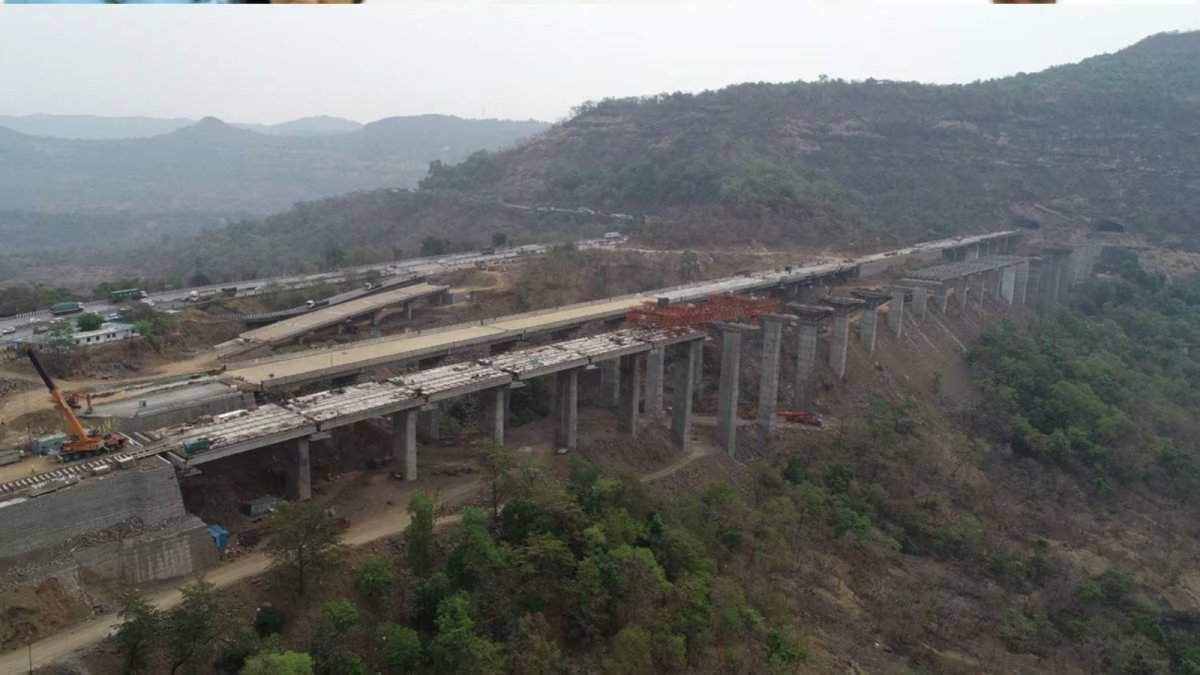
The long-delayed Mumbai Pune missing link on the expressway corridor has entered its final pre-opening phase, with authorities initiating structural load assessments and system-wide inspections across the newly connected alignment. The milestone signals that one of Maharashtra’s most complex highway upgrades is nearing operational readiness, promising to ease congestion and improve travel reliability between the two cities.
Officials overseeing the project indicated that physical connectivity across the entire stretch has now been achieved, with only finishing works and safety validations remaining. The near-complete status reflects years of engineering effort on a route designed to bypass the accident-prone ghat section between Khopoli and Kusgaon—an area historically associated with delays, steep gradients, and weather-related disruptions. The Mumbai Pune missing link is expected to significantly cut travel distance and reduce journey time by up to half an hour, a shift that could have measurable economic benefits for logistics, daily commuters, and intercity business travel. Infrastructure experts note that improved corridor efficiency often translates into lower fuel consumption and reduced emissions, although these gains depend on traffic management and vehicle mix.
To manage safety and operational risks, authorities are preparing a phased traffic rollout strategy once the corridor opens. Initial access is likely to be restricted to lighter vehicles, with heavier categories introduced gradually after performance monitoring. Transport planners say such staggered commissioning is critical for tunnel-heavy alignments, allowing agencies to assess ventilation systems, emergency response readiness, and traffic behaviour under controlled conditions. Safety considerations remain central to the project, particularly given the presence of long tunnels and elevated structures. Restrictions on vehicles carrying hazardous or combustible materials are expected to continue, in line with international best practices for tunnel safety. Experts highlight that incidents in enclosed road environments can escalate rapidly, making preventive regulation essential.
From an engineering perspective, the project represents a notable shift in highway design in India. The alignment features high-altitude viaducts, a cable-supported bridge structure, and extended tunnel sections, all built to navigate difficult terrain while minimising surface disruption. Urban infrastructure analysts point out that such designs, while capital-intensive, can reduce ecological damage in sensitive hill regions when compared with traditional road expansion. The broader significance of the Mumbai Pune missing link lies in its role within the Mumbai Metropolitan Region’s evolving mobility network. As freight movement and commuter volumes continue to rise, efficient intercity corridors are becoming critical to sustaining economic growth while maintaining environmental balance.
With final testing underway and an inauguration window expected soon, attention is now shifting to long-term operations, maintenance, and safety enforcement. For commuters, the project could redefine travel across one of India’s busiest corridors, but its success will depend on how effectively authorities manage traffic, ensure resilience, and integrate the new link into a more sustainable transport ecosystem.
MSRDC Advances Mumbai Pune Missing Link Testing Phase