



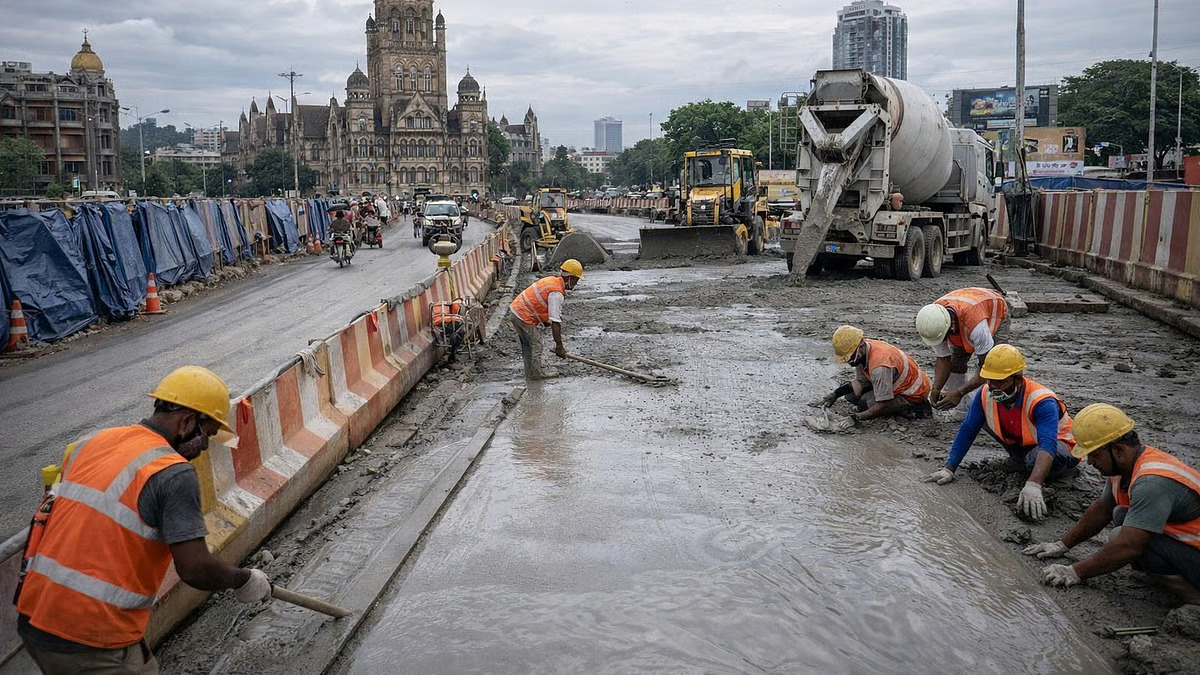
Mumbai’s long-running effort to overhaul its road network through large-scale road concretisation Mumbai works is entering a decisive phase, with civic authorities targeting full completion of nearly 700 kilometres of roads by mid-2027. The initiative, among the largest urban road upgrades in India, is being positioned as a structural solution to the city’s recurring pothole crisis and rising maintenance costs.
A senior civic official, who recently reviewed the progress, indicated that the programme is being executed in two phases, with the first tranche expected to conclude by late 2026 and the remaining stretches by May 2027. The exercise marks a shift away from traditional asphalt roads towards more durable concrete surfaces, aimed at improving longevity in a high-rainfall coastal environment. The road concretisation Mumbai plan was first conceptualised as part of a broader urban resilience strategy, particularly in response to the city’s annual monsoon disruptions. Officials argue that frequent pothole repairs not only strain municipal finances but also create safety risks, disrupt mobility, and affect economic productivity in one of India’s busiest metropolitan regions.
Data reviewed by civic authorities suggests that the transition is already yielding fiscal benefits. Expenditure on pothole repairs has steadily declined over the past three financial years, reflecting reduced dependence on reactive maintenance. Urban infrastructure analysts note that while upfront capital costs of concrete roads are significantly higher, lifecycle costs tend to be lower due to reduced maintenance frequency and longer service life. However, the scale of execution has also presented challenges. With a portion of roads still under construction or yet to begin, traffic congestion, last-mile accessibility issues, and disruptions to local businesses remain key concerns. Urban planners highlight that construction sequencing, pedestrian safety, and drainage integration will determine whether the project delivers on its promise of resilient infrastructure.
The push for stricter timelines and quality control has also been emphasised by officials, who have indicated that contractors will be held accountable for delays and workmanship standards. Real-time monitoring through digital dashboards is being used to track progress, signalling a shift towards data-driven governance in urban project delivery. Beyond pothole mitigation, experts see the initiative as part of a larger transition in Indian cities towards climate-resilient infrastructure. Concrete roads, when designed with proper drainage and heat mitigation measures, can support more stable urban mobility systems. Yet, sustainability advocates caution that material choices and construction practices must also consider carbon emissions and urban heat island effects.
As Mumbai advances its road concretisation Mumbai programme, the coming year will be critical in balancing execution speed with quality and environmental sensitivity. For residents and businesses alike, the success of the initiative will ultimately be measured not just in smoother roads, but in safer, more reliable, and climate-ready urban infrastructure.
