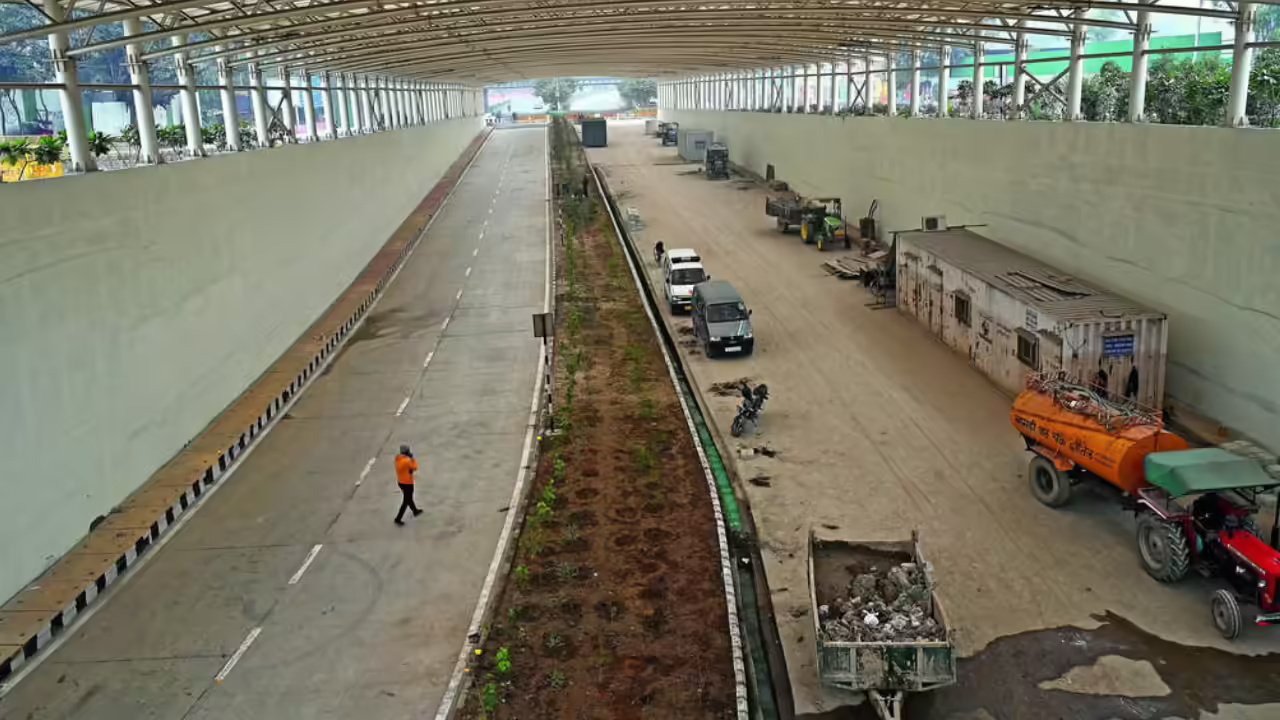
Construction of a long-delayed road infrastructure project in central Delhi is set to resume after authorities obtained the final regulatory approval required from railway officials. The clearance enables work to continue on the Bhairon Marg underpass project, a critical transport link intended to improve traffic movement near the Pragati Maidan and ITO corridors—two of the capital’s most congested junctions. Urban development officials say the Bhairon Marg underpass project forms part of a broader network of road infrastructure upgrades connected to the redevelopment of the Pragati Maidan area and the adjoining underground transit corridor. Once completed, the underpass is expected to reduce traffic bottlenecks by separating through-traffic from surface-level intersections that currently experience heavy congestion during peak hours.
The project had remained inactive for several years because of technical challenges related to construction beneath an active railway alignment. Engineers involved in the project reported structural concerns during earlier stages of work, prompting authorities to halt construction and reassess the design to ensure the stability of both the roadway structure and the railway track above. With the latest no-objection approval from railway authorities now secured, planners indicate that the Bhairon Marg underpass project can move ahead after addressing the structural issues that caused the delay. Engineering teams have revised the construction methodology to accommodate local soil conditions and the presence of railway infrastructure. Technical measures identified during the review include reinforcing the foundation system to improve load distribution and strengthening the structural joints beneath the rail corridor. Specialists also recommended adopting cast-in-place construction techniques, which allow greater control over the structural integrity of underground infrastructure projects built in dense urban settings.
Transport planners note that the Bhairon Marg corridor plays a crucial role in connecting central Delhi with major institutional, cultural and exhibition zones around Pragati Maidan. The surrounding road network experiences heavy traffic volumes due to office complexes, exhibition venues and connectivity to key arterial routes. Reducing congestion in this area is considered important not only for daily commuters but also for the movement of commercial vehicles and visitors attending large-scale events at the exhibition complex. Infrastructure experts say grade-separated road links such as underpasses can improve traffic flow by allowing continuous vehicle movement while reducing signal delays at intersections. Authorities overseeing the project have indicated that construction will proceed within the existing financial allocation approved earlier for the scheme. Maintaining the project within the sanctioned budget is expected to avoid additional fiscal pressure while ensuring that the long-pending infrastructure upgrade reaches completion. Urban mobility specialists emphasise that modernising key traffic corridors in dense metropolitan zones often requires complex engineering coordination, particularly when projects intersect with railway networks, utilities and underground infrastructure. Delays are therefore not uncommon when structural safety issues arise.
The Bhairon Marg underpass project is now expected to play an important role in improving connectivity in the central district once construction resumes and the corridor becomes operational. For Delhi’s traffic management authorities, completing such stalled infrastructure works remains essential to supporting smoother mobility in one of the city’s busiest transport zones.