


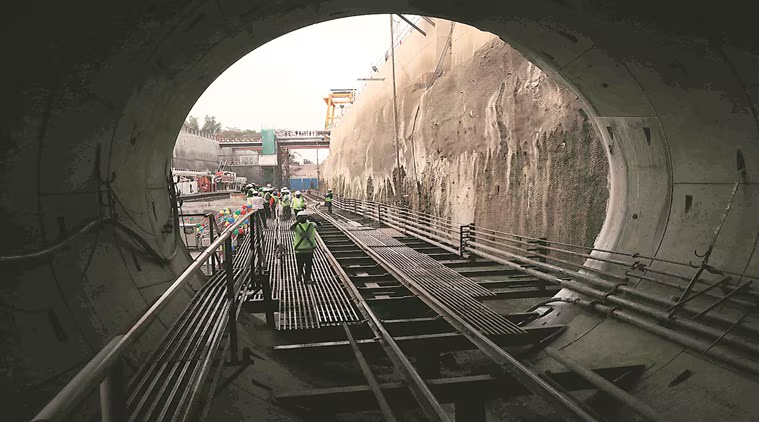
Urban infrastructure planners and civic authorities in Indore have begun reviewing objections and planning concerns surrounding the city’s proposed underground metro corridor, as officials seek to balance mobility improvements with environmental and civic priorities. The discussions, held during a high-level administrative review, come amid increasing scrutiny over the Indore metro alignment, a key component of the region’s long-term public transport strategy. Officials involved in the consultation indicated that the Indore metro alignment will undergo further technical evaluation before final approvals are granted. Authorities emphasised that decisions about the underground route will be shaped by several factors, including environmental impact assessments, heritage protection clearances, and geotechnical studies examining soil stability and groundwater conditions. 
The metro network represents one of central India’s largest urban mobility investments, designed to reduce congestion and improve connectivity across a rapidly expanding metropolitan area. However, planners say the alignment debate highlights a broader question confronting fast-growing Indian cities: how to integrate large infrastructure projects without worsening ecological stress or disrupting neighbourhood-level urban life. During the review meeting, civic stakeholders also raised wider urban concerns beyond the transport corridor itself. Discussions included deteriorating air quality, falling groundwater levels, rising traffic density, and concerns about uneven development patterns across the city.  Urban planners argue that these issues are closely linked to the design of transport infrastructure and land use planning. Experts note that the Indore metro alignment will likely influence how the city evolves over the next two decades. Underground metro segments typically require complex engineering and higher investment but can reduce surface disruption, preserve heritage precincts, and maintain existing road networks. In dense commercial districts, such approaches can also minimise displacement and allow economic activity to continue during construction. Officials familiar with the planning process indicated that multiple government departments will now participate in a coordinated consultation exercise. The objective is to bring together transport authorities, municipal agencies, environmental regulators, and citizen groups to reach a workable consensus before final submissions are placed before judicial authorities reviewing the matter. Urban mobility specialists say such multi-agency consultations are increasingly necessary in Indian cities undertaking major infrastructure upgrades. Transport projects now intersect with climate resilience, water management, heritage conservation, and housing access — areas that traditionally operated in policy silos.
For Indore, which has positioned itself as a model for urban governance and civic innovation, the metro debate represents a crucial test of how infrastructure decisions are negotiated in a rapidly urbanising environment. If consensus emerges in the coming weeks, officials are expected to compile a detailed technical report outlining the final route strategy, environmental safeguards, and planning framework for the underground corridor. The outcome could shape not only the future of the metro system but also how Indian cities integrate large transit systems into sustainable and people-centred urban development.
ALSO READ – Uttar Pradesh Youth Digital Scheme Targets Inclusion
Indore Metro Alignment Debate Triggers Citywide Civic Review
