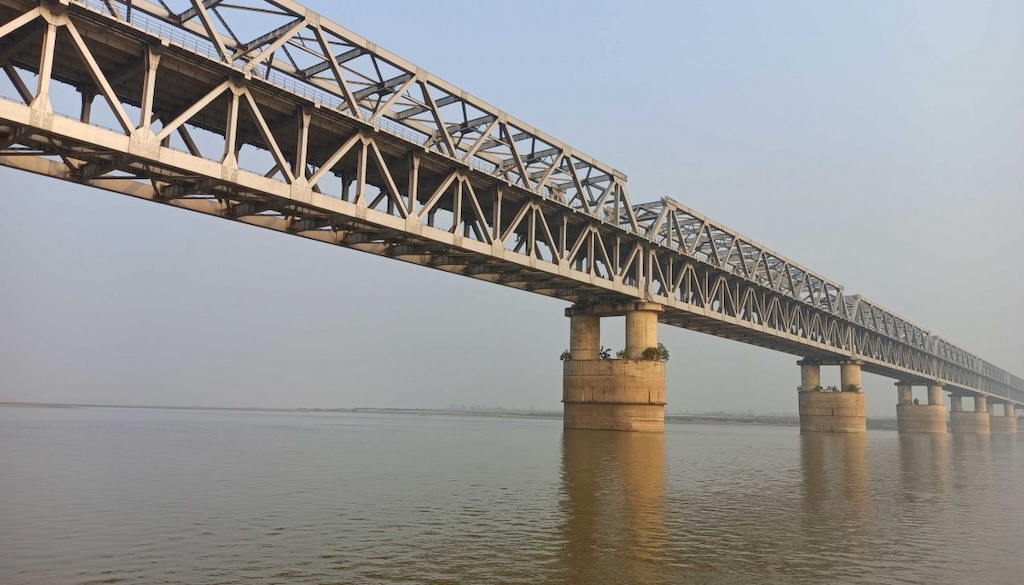
Bihar’s rail infrastructure is entering a critical upgrade phase with a new bridge across the Ganga near Mokama nearing completion, set to transform connectivity between the state’s northern and southern regions. The project, designed as a parallel alternative to the ageing Rajendra Setu, is expected to significantly ease congestion on one of eastern India’s most important transport corridors.
The new rail bridge, part of the Mokama–Barauni section, is being developed as a double-line structure to handle higher train volumes and faster speeds. Spanning approximately 1.86 kilometres, the bridge is expected to become operational in 2026, enhancing both passenger and freight movement across the river. For decades, the Rajendra Setu—commissioned in 1959—has served as a vital yet overburdened link connecting north and south Bihar, carrying both rail and road traffic on limited capacity. With growing economic activity and rising rail demand, the single-line railway component of the bridge has increasingly constrained operational efficiency, often leading to delays and bottlenecks. The new structure addresses these limitations by enabling simultaneous two-way train movement, thereby increasing line capacity and reducing transit times. It is also designed to support higher speeds and modern signalling systems, aligning with Indian Railways’ broader push toward network modernisation and freight efficiency. Urban and regional planners view the project as more than a transport upgrade. Improved rail connectivity across the Ganga is expected to strengthen economic integration between districts, facilitating smoother movement of goods such as agricultural produce, industrial materials, and consumer products. This is particularly significant for logistics chains that rely on uninterrupted rail corridors linking eastern India to national markets.
The rail bridge is part of a larger cluster of infrastructure investments in the Mokama–Barauni region, including recently completed road bridges and highway expansions. Together, these projects are reshaping the region into a multimodal connectivity hub, reducing dependence on legacy infrastructure and diversifying transport options. From a sustainability perspective, shifting freight and passenger movement to more efficient rail systems can help reduce reliance on road transport, lowering emissions and easing pressure on highways. As cities and industrial clusters expand, such modal shifts are increasingly critical for building low-carbon transport networks. However, infrastructure experts caution that the benefits of the new bridge will depend on seamless integration with approach lines, signalling systems, and terminal capacity. The project includes new rail approaches and electrification works, which are essential to fully unlock its operational potential. The continued operation of the Rajendra Setu alongside the new bridge also reflects a transitional approach—where legacy assets remain functional while new infrastructure absorbs growing demand. This dual-system model is likely to improve resilience, ensuring redundancy in case of maintenance or disruptions.
As Bihar accelerates its infrastructure pipeline, the Mokama–Barauni rail bridge highlights the state’s evolving strategy: augmenting capacity rather than replacing it outright. If executed effectively, the project could redefine regional mobility patterns, reduce logistical friction, and support more balanced economic growth across the Ganga divide.