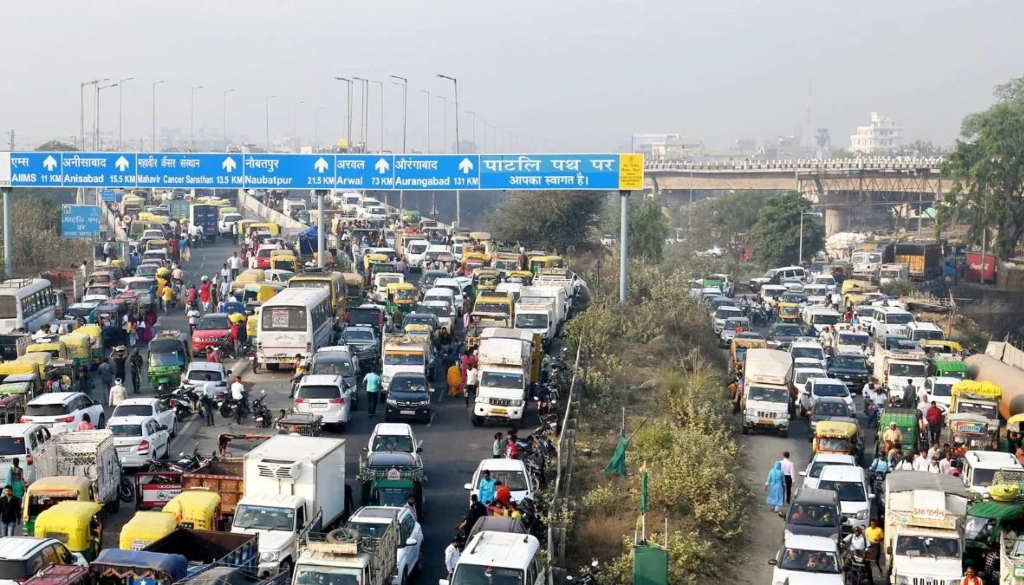
Patna Traffic Plan Affects Digha Rupaspur Commuters
Patna is set to witness temporary but significant traffic disruptions along the Digha–Rupaspur corridor on April 7 and 8, as authorities implement road closures to facilitate critical power infrastructure work. The move, while short-term in nature, highlights the increasing coordination required between urban mobility systems and essential utility upgrades in a rapidly expanding city.
According to officials, vehicular movement on the affected stretch will be completely halted between 9 am and 2 pm on both days to enable work on a 132 kV transmission line. The closure targets a key urban link that connects residential zones and emerging peri-urban areas, making it a vital route for daily commuters. The decision reflects a broader infrastructure reality in Indian cities, where upgrading energy systems often necessitates temporary disruption of transport networks. As Patna scales up its power distribution capacity to support rising residential and commercial demand, such interventions are becoming more frequent. However, the challenge lies in balancing infrastructure expansion with minimal inconvenience to citizens. Traffic authorities have advised commuters to plan alternate routes and adjust travel schedules during the restriction window. While diversions are expected to redistribute vehicular flow, urban mobility experts caution that such sudden disruptions can lead to spillover congestion on adjacent roads, particularly in areas with limited road width and high traffic density. The Digha–Rupaspur stretch has gained strategic importance in recent years due to rapid real estate growth and increased connectivity with western Patna. ]
As new housing clusters and institutional developments emerge along this corridor, traffic volumes have surged, exposing the limitations of existing road infrastructure. Temporary closures, even for essential works, can therefore have amplified effects on daily movement patterns. From an urban planning perspective, the episode underscores the need for integrated scheduling of infrastructure upgrades. Coordinating roadworks, utility installations, and traffic management in a synchronised manner can reduce cumulative disruption. Cities that adopt advance communication systems and phased execution strategies are better positioned to maintain continuity in mobility while upgrading core services. There is also a growing case for embedding resilience into infrastructure planning. As cities expand, utility corridors—covering electricity, water, and telecommunications—must be designed alongside transport networks rather than retrofitted into them. This reduces the need for repeated excavation or closures and improves long-term efficiency. For citizens, the immediate impact will be felt in altered commute times and potential delays, particularly for those relying on this route for work, education, or essential services. Informal sector workers and service providers, who depend on predictable travel patterns, are likely to be disproportionately affected.
Yet, such disruptions also point to a longer-term transition. Strengthening power infrastructure is essential for supporting economic growth, improving service reliability, and enabling future-ready urban systems. The success of such interventions will depend on how effectively cities manage the trade-off between short-term inconvenience and long-term gains. As Patna continues to modernise its infrastructure backbone, episodes like the Digha–Rupaspur traffic restriction highlight the importance of communication, coordination, and citizen-centric planning in shaping a more resilient urban future.