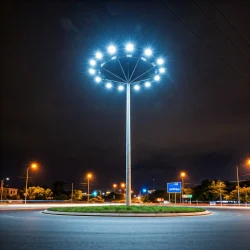
A citywide lighting upgrade in Patna is set to reshape night-time mobility and safety, with authorities rolling out 35 high-mast lighting systems across multiple neighbourhoods under a ₹1.62 crore urban infrastructure initiative. The project targets poorly lit zones that have long posed safety risks and limited after-dark economic activity in the state capital.
The installations will be spread across nearly 30 municipal wards, focusing on high-footfall areas, traffic intersections, and residential pockets where inadequate lighting has constrained visibility. Each structure, designed at a height of over 12 metres, is expected to provide wider illumination coverage compared to conventional streetlights, improving both vehicular navigation and pedestrian safety. Officials associated with the rollout indicate that the project is being implemented through a corporate social responsibility partnership with Housing and Urban Development Corporation, reflecting a growing trend of blended financing in urban infrastructure delivery. Such models are increasingly being used to accelerate civic upgrades without placing additional strain on municipal budgets. Urban planners highlight that lighting infrastructure plays a critical yet often under-prioritised role in city design. Beyond visibility, well-lit public spaces influence perceptions of safety, particularly for women and vulnerable groups, and can extend the usability of streets, markets, and transit corridors into evening hours.
In dense cities like Patna, where mixed land use is common, lighting improvements can also stimulate small-scale economic activity after sunset. The Patna high mast lighting initiative also intersects with broader climate and efficiency considerations. High-mast systems, when integrated with energy-efficient fixtures, can reduce power consumption while delivering higher illumination per unit. Experts note that cities transitioning to such systems must also consider maintenance cycles, energy sourcing, and smart controls to maximise long-term sustainability benefits. However, the effectiveness of the intervention will depend on strategic placement and upkeep. Past experiences in Indian cities show that lighting gaps often re-emerge due to inconsistent maintenance, power outages, or uneven spatial coverage. Ensuring that installations are mapped against actual need—rather than administrative boundaries—will be key to achieving equitable outcomes.
For residents, the immediate benefit is likely to be safer and more accessible public spaces after dark. For city administrators, the project presents an opportunity to integrate lighting into a broader urban systems approach—linking it with surveillance, mobility planning, and public space design. As Patna continues to expand, targeted investments such as high-mast lighting signal a gradual shift towards infrastructure that prioritises safety, inclusivity, and usability—critical elements in building resilient and people-centric urban environments.