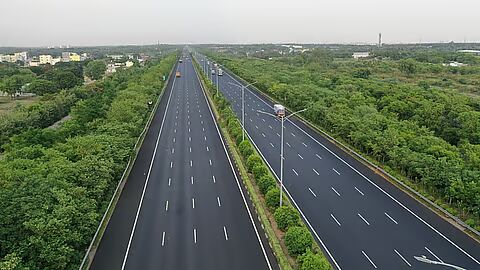
Uttar Pradesh is entering a decisive phase in its transport-led development strategy, with the 594-km Ganga Expressway nearing completion and expected to open around April 2026, alongside plans to build 11 additional expressway corridors by 2029. The dual push signals a large-scale effort to reshape regional connectivity, unlock economic corridors, and accelerate urban expansion across the state.
The Ganga Expressway—stretching from Meerut in western Uttar Pradesh to Prayagraj in the east—is among the longest access-controlled highways in India. Construction has reached advanced stages, with final works such as signage, toll infrastructure, and finishing touches underway. Once operational, the corridor is expected to significantly reduce travel time across the state while linking multiple districts that have historically lacked high-speed connectivity. Officials have positioned the expressway as a backbone infrastructure project, intended to integrate western industrial belts with eastern regions and improve logistics efficiency. The project is also being viewed as a catalyst for broader economic transformation. Infrastructure planners highlight that expressways are no longer standalone mobility assets but anchors for industrial and logistics ecosystems. Uttar Pradesh has already outlined plans to develop manufacturing and logistics clusters along major expressway corridors, including the Ganga Expressway, to attract investment and generate employment. The upcoming network expansion reinforces this approach. The state government is planning over 1,500 kilometres of additional expressways and link corridors by 2029, connecting key nodes such as Noida, Jhansi, Chitrakoot, and eastern Uttar Pradesh.
These corridors aim to create a seamless, high-speed grid that integrates existing routes like the Agra–Lucknow and Purvanchal expressways. Urban development experts note that such networked infrastructure can fundamentally alter settlement patterns. Improved connectivity reduces travel friction, enabling industries and residential development to move beyond metropolitan cores into tier-2 and tier-3 cities. This could ease pressure on major urban centres while distributing growth more evenly across regions. The real estate sector is already responding to this shift. Land values and investor interest have risen along expressway corridors, particularly in western Uttar Pradesh, where industrial nodes and warehousing hubs are being planned. Experts suggest that this trend could extend eastward as connectivity improves, creating new urban growth clusters. However, the scale of expansion also raises questions around sustainability and planning discipline. Large expressway projects often trigger rapid, and sometimes unregulated, peri-urban development. Without integrated land-use planning, such growth can strain local infrastructure, increase carbon emissions, and create fragmented urban forms. From a climate and resilience perspective, the challenge lies in aligning highway-led growth with sustainable urbanisation.
Incorporating green buffers, multimodal transport linkages, and transit-oriented development principles will be critical to ensuring that infrastructure expansion does not come at the cost of environmental degradation. The Ganga Expressway’s imminent launch, combined with the pipeline of new corridors, marks a shift towards infrastructure-driven regional planning in Uttar Pradesh. The next phase will test whether this expansion can translate into balanced economic growth, efficient logistics systems, and more inclusive urban development across the state.